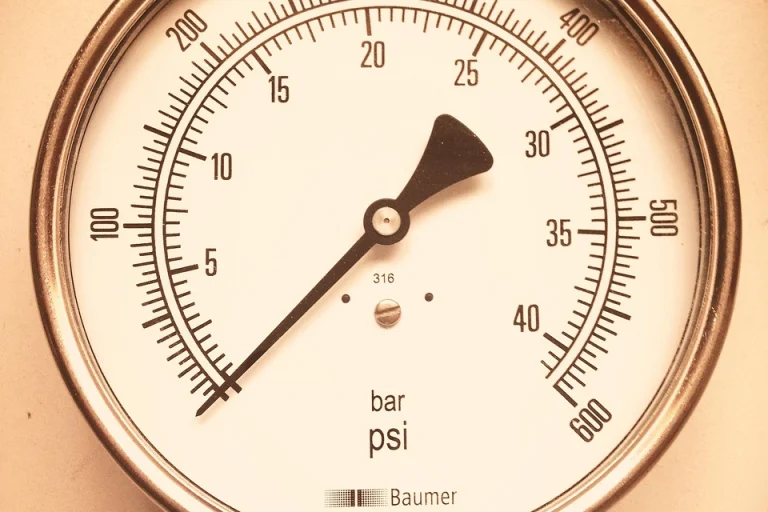
Troubleshoot a well pump by the symptom, in order, and stop where the makers stop. Read the pressure gauge, check the pump’s breaker, look for running water or a leak, and time one on-off cycle: those are owner checks in the makers’ own documents. A breaker that trips again, a flooded pump, a tank that has lost its air, wiring, the control box and anything down the well are where Goulds, Franklin Electric, Grundfos and Amtrol hand the job to a qualified electrician or a licensed pump installer. Pick your symptom below; each section stands on its own.
General information, not professional advice. Your pump and tank makers’ manuals and a licensed well or pump contractor decide what’s safe for your system; your state or county decides what needs a permit or a licence.
This is the overview page of our no water and pump problems guide. Every owner step below comes from a maker’s or a public agency’s document, named at the step with its number, revision, page and the date we read it (11 November 2026). A maker’s manual describes that maker’s product, so where two makers differ we show both. Your own pump, tank and switch manuals win wherever they say something different.
| What you see | First owner check | Where the makers stop |
|---|---|---|
| No water at all | Gauge reading, then the pump’s breaker | A breaker that trips again; wiring, control box, the pump |
| Pump keeps running | Gauge while it runs; running water or a leak | Switch contacts, check valve, drop pipe, worn pump |
| Clicks on and off | Time one cycle; note cut-in and cut-out | Never add air to a tank that has lost it; tank and valve work |
| Low pressure | Gauge through one full cycle | Pressures above the tank’s rating; pump, voltage, pipe faults |
| After a power cut | Flood first; breaker; lever on the switch | Flooded equipment; a breaker that trips again |
Before any check
A well pump runs on 115 or 230 volts, close to water. Four lines from the makers apply to every section below.
- Power off first. Goulds tells installers to “disconnect and lockout electrical power” before servicing any electrical equipment, and warns that a pump with automatic thermal overload protection “may allow an overheated pump to restart unexpectedly” (Goulds IM096 Rev 14, p. 1, read 11 Nov 2026). Square D’s switch sheet says to disconnect all power before wiring or servicing and to put the cover back on before power is restored (sheet 65013-005-39, September 2025, p. 1, read 11 Nov 2026).
- More than one switch, and stored charge. Franklin Electric warns that more than one disconnect switch may be needed to de-energize the equipment, and that some controls can hold lethal voltage after the power is off: allow 5 minutes before removing covers (Franklin AIM Manual M1311, 2026 edition, printed p. 3, read 11 Nov 2026). Nothing on this page asks you to remove a cover.
- Wiring is not owner work. “All electrical work must be performed by a qualified technician” (Goulds IM096 Rev 14, p. 1). Franklin: installed and serviced by “technically qualified personnel” (AIM, printed p. 3). Grundfos: the electrical connection by “an authorized electrician” (Grundfos SQ/SQE instructions 3835175, 2006 edition, p. 6, read 11 Nov 2026).
- Never run a pump dry. Goulds: “Never run a pump dry”; damage results and the warranty is void (Goulds IM457 Rev 2, p. 1, read 11 Nov 2026).
Two more from the public agencies: if the pump or its controls have been under flood water, don’t turn the pump on (EPA 816-F-05-021, read 11 Nov 2026), and don’t climb into a well pit, where gases and vapors can build up (CDC, page dated 29 May 2025, read 11 Nov 2026).
Know which system you have
The checks depend on the pump. A jet pump sits in the house or a pump house and pulls water up; EPA lists jet pumps for shallow wells of 25 feet or less (EPA, Learn About Private Water Wells, read 11 Nov 2026). A submersible pump hangs down the well, out of sight. A 2-wire submersible carries its starting parts inside the motor; a 3-wire one needs a matching control box on the wall, which holds the starting capacitors and relay (Franklin AIM, printed p. 11-12). A constant-pressure system has an electronic drive on the wall in place of the usual switch; many drives, such as Franklin’s SubDrive Utility, report faults by flashing a light. The pressure switch is the small box on a tube near the tank; its cut-in is the pressure at which the pump starts and its cut-out the pressure at which it stops.
No water at any tap
If one tap is dry and the others run, the cause is at that tap or its pipe, not the well. If every tap is dry, start here. The usual causes in the makers’ tables are a pump without power, a tripped motor protector, a switch that has cut the pump off, a well drawn down below the pump, or a fault in the cable, control box or pump.
You check
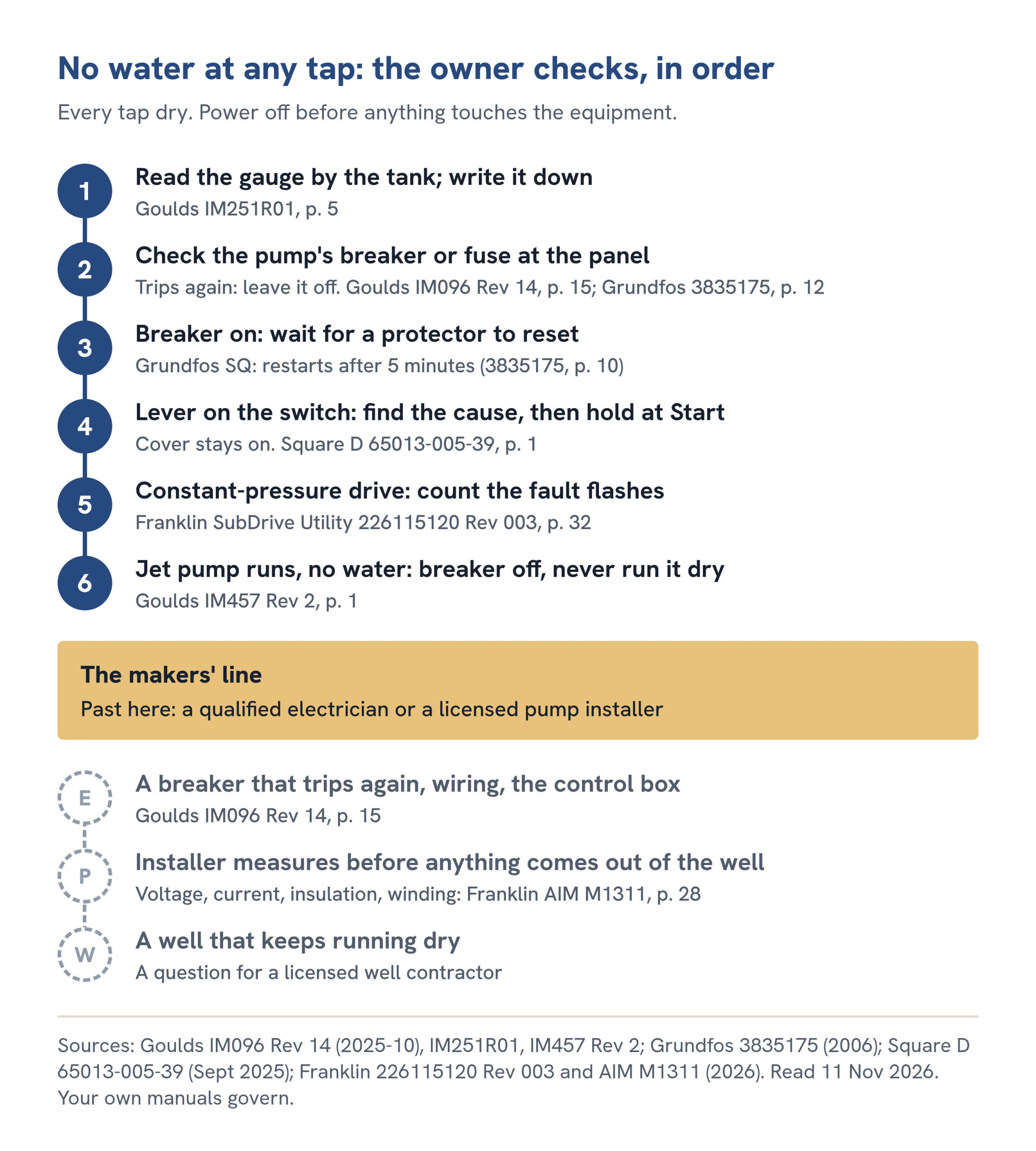
- Read the gauge by the tank and write the number down. Goulds’ tank owner’s manual asks owners to observe the system and note anything unusual before calling the dealer, and its switch check has you note the gauge reading where the pump stops and starts (Goulds IM251R01, p. 5, read 11 Nov 2026). Zero or near zero usually means no water is reaching the tank.
- Check the pump’s breaker or fuse at the panel. The makers differ here. Goulds sends an open breaker or blown fuse straight to an electrician: “Have a qualified electrician inspect and repair” (IM096 Rev 14, p. 15). Grundfos’s SQ table gives “Reset the circuit breaker” for a tripped ground-fault breaker, and says that if new fuses blow too, the electrical installation and the drop cable need checking (Grundfos 3835175, p. 12). Franklin’s table, written for qualified personnel, checks fuse size and connections before resetting (AIM, printed p. 26). If you reset a breaker and it trips again, leave it off: a repeat trip is a fault for an electrician, not something to keep resetting.
- If the breaker is on, wait. Goulds’ first cause for a motor that won’t run is a tripped thermal protector, and the action is to let the motor cool: the protector resets by itself (IM096 Rev 14, p. 15). A Grundfos SQ that stopped on dry running starts again by itself after 5 minutes, and stops again after 30 seconds if the well has not recovered (Grundfos 3835175, p. 10).
- If your switch has a lever on its side, it may be a low-pressure cut-off model. On Square D’s Form M4, low water or a loss of pressure cuts the pump off; after the fault is corrected, move the lever to Start and hold it until the pressure keeps the contacts closed (sheet 65013-005-39, p. 1). On Square D’s 40/60 Form M4 model, the cut-off operates roughly 10 psi below cut-in (Square D datasheet 9013FSG2J24M4, 30 Jul 2024, read 11 Nov 2026). Find the reason first: a burst pipe, a hose left running, or a well running low. The cover stays on.
- On a constant-pressure drive, count the flashes of its fault light and write them down. On Franklin’s SubDrive Utility, one flash is “motor underload”, which the maker links to an over-pumped well, among other causes (Franklin SubDrive Utility owner’s manual 226115120 Rev 003, 10/20, p. 32, read 11 Nov 2026). Your drive’s manual has its own code list.
- If a jet pump hums or runs but sends no water, switch it off at the breaker: it may have lost its prime, and Goulds says never to run a pump dry (IM457 Rev 2, p. 1). See priming a jet pump below.
The makers’ line
Goulds’ table ends almost every “motor not running” cause with a qualified electrician: wrong control box, faulty connections, a faulty protector, low voltage, a hot control box, damaged cable insulation and a faulty cable splice (IM096 Rev 14, p. 15). A pump bound by debris is “pull pump, clean”. A breaker that trips again, a control box, a burned smell or any wiring is past the line. So is a well that keeps running dry: that is a question for a licensed well contractor.
The pro
A licensed pump installer or electrician measures before anything comes out of the well. Franklin’s list of tests to complete before a motor is removed is line voltage, the current on every motor wire, insulation resistance from the motor leads to ground, and winding resistance (AIM, printed p. 28). They may also measure the water level in the well to see whether the pump is above it. Pulling the pump comes last, because it is the expensive step.
The full check, including what to do when the well itself has run low: suddenly no water from your well.
Pump keeps running and won’t shut off
A pump should stop when the pressure reaches the cut-out. If it runs on, either the pressure never gets there (a leak, water being used, a worn pump, a low well) or the switch is not opening when it does. Franklin’s table for “motor runs continuously” lists the pressure switch, a low water level in the well, a leak, a worn pump, a loose coupling or broken shaft, a blocked intake screen and a check valve stuck closed (AIM, printed p. 26).
You check
- Watch the gauge while the pump runs, with every tap closed. Note whether it climbs to the cut-out on your switch’s label, stalls below it, or goes past it (Goulds IM251R01, p. 5).
- Look for water being used or lost: a tap, toilet, hose or sprinkler running, water where it shouldn’t be, or wet ground along the line to the house. Franklin lists a leak in the system as a cause, and the check is to look for leaks (AIM, printed p. 26); Goulds lists leaks in the piping or at the house as a cause of a jet pump that won’t shut off (Goulds IM102 Revision 13, June 2025, p. 12, read 11 Nov 2026).
- If it still runs with nothing open, switch it off at the breaker and let the well recover. For a low water level, Franklin says to shut off the pump and wait for the well to recover (AIM, printed p. 26). Grundfos says that if the flow suddenly falls, the pump must be stopped at once and the fault corrected (Grundfos 3835175, p. 10).
- If the gauge reads above the cut-out and the pump still runs, keep the breaker off. Franklin lists welded switch contacts as a cause (AIM, printed p. 26), and Amtrol says the relief valve is there to protect the tank if the switch fails to shut the pump off (Amtrol 9015-939, 04/18, p. 4, read 11 Nov 2026). A relief valve discharging while the pump runs can be a sign of this.
The makers’ line
The fixes in Franklin’s “runs continuously” rows are written for the technically qualified personnel the manual addresses (AIM, printed p. 3): clean the contacts or replace the switch, replace damaged pipe, throttle the pump or set it lower, pull the pump and replace worn parts, replace a loose coupling or broken shaft, clean the screen and reset the pump depth, replace a check valve (AIM, printed p. 26). Square D’s own sheet says its switches should be “installed, operated and maintained only by qualified personnel” (65013-005-39, p. 2). Welded contacts are not something to adjust your way out of.
The pro
The installer separates the switch from the pump. One test in Franklin’s table: lower the switch setting, and if the pump then shuts off, worn pump parts may be the fault (AIM, printed p. 26). They measure the static water level and the level while pumping, compare the motor’s current with its nameplate, and check whether the check valve holds pressure. A pump that runs nonstop on a falling well is a well question as much as a pump question, and they will say so.
The full check: well pump keeps running.
Clicks on and off (short cycling)
Short cycling means the pump starts and stops every few seconds while water is running, often with a click at the switch each time. The pressure tank is meant to prevent it: it holds a cushion of air that pushes stored water out between starts. When the tank loses that air, it fills with water (it is waterlogged) and the pressure drops to cut-in almost as soon as a tap opens. Franklin says a waterlogged tank causes rapid cycling and nuisance tripping of the motor’s overload (AIM, printed p. 11). Other causes in the makers’ tables: a leaking check valve or foot valve, a switch differential that is too narrow, and on jet pumps a pump set too far from the tank (Goulds IM102 Rev 13, p. 12; Grundfos 3835175, p. 12).
You check
- Time one cycle. Open one tap. Note the gauge when the pump starts (cut-in) and when it stops (cut-out), and count the seconds it runs. Goulds’ tank manual gives owners this check: let the pressure build to cut-off and note it, then drain until the pump starts and note that (IM251R01, p. 5). Franklin asks for at least one minute of running per start on its motors (AIM, printed p. 4); a run of a few seconds is far short of that.
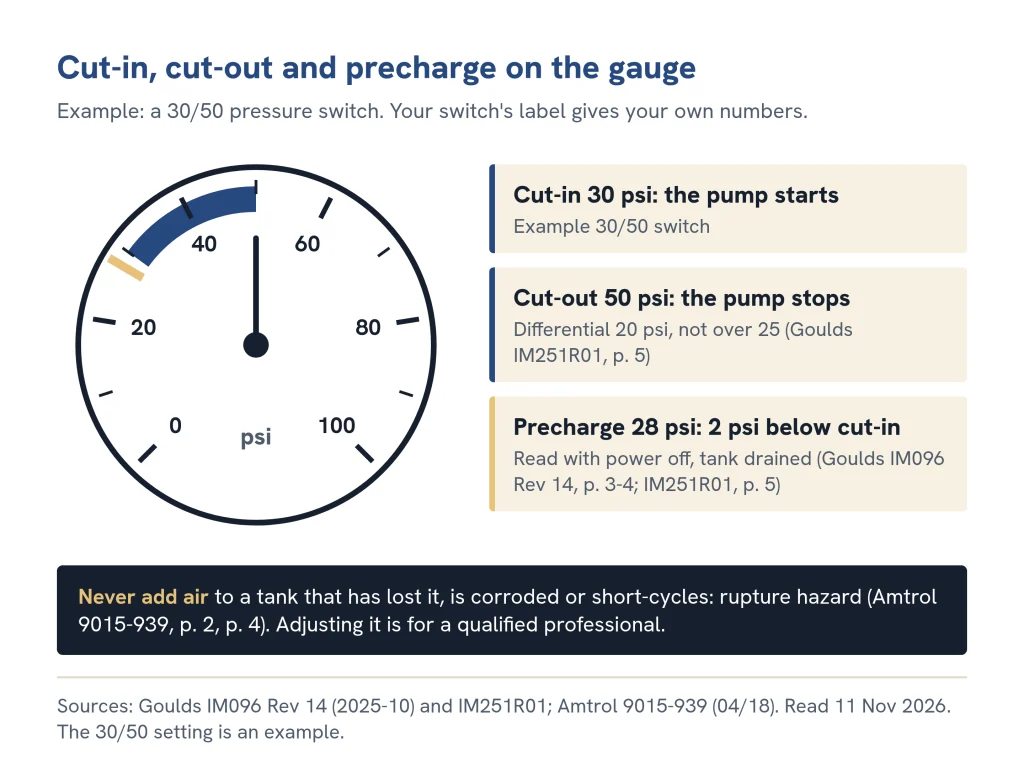
- Compare the two numbers. Goulds gives a proper differential (cut-out minus cut-in) of 20 psi, not over 25 psi, and says to call a qualified professional if the system doesn’t hold it (IM251R01, p. 5).
- Leave the tank’s air alone. Amtrol’s danger notice: do not add air or adjust the precharge after a loss of air, with visible corrosion, or when the pump’s cycle time has dropped, because this can mean internal corrosion and the tank could rupture (9015-939, p. 2 and p. 4). Short cycling is exactly that drop. Amtrol also says only qualified professionals should check, adjust or recharge its tanks’ precharge (p. 2).
- If your tank maker gives owners a check, it is a check only, power off: Goulds’ owner’s manual says turn off the pump’s power, open a faucet, drain the tank completely and read the air valve with a tire gauge; if it isn’t about 2 to 3 psi below cut-in, the tank “must be adjusted by a qualified professional” (IM251R01, p. 5). Goulds also notes you lose 1 to 2 psi each time you check (IM102 Rev 13, p. 6).
The makers’ line
A tank that has lost its air, shows rust or short-cycles must not be refilled with air (Amtrol 9015-939, p. 2, p. 4), and Amtrol says to call a qualified professional at once if a tank shows signs of corrosion (p. 2). A tank that leaks needs “replacement by a qualified professional” (Goulds IM251R01, p. 5). For a check valve in its SQ pump that leaks or sticks half-open, Grundfos’s remedy is to pull the pump (Grundfos 3835175, p. 12). Changing the switch differential is switch work under Square D’s qualified-personnel line (65013-005-39, p. 2).
The pro
The installer drains the tank and reads its precharge, decides whether the tank can stay, and checks whether pressure falls with every tap closed, which points to a check valve leaking back down the well. They also check the switch sits close to the tank (Goulds asks for within 4 feet to prevent switch chatter, IM096 Rev 14, p. 2) and whether the tank is big enough for the pump. Ask them for the precharge they read and the cut-in and cut-out they set. The precharge and switch settings calculator shows the makers’ figures for each switch setting.
Why it matters: Franklin limits starts per day on its motors (300 a day up to 0.75 HP, 100 a day for single-phase motors of 1 to 5.5 HP; AIM, printed p. 4), and a pump that clicks on and off with every glass of water uses those up fast. The full check: well pump short cycling; the tank itself: waterlogged pressure tank.
Low water pressure at the taps
Weak flow at one tap is that fixture or its pipe. Weak flow everywhere has two kinds of cause. Either the system works as set and the setting is low (a 30/50 switch, for example, starts the pump at 30 psi and stops it at 50), or the pump can’t reach its setting because of a leak, a worn pump, low voltage or a lift too high for the pump.
You check
- Read the gauge through one full cycle and write down cut-in and cut-out (Goulds IM251R01, p. 5). If they match the setting on the switch and the pump stops on time, the system is doing what it was set to do.
- If the gauge never reaches cut-out, or creeps up slowly, treat it as a pump that keeps running: look for leaks and use, and switch the pump off to let the well recover if it runs on (Franklin AIM, printed p. 26).
- If the setting itself is low, Square D’s sheet gives the adjustment, with all power disconnected and the cover refitted before power returns: turn the range nut first (clockwise raises cut-in), then the differential nut (clockwise raises cut-out), and check the switch’s operation several times afterwards (65013-005-39, p. 1-2). Square D also says its switches should be installed, operated and maintained only by qualified personnel (p. 2), and some switches don’t follow this layout: use your switch’s own sheet. Our page on pressure switch settings has the full detail.
- A higher cut-in means a higher precharge. Goulds sets precharge 2 psi below cut-in, 28 psi on a 30/50 switch (IM096 Rev 14, p. 3). Amtrol warns that raising the precharge on a tank already in service is an explosion hazard if the tank has lost air, is corroded or its cycle time has dropped, and that only qualified professionals should check, adjust or recharge the precharge (9015-939, p. 2, p. 4); Goulds’ owner’s manual also leaves the adjustment to a qualified professional (IM251R01, p. 5), and Goulds warns never to pressurise a tank above its maximum rating (IM096 Rev 14, p. 2).
The makers’ line
A pump that can’t reach its pressure is past the line. Goulds’ causes for little or no water include a lift too high for the pump (“check with dealer”), a pump not fully submerged, and excessive pump wear (“pull pump and repair”) (IM096 Rev 14, p. 15); for jet pumps it adds low voltage, a worn or plugged impeller or jet, and too much suction lift (IM102 Rev 13, p. 12). Voltage is electrician work.
The pro
The installer checks the pump against its curve: the flow it delivers and the total head it works against (the lift from the water level, the climb to the house, pipe friction and the pressure setting). They measure voltage under load and the motor’s current, and may run a flow test. If the pipe from the well is small for the flow, friction is part of the answer. The well pump size calculator shows how those parts add up.
The full check: low water pressure from a well.
No water after a power cut
A pump on a pressure switch normally starts again when the power returns and the pressure is below cut-in. When one doesn’t, the usual reasons are a tripped breaker or overload from the surge or flicker, a low-pressure cut-off switch that dropped out while the power was off, an electronic drive holding a fault, or a jet pump that lost its prime. After a storm, a flood comes first.
You check
- Was the well, the pump or its controls under water? If so, leave the power off. EPA: “DO NOT TURN ON THE PUMP”; don’t turn the equipment on until the wiring has been checked by a qualified electrician, well contractor or pump contractor, and a control box that was under water must be dry first (EPA 816-F-05-021, read 11 Nov 2026). CDC says the same and adds: don’t enter the well pit (CDC, 29 May 2025). Stop here.
- Check the pump’s breaker. As in no water: Goulds sends an open breaker to a qualified electrician (IM096 Rev 14, p. 15), Grundfos lists resetting it (3835175, p. 12), and one that trips again stays off for an electrician.
- Give it a few minutes. Franklin warns that restarting one of its 2-wire motors within 5 seconds of power loss may trip the motor overload (AIM, printed p. 11), which is what a flickering supply does; Goulds says a tripped thermal protector resets by itself once the motor cools (IM096 Rev 14, p. 15).
- Lever switch: if water was used while the power was off, the pressure may have fallen below a Form M4 switch’s cut-off. With the fault fixed and the cover on, hold the lever at Start until the pressure keeps the contacts closed (Square D 65013-005-39, p. 1).
- Grundfos SQ: the maker’s reset is to switch off the supply for 1 minute (Grundfos 3835175, p. 10). Constant-pressure drives: Franklin’s SubDrive Utility tries to restart itself when a fault clears (226115120 Rev 003, p. 31); two flashes mean under- or overvoltage (p. 32). Write the code down.
- Jet pump running with no water: breaker off, then see priming below (Goulds IM457 Rev 2, p. 1).
The makers’ line
Flooded equipment goes to a qualified electrician, well contractor or pump contractor before it runs (EPA 816-F-05-021; CDC). So does a breaker that trips again, a control box that stays dead, and anything to do with a generator connection. Goulds lists “power source inadequate for load” with the action to check the supply or generator capacity (IM096 Rev 14, p. 15); Franklin gives a 6,000-watt minimum generator for its SubDrive Utility and says it is not compatible with inverter-controlled generators (226115120 Rev 003, p. 9). How a generator is connected to the house is an electrician’s job.
The pro
After a storm the installer looks for surge damage: a failed control box part, a damaged switch, or a motor or cable fault, using the same tests listed under no water. Grundfos notes that its SQ motors are protected against surges up to 6,000 volts, and that areas with high lightning intensity need external lightning protection (3835175, p. 10). After a flood, the wellhead, the casing and the pump’s silt and sand are also part of the job (EPA 816-F-05-021).
The full check: restarting a well pump after a power outage.
Other symptoms, briefly
Pump runs but no pressure
Goulds’ causes for “little or no liquid delivered” by a submersible are a faulty check valve, an air-bound pump, a lift too high for the pump, a pump bound by debris, a pump not fully submerged, air or gas in the well, and excessive wear (IM096 Rev 14, p. 15). Your part is the gauge reading and switching the pump off at the breaker so it doesn’t run without water (Grundfos 3835175, p. 10; Franklin AIM, printed p. 26). For an air-bound pump, Goulds’ remedy is to start and stop the pump repeatedly until flow is delivered. We treat that as the installer’s step on a submersible: repeated starts are hard on the motor (Franklin limits starts per day, AIM, printed p. 4), and the installer can measure what the pump is doing. The full check: well pump runs but no pressure.
Pump not working at all: power, breaker, switch, control box
Silence at the pump with power at the panel narrows it to the switch, the control box (on 3-wire pumps), the cable or the motor. Franklin’s “motor does not start” rows are voltage, fuses or breakers, a damaged pressure switch, the control box, damaged wiring, a bound pump and a damaged cable or motor, most of them checked with meters (AIM, printed p. 26). Owners stop at the breaker. The control box and its capacitors are covered on the control box page, explained, not as a repair. The full check: well pump not working.
Priming a jet pump
Priming means filling the pump and suction pipe with water so a jet pump can lift. Submersible pumps sit under water in the well and aren’t primed this way. Goulds gives the steps for its jet pumps, power off first (“always disconnect and lock-out all electrical power” when working on pumps, IM102 Rev 13, p. 7), with the pressure let off at a tap first (Goulds warns that failing to relieve system pressure before maintenance can cause injury, IM096 Rev 14, p. 3): remove the plug or gauge bushing in the discharge tee; on shallow-well pumps also remove the small vent plug so air can escape; fill the pump and as much of the suction pipe as you can; refit the plugs; open the faucet nearest the pump a little; then power the pump. Long suction pipes may need several fills, and deep-well jets need a complete prime before starting (IM102 Rev 13, p. 6; IM457 Rev 2, p. 1). Never run it dry. A pump that keeps losing its prime needs the installer: Goulds’ causes include an air leak in the suction pipe and a defective suction check or foot valve (IM102 Rev 13, p. 12). The full page: how to prime a well pump.
How to tell if the pump itself is failing
From the surface, you can’t. Franklin says the symptoms of a worn pump are similar to those of a drop-pipe leak or a low water level in the well (AIM, printed p. 26), so a pump that runs long, delivers less, or can’t reach its cut-out may be fine while the well or the pipe is not. The signs worth writing down: the pump runs longer than it used to for the same use; the gauge stalls below cut-out; the breaker or overload trips; and the two Goulds asks owners to note, short cycling and water spurting from a faucet with air (Goulds IM251R01, p. 5). NGWA, the groundwater industry’s association, lists a loss of capacity or pressure, pressure that drops and surges, and a pump that cycles on and off frequently as reasons to call a water well systems professional (wellowner.org, association guidance, read 11 Nov 2026).
None of the pump makers’ documents we read gives a life expectancy for a pump. They give warranties: Goulds’ standard 4-inch submersibles carry 36 months from installation or 42 from manufacture, whichever is shorter (IM096 Rev 14, p. 15), and Goulds’ jet pumps 1 year from installation or 18 months from the date code (IM102 Rev 13, p. 12). Age alone doesn’t tell you the pump has failed; the installer’s measurements do.
What the pump installer tests
These tests are explained so you can follow the visit and the quote. They are not owner steps: they are done on live or freshly disconnected circuits, with meters, by a qualified person.
- Voltage. Line voltage within 10% of the motor’s nameplate rating, measured at the line terminals (Franklin AIM, printed p. 26, p. 28). Low voltage alone can stop a motor or trip its protector.
- Amp draw. The current on each motor wire, compared with the motor’s figures. Franklin says a bound pump draws 3 to 6 times normal current until the overload trips (AIM, printed p. 26). Low current can point the other way: Franklin’s SubDrive Utility links an underload to an over-pumped well, a broken shaft or coupling, or a blocked screen or worn pump (226115120 Rev 003, p. 32).
- Insulation resistance. With the breaker open and the leads disconnected, a megohmmeter reads from a motor lead to ground. Franklin’s table for a motor and cable in the well: 0.5 to 2.0 megohms is a motor in good condition; below 0.5 means insulation damage to locate and repair (AIM, printed p. 28). Grundfos, by contrast, does not allow insulation-resistance or high-voltage testers when troubleshooting its SQ pumps (3835175, p. 13). Your installer follows your pump maker’s method.
- Winding resistance, lead to lead, against the motor’s published values (AIM, printed p. 28).
- The control box, on 3-wire pumps: capacitors, relay and overloads. Franklin says the box and motor are two pieces of one assembly and must match in horsepower and voltage (AIM, printed p. 12). Some controls hold lethal voltage after the power is off (AIM, printed p. 3).
- The well, by measuring the static water level and the level while pumping (AIM, printed p. 26).
- The tank and switch, drained, with the precharge read and the switch checked through several cycles.
NGWA cautions that a mistake in self-servicing a well can cost thousands of dollars, cause injury or death, damage property, and leave a household without water until a qualified contractor can come out (wellowner.org, association guidance, read 11 Nov 2026). Who may legally work on a pump at their own home is set by each state, and a state that allows it doesn’t change what the makers say. Our page can I replace my own well pump? has the state rules we have read.
After any repair, EPA says to test the water “immediately” if you “replace or repair any part of your well system” (EPA, Protect Your Home’s Water, updated 26 Feb 2026, read 11 Nov 2026). Your state or county health department can tell you how.
Your next step
- Now: the checks for your symptom above, power off where a step touches the equipment.
- Write down for the installer: the gauge reading now; cut-in and cut-out; one timed cycle (seconds on, seconds off); the setting printed on the switch; the labels on the pump controls, the tank and any control box or drive; any fault-light flashes; what happened and when (a storm, a dry spell, a new fixture); the well record, if you have one.
- Ask: what they measured (voltage, amps, insulation resistance) and the readings; whether they checked the check valve, the tank precharge and the switch; the water level in the well; and a written quote, line by line.
- Can’t wait: a breaker that trips again; a pump, control box or wellhead that has been under water; a tank that has lost its air, is rusting or leaking; a relief valve discharging; a damaged, open or uncapped well.
Sources checked on 11 November 2026: Goulds IM096 Rev 14 (2025-10), IM102 Revision 13 (June 2025), IM457 Rev 2 (2025-07) and IM251R01; Franklin Electric AIM Manual M1311 (2026 edition, 06-26) and SubDrive Utility owner’s manual 226115120 Rev 003 (10/20); Grundfos SQ/SQE instructions 3835175 (2006 edition, the newest on Grundfos’s site); Amtrol 9015-939 (04/18); Square D / Telemecanique sheet 65013-005-39 (September 2025) and datasheet 9013FSG2J24M4 (30 Jul 2024); EPA 816-F-05-021 and EPA private-well pages; CDC; NGWA wellowner.org.
Sources
- Goulds Water Technology, 4" Submersible Pumps instruction manual IM096 Rev 14 (2025-10)
- Goulds Water Technology, Jet Pumps instruction manual IM102 Revision 13 (June 2025)
- Goulds Water Technology, Jet Pumps quick guide IM457 Rev 2 (2025-07)
- Goulds, Water System Tank owner's manual IM251R01
- Franklin Electric, Application, Installation, Maintenance (AIM) Manual 60 Hz, M1311, 2026 edition
- Franklin Electric, SubDrive Utility owner's manual 226115120 Rev 003 (10/20)
- Grundfos, SQ/SQE installation and operating instructions, literature 3835175 (2006 edition)
- Amtrol, Precharged Well Tanks installation and operating instructions 9015-939 (04/18)
- Square D / Telemecanique Sensors, Pumptrol pressure switch instruction sheet 65013-005-39 (September 2025)
- Square D / Telemecanique Sensors, product datasheet 9013FSG2J24M4 (30 Jul 2024)
- EPA, What to Do After the Flood, EPA 816-F-05-021
- EPA, Protect Your Home's Water (updated 26 Feb 2026)
- EPA, Learn About Private Water Wells
- CDC, How to Disinfect Wells After an Emergency (29 May 2025)
- NGWA wellowner.org, Well Owner Maintenance Practices (association guidance)