A waterlogged pressure tank has lost the cushion of air that pushes water out between pump starts, so it fills with water and the pump has to start almost every time you open a tap. The usual signs are a pump that clicks on and off in quick bursts, a gauge needle that swings fast, and pressure that surges at the taps. This page is part of our guide to pressure tanks and switches. You can confirm most of it by watching the gauge and timing one pump run. Putting air back in is the one fix a tank maker warns against. Amtrol’s tank instructions say not to add air or adjust the precharge after the tank has lost air, when the outside shows corrosion, or once the pump’s cycle time has dropped, because lost air can mean the inside is corroded and re-pressurizing it could make the tank rupture (Amtrol 9015-939 (04/18), p. 2 and 4, read 11 Nov 2026).
General information, not professional advice. Your pump and tank makers’ manuals and a licensed well or pump contractor decide what’s safe for your system; your state or county decides what needs a permit or a licence.
Each owner step comes from a tank or pump maker’s own manual, or from the Water Systems Council (WSC), a well industry association, named at the step with its document number, revision, page and the date we read it (11 November 2026). If you aren’t sure the tank is the problem, start with the symptom-by-symptom troubleshooting page.
What “waterlogged” means
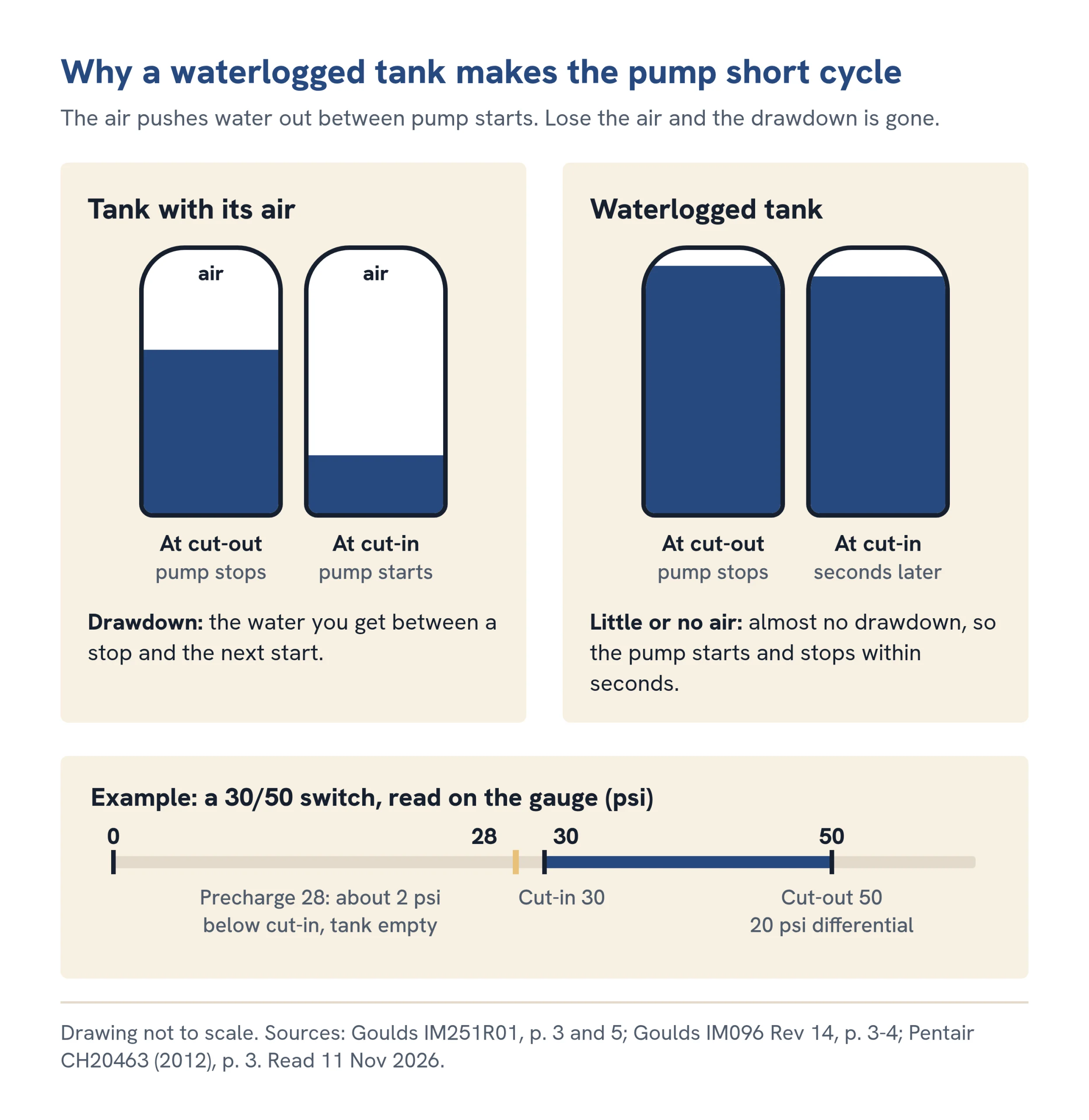
A precharged tank is a steel or composite shell with a rubber bladder or diaphragm inside that keeps the water away from a pocket of compressed air. As the pump fills the tank, the air is squeezed until the pressure reaches the switch’s cut-out setting and the pump stops. When you open a tap, the air pushes water out until the pressure falls to the cut-in setting and the pump starts again (Goulds tank owner’s manual IM251R01, p. 3, read 11 Nov 2026). The gap between the two is the differential, and the water the tank gives you between a stop and the next start is the drawdown.
The air pressure in the empty tank is the precharge. The tank makers we read set it about 2 psi below the cut-in, checked with the tank empty of water: 28 psi for a 30/50 switch, for example (Goulds IM096 Rev 14, p. 3-4; Amtrol 9015-939, p. 4; Flexcon Steel Well Tanks instructions, 2021 Rev. 9.21; all read 11 Nov 2026). Pentair’s composite tank manual prints the same in a chart: 18 psi for a 20/40 switch, 28 for 30/50, 38 for 40/60 and 48 for 50/70, always set with no water in the tank (CH20463, 2012 edition, p. 3, read 11 Nov 2026). One Goulds owner’s manual says 2 to 3 psi below (IM251R01, p. 5).
Waterlogged means that air pocket has shrunk or gone. With little air left to push, the tank holds almost no usable water, so the pressure falls to cut-in within seconds of opening a tap and the pump starts. Close the tap and the pump stops just as fast. That rapid on-off pattern is short cycling.
Older plain steel tanks (often galvanized) have no bladder. Water and air sit together, and the water slowly takes up the air. Goulds says these tanks need an air volume control “to replenish air lost through absorption” (Goulds jet pump manual IM102 Rev 13, June 2025, p. 6, read 11 Nov 2026). When that control fails, the tank waterlogs, and Goulds’ service manual lists a “waterlogged galvanized tank, faulty air control” as a cause of a pump that starts and stops too often (Goulds service manual GSSERVICE R10, 8/2025, p. 71, read 11 Nov 2026). Step 6 below doesn’t apply to a plain steel tank: its air is handled by the control and by your installer.
Signs of a waterlogged tank
- The pump clicks on and off in quick bursts while a tap runs, or starts the moment you open one. Goulds’ tank manual lists “short cycling of the pump (rapid starts and stops)” among the first things to watch for (IM251R01, p. 5).
- The gauge needle swings fast between two numbers instead of falling slowly while you run water: with little air left, the pressure reaches cut-in and then cut-out within seconds, as described above.
- Pressure surges and fades at the tap. The WSC says surging water is a sign that the tank’s air charge is out of balance with the pressure switch or that the diaphragm is torn, that the tank may need replacing, and that the surging “will eventually lead to pump failure” (WSC FAQ, read 11 Nov 2026).
- Pressure drops hard for a moment between starts. Franklin Electric explains that on its 2-wire motors, a waterlogged tank can make the pump try to restart before its starting switch has reset; the motor’s overload then trips, the pressure “will drop drastically” during the off time, and the condition should be corrected to stop the nuisance trips (Franklin Electric AIM Manual, 2026 edition, M1311, printed p. 11, read 11 Nov 2026).
- Less water between starts than there used to be. Pentair’s composite tank manual tells owners to check the air charge if the drawdown “decreases significantly” (Pentair CH20463, 2012 edition, p. 5, read 11 Nov 2026).

Causes, and what looks the same
Air leaves a precharged tank in a few ways. It can seep out through the air valve: Pentair warns that a missing valve cap “may allow loss of air pressure and eventually lead to tank waterlogging and air cell failure” (CH20463, p. 3). The bladder or diaphragm can tear, which the WSC names as a cause of surging. And Amtrol’s warning cuts the other way: a tank that has lost air, or whose pump cycle time has dropped, may be corroded inside (9015-939, p. 4). From outside the tank, an owner can’t tell which of these it is.
Several other faults make a pump start too often, and the makers list them beside the waterlogged tank. Worth knowing before you blame the tank:
| Cause | What it looks like | Maker’s document |
|---|---|---|
| Check valve stuck open or leaking | Pressure falls and the pump restarts with every tap closed | Franklin AIM M1311, printed p. 26; Goulds GSSERVICE, p. 11 |
| A leak in the piping or elsewhere in the system | Same: the pump restarts when nothing is in use | Franklin AIM, printed p. 26; GSSERVICE, p. 11 |
| Pressure switch set wrong or faulty | Cut-in and cut-out read wrong on the gauge | Franklin AIM, printed p. 26; GSSERVICE, p. 11 |
| Switch too far from the tank | Switch chatter | Goulds IM096 Rev 14, p. 2 (switch within 4 ft of the tank); GSSERVICE, p. 11 |
| Tank too small for the pump | Short runs even with a sound tank | GSSERVICE, p. 11 |
| Jet pumps: a leaking foot valve or suction check valve, or the pump more than 5 feet from the tank | Excessive cycling | Goulds IM102 Rev 13, p. 12 |
Short cycling has its own page with these causes in more depth: why a well pump short cycles.
You check, in this order
Steps 1 to 5 need nothing but your eyes, a watch and a notepad. Step 6 involves the tank itself, so it starts with the power off, and it applies only if your tank’s own maker gives that check to owners. Write down what you see at each step; it is what an installer will ask for first.
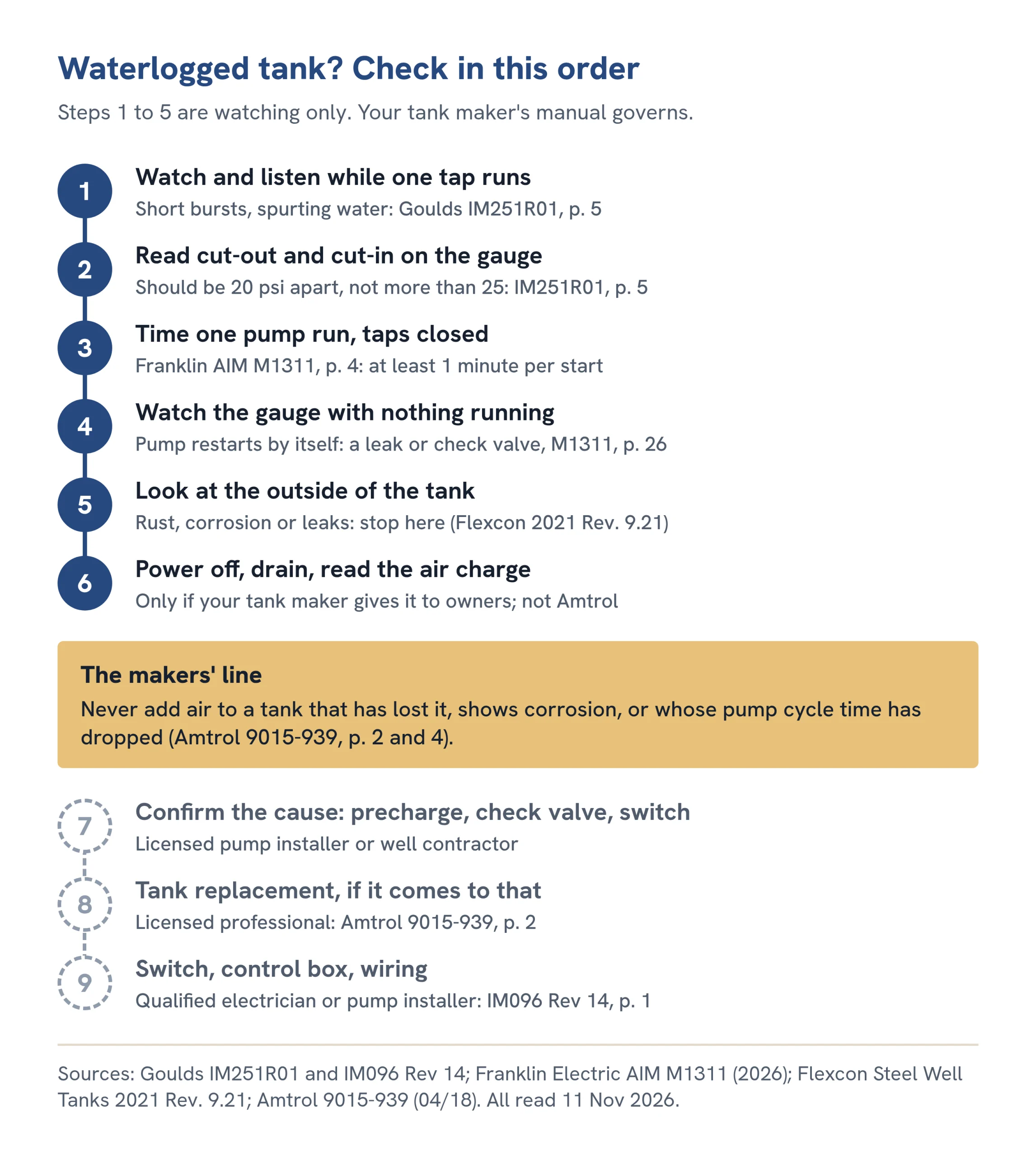
1. Watch and listen while water runs
Open one tap near the tank and watch the gauge and the pressure switch. Note whether the pump clicks on and off in short bursts, and whether the water spurts or surges. Goulds’ tank manual starts its troubleshooting here: observe the system and note anything unusual, such as spurting water or short cycling (IM251R01, p. 5, read 11 Nov 2026). Don’t touch the switch or open its cover.
2. Read cut-out and cut-in on the gauge
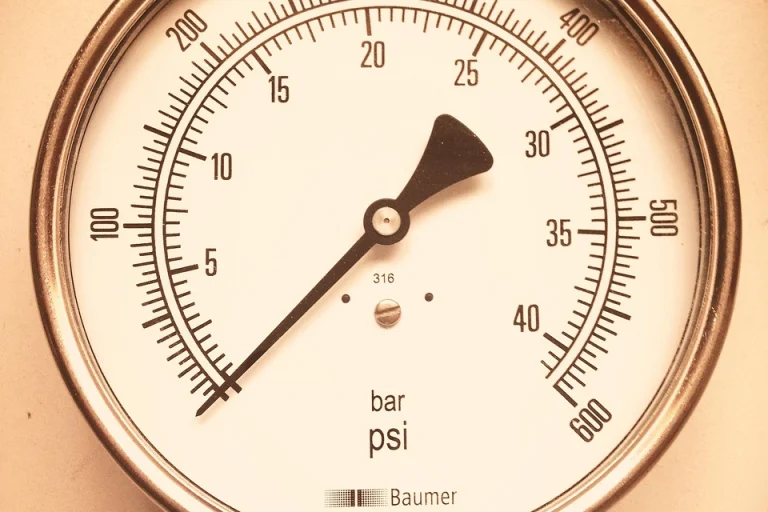
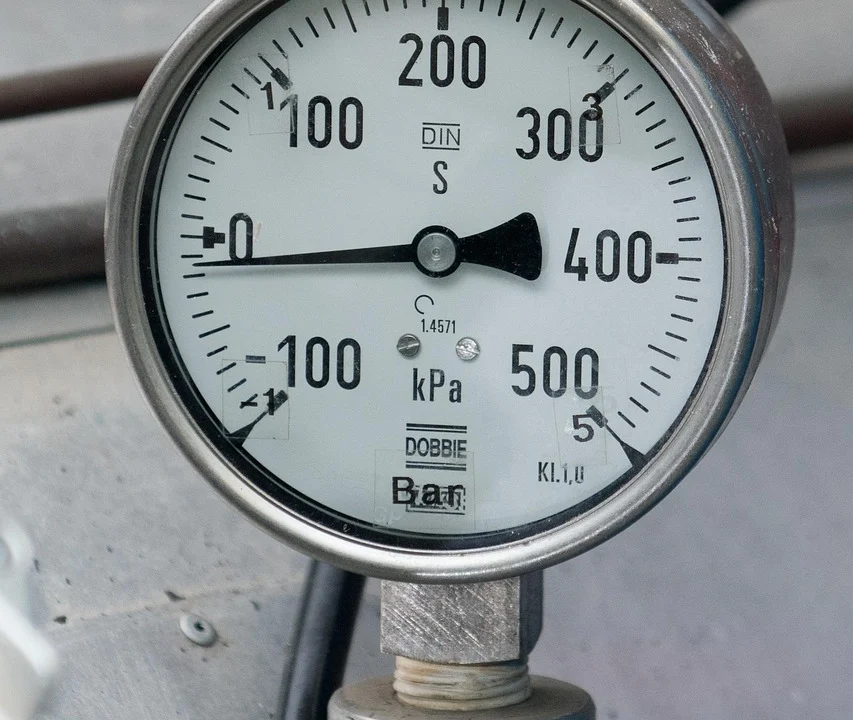
Close the taps and let the pump run until it stops; write down the gauge reading at that moment (cut-out). Then open a tap and let the tank drain down until the pump starts; write down that reading (cut-in). Goulds gives owners this exact check and says the difference should be 20 psi, not more than 25; if it isn’t, contact a qualified professional (IM251R01, p. 5). Our precharge and switch settings calculator shows what the gauge should read for common switch settings.
3. Time one pump run
From the moment the pump starts at cut-in, with the taps closed again, time how long it runs until it stops at cut-out. This is still only watching, as Goulds’ troubleshooting asks of owners (IM251R01, p. 5); Amtrol’s start-up check has the installer measure the same thing, refilling the tank to cut-off to “check time to fill” (9015-939, p. 4). The yardstick: Franklin Electric says its submersible motors should run at least one minute per start to get rid of the heat from starting, and sets a maximum of 300 starts a day for motors up to 0.75 HP and 100 a day for single-phase motors from 1 to 5.5 HP; excessive cycling shortens the life of controls and can damage motor splines and bearings (AIM M1311, printed p. 4, read 11 Nov 2026). A run of a few seconds points at a tank with little or no air, or at one of the causes in the table above. A run that is short only compared with what it used to be is worth noting too: Amtrol treats a drop in cycle time as a reason not to add air.
4. Watch the gauge with nothing running
With every tap, toilet and appliance off, watch the gauge for several minutes after the pump stops. If the pressure creeps down and the pump starts by itself, the problem is a leak or a check valve that won’t hold pressure, both listed by Franklin as causes of a motor that “starts too often” (AIM M1311, printed p. 26). A waterlogged tank on its own doesn’t make the pump start when no water is used.
5. Look at the outside of the tank
Look for rust, flaking paint, wet spots, drips at the pipe connection or water on the floor under the tank. Goulds notes that cold water entering a tank in a warm room can form condensation, and says to check the elbow if a small leak appears near the water fitting (IM251R01, p. 5). Flexcon’s instructions say a tank showing “any visible signs of leaking, corrosion or rusting” must be replaced immediately and its air pressure must not be adjusted (Flexcon Steel Well Tanks instructions, 2021 Rev. 9.21, read 11 Nov 2026). Amtrol says to call a qualified professional at once if the tank shows signs of corrosion (9015-939, p. 2). If you see corrosion, stop here.
6. Power off, drain, read the air charge (only where your tank maker allows it)
Read the label on your tank first. If it is an Amtrol tank, skip this step: Amtrol’s instructions say “ONLY QUALIFIED PROFESSIONALS SHOULD CHECK, ADJUST OR RE-CHARGE” the precharge (9015-939, p. 2; Well-X-Trol instructions 9016-868, p. 2, read 11 Nov 2026). Goulds’ and Pentair’s owner’s manuals give this check to owners (IM251R01, p. 5; CH20463, p. 5). Flexcon’s instructions print the same drain-and-gauge procedure but also say its tanks are installed by a qualified professional and checked by one every year (Flexcon 2021 Rev. 9.21), so on a Flexcon tank, as on any tank whose maker doesn’t give the check to owners, leave it to your installer. The WSC describes the same start (power off, drain), then says to follow the tank maker’s instructions while suggesting a licensed well contractor do any repairs (WSC FAQ). As Goulds gives it (IM251R01, p. 5):
- Turn off the breaker for the pump. Goulds’ tank manual says to disconnect power and bleed off water pressure before servicing the tank (IM251R01, p. 2), and Amtrol says to turn off the pump’s power and release all water pressure before any work on a tank (9016-868, p. 2). Some pumps have more than one disconnect (Franklin AIM M1311, printed p. 3): make sure the pump can’t start.
- Open a tap near the tank and let the tank drain completely, until the gauge reads zero and the water stops. This is how Goulds and Pentair have owners drain a tank, and how Flexcon and the WSC describe it: through a nearby faucet with the power off (IM251R01, p. 5; Pentair CH20463, p. 5; Flexcon 2021 Rev. 9.21; WSC FAQ).
- Take the cap off the air valve on top of the tank and read the pressure with a tire gauge. Goulds expects about 2 to 3 psi below cut-in; if it isn’t, the “tank pressure must be adjusted by a qualified professional.” Put the valve cap back.
- Brush soapy water on the air valve and the tank seams. Goulds gives this as the owner’s leak check; if the tank itself leaks, “replacement by a qualified professional is required” (IM251R01, p. 5).
- Close the tap and turn the breaker back on only once the valve cap is back on, then watch the pump fill the tank and stop.
What the reading tells you: a reading near the expected precharge means the tank still holds its air, so look again at the causes in the table. A reading well below it, or near zero, means the tank has lost air: that is the waterlogged tank, and it is where Amtrol’s rule applies. If water comes out of the air valve when you put the gauge on, put the cap back and stop there; note it for the installer. Amtrol’s advice for a tank that seems to be malfunctioning is to call a qualified professional at once (9015-939, p. 2).
The makers’ line
- Don’t add air to a tank that has lost it. Amtrol: don’t adjust or add pressure after a loss of air, with visible exterior corrosion, or when the pump cycle time or precharge has dropped, because the tank may be corroded inside and could rupture or explode (9015-939, p. 2 and 4). Flexcon: don’t adjust the air on a tank with any sign of corrosion; replace it (2021 Rev. 9.21).
- Adjusting the air charge is a professional’s job for Goulds (IM251R01, p. 5) and for Amtrol, which reserves even the check (9015-939, p. 2). Pentair’s 2012 composite tank manual is the exception we found: it tells owners to add air if the charge is more than 2 psi low (CH20463, p. 5). Flexcon says precharge changes are made before the tank is installed, with the system at 0 psi, although the same sheet also prints an after-installation procedure (2021 Rev. 9.21). On a tank that has waterlogged, we follow Amtrol’s stricter line, because the loss of air is the very condition Amtrol warns about.
- Replacing a tank is installer work. Amtrol says a licensed professional must install, periodically inspect and service its tanks (9015-939, p. 2); Flexcon says its tanks “must be installed by a Qualified Professional” and checked annually by one (2021 Rev. 9.21).
- Anything electrical goes to a qualified electrician or licensed pump installer. Goulds: “All electrical work must be performed by a qualified technician” (IM096 Rev 14, p. 1). Franklin adds that some controls hold a lethal voltage after the power is off and calls for 5 minutes before covers come off (AIM M1311, printed p. 3). There are no steps on this site for opening a switch, a control box or wiring.
- A tank that leaks or is corroded is replaced, not patched (Goulds IM251R01, p. 5; Flexcon).
The pro, explained
A licensed pump installer or well contractor will usually confirm the cause before quoting a tank. Expect them to read the gauge through a cycle, check the precharge on the drained tank, watch whether the pressure holds with nothing running (the check valve), and look at the switch and its distance from the tank. If the tank has lost its air, Amtrol’s warning rules out simply recharging it, and the WSC says such a tank may need replacing.
What a tank replacement involves. The installer shuts off the pump’s power, drains the system and releases its pressure, disconnects the old tank and bleeds its air before it leaves the house (Goulds says to drain the water and bleed off the air completely before discarding a tank, IM251R01, p. 4). Before the new tank is filled, its precharge is set about 2 psi below the cut-in (Amtrol’s precharged well tanks and Flexcon’s steel well tanks ship at 38 psi, so a 30/50 system needs it lowered to 28: Amtrol 9015-939, p. 4; Flexcon 2021 Rev. 9.21). The tank’s own manual sets the relief valve, and the makers differ: Flexcon calls for one set at a maximum of 100 psi (2021 Rev. 9.21); Amtrol’s instructions for its 125 psig tanks call for one with a maximum relief pressure of 100 psi on p. 2 but word it as set to open at “100 psig or more” on p. 4 (9015-939); and its Well-X-Trol instructions call for one set to open at 125 psig or more (9016-868, p. 2). The installer should also look at the size: Goulds lists a tank too small for the pump as a cause of too-frequent starts (GSSERVICE, p. 11). Our pressure tank size calculator shows the drawdown a given pump needs. The pressure tank replacement page covers the job and its published prices.
Plain steel to bladder. Swapping an old plain steel tank for a precharged one also means removing the parts that fed it air. Pentair’s manual tells the installer to remove the bleeder orifices from the drop pipe in a submersible system, or the air volume control on a jet pump (CH20463, p. 4). On a submersible, Pentair has the pump and discharge pipe raised far enough to reach those fittings and plug the tees, which is a bigger job than a tank swap.
Repairs instead of replacement. Some composite tanks have a replaceable air cell; Pentair prints that procedure for its Pro-Source tanks (CH20463, p. 5-6). Goulds describes the diaphragm in its steel tanks as sealed in place (IM251R01, p. 3). A worn check valve, a leak or a switch out of adjustment is fixed on its own, and the tank stays. See checking and setting a tank’s air charge for a tank that is sound but set wrong.
After the repair. EPA lists “You replace or repair any part of your well system” among the times to have your water tested right away (EPA, Protect Your Home’s Water, updated 26 Feb 2026, read 11 Nov 2026). Your state or county health department can point you to a certified lab.
Permits and who may replace a tank
This is set state by state, and many states leave permits to the county. Three we read on 11 November 2026, two in the official statute or rule text and one in the state agency’s own publication:
- North Carolina: a repair permit is not required “for the repair or replacement of a pump or tank” (G.S. 87-97(b)).
- Ohio: “repair”, work that needs no permit, includes “servicing or replacing … storage or pressure tanks” (OAC 3701-28-01(BBBB), effective 1 January 2020).
- Wisconsin: the DNR says only people holding a current pump installer license may “install and replace pumps, pitless adapters and accessory piping and pressure tanks” on drilled and driven-point drinking water wells (DNR, You and Your Well, PUB-DG-002, file dated June 2025). This is the DNR’s own summary; the statute and NR 812 text would not open for us, so any exception in them is not confirmed here.
- Other states: not confirmed here. Ask your county health department or the state agency that licenses well and pump contractors.
No permit is not the same as permission to do the work yourself, and no state rule changes what the tank makers say about who should. More on permits by state: water well permits.
Check the warranty before you pay
Find the model and date code on the tank’s label. Makers’ terms we read: Goulds water system tanks, 5 years from installation (IM251R01, p. 7); Amtrol Well-X-Trol tanks 7 years and Amtrol CH and PL tanks 5 years, from the date of purchase, or from the date of manufacture if the tank was installed more than 18 months after it was made (Amtrol warranty MC10253, 10/26); Flexcon steel well tanks 5 years from the date of manufacture (2021 Rev. 9.21). None of these covers the labour to swap the tank (Amtrol MC10253 and 9015-939, p. 3; Goulds IM251R01, p. 7; Flexcon 2021 Rev. 9.21). Amtrol also asks for proof of purchase and of home ownership, and says Well-X-Trol tanks bought from an online seller aren’t eligible for its support (MC10253). A warranty is not a life expectancy; no maker we read publishes one.
Things you may read elsewhere
- “Just drain it and add air.” You may see this on other sites. We checked it against Amtrol’s instructions, and for a tank that has lost its air, it is exactly what they say not to do (9015-939, p. 4).
- “Set the precharge equal to the cut-in.” The makers we read say about 2 psi below it, on an empty tank. Even the WSC FAQ words it as “the same as your pump’s cut on setting”, but its own examples are 2 psi below: 28 psi for a 30/50 setting, 38 for 40/60, 48 for 50/70.
- “Tap the tank to hear the water line” or “press the air valve and see if water comes out.” We found neither in any maker’s owner instructions, so we don’t give them as steps. An installer may use them.
What to write down and ask
Before you call, note:
- the gauge readings at cut-out and cut-in, and the switch setting printed inside the cover lid or on the switch label if you can see it without opening anything;
- how long one pump run lasts, timed with the taps closed, and whether the pump starts on its own when nothing is running;
- the tank’s label: maker, model, size and date code; and the air-charge reading if your tank maker allowed you to take it;
- any rust, leaks or water on the floor, and when the symptoms started.
Ask the installer what they tested and what they found (precharge on the drained tank, the check valve, the switch), whether the tank is the right size for the pump, and for a written quote listing the tank, its size, fittings, any valve or switch, and labour separately.
What can’t wait: a breaker that trips again, any water on or near wiring or the switch, a tank that is leaking or visibly corroded, and a pump that runs in bursts all day. If the pump is cycling every few seconds and you’re waiting for help, use as little water as you can: every start counts toward the daily maximum a motor maker sets (Franklin’s figures are in step 3).
Sources checked on 11 November 2026: Amtrol 9015-939 (04/18) precharged well tanks, 9016-868 (02/19) Well-X-Trol instructions and warranty MC10253 (10/26); Goulds (Xylem) IM251R01 water system tank owner’s manual, IM096 Rev 14, IM102 Rev 13 (June 2025) and service manual GSSERVICE R10 (8/2025); Flexcon Steel Well Tanks installation and operation instructions, 2021 Rev. 9.21; Pentair Pro-Source composite tank owner’s manual CH20463 (2012 edition, the one on the maker’s site); Franklin Electric AIM Manual 60 Hz, 2026 edition (M1311); the Water Systems Council FAQ (association guidance); EPA’s Protect Your Home’s Water page; N.C. G.S. 87-97; Ohio Adm. Code 3701-28-01; Wisconsin DNR’s You and Your Well (PUB-DG-002). Page numbers are the printed numbers where a manual prints them. See something out of date? Tell us through our corrections page.
Sources
- Amtrol 9015-939 (04/18), Precharged Well Tanks installation and operation instructions
- Amtrol 9016-868 (02/19), Well-X-Trol installation and operation instructions
- Amtrol limited warranty MC10253 (10/26)
- Goulds IM251R01, Water System Tank owner's manual
- Goulds IM096 Rev 14, 4" submersible pumps instruction manual
- Goulds IM102 Rev 13 (June 2025), jet pumps instruction manual
- Goulds service manual GSSERVICE R10 (8/2025)
- Flexcon Steel Well Tanks installation, warnings and operation instructions, 2021 Rev. 9.21
- Pentair Pro-Source composite tank owner's manual CH20463 (2012)
- Franklin Electric AIM Manual 60 Hz, 2026 edition (M1311)
- Water Systems Council, Frequently Asked Questions (association guidance)
- EPA, Protect Your Home's Water (updated 26 Feb 2026)
- North Carolina G.S. Chapter 87, Article 7 (87-97)
- Ohio Adm. Code 3701-28-01, Definitions
- Wisconsin DNR, You and Your Well (DG002)