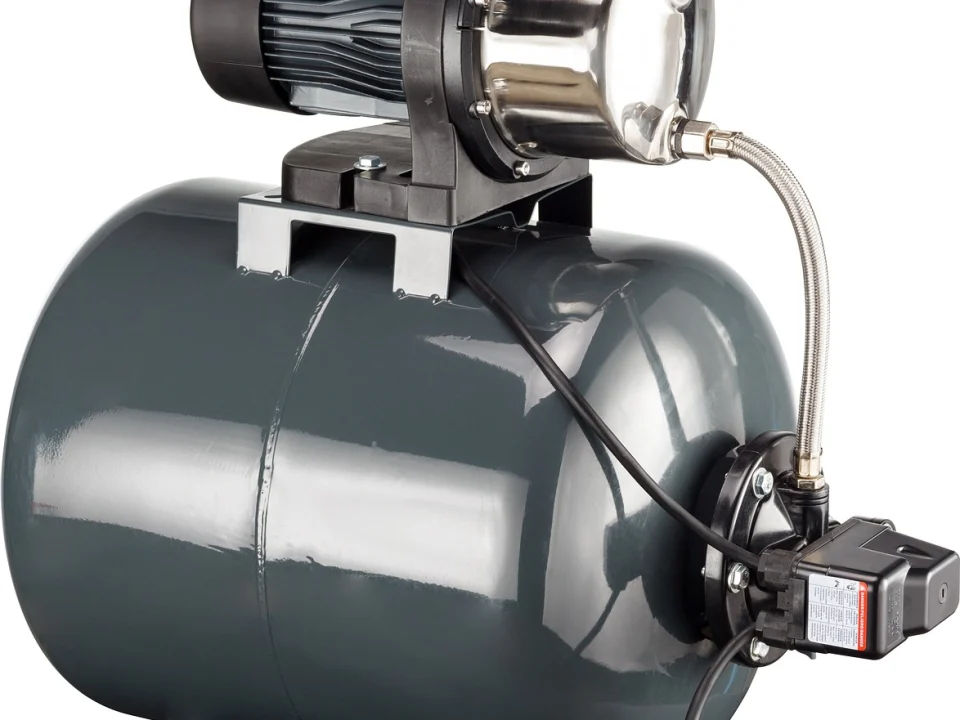
A well pressure tank and its pressure switch work as a pair. The switch starts the pump when the pressure falls to its cut-in and stops it at its cut-out: a “30/50” switch starts the pump at 30 psi and stops it at 50. The tank holds a cushion of compressed air behind a rubber bladder or diaphragm, which pushes water to your taps between pump starts. Most tank problems come down to that air cushion, and most switch questions to two numbers on a gauge. This guide takes them in the order owners usually meet them.
General information, not professional advice. Your pump and tank makers’ manuals and a licensed well or pump contractor decide what’s safe for your system; your state or county decides what needs a permit or a licence.
Never add air to a tank that has lost it. Amtrol warns against adding air or raising the precharge after a loss of air, with visible rust outside, or when the pump’s cycle time has dropped: lost air can mean corrosion inside, and re-pressurising “could result in rupture or explosion” (Amtrol 9015-939 (04/18), p. 2 and p. 4, read 11 November 2026). The switch side runs at 115 or 230 volts: “All electrical work must be performed by a qualified technician” (Goulds IM096 Rev 14, p. 1, read 11 November 2026).
How the tank and switch work together
When the pump runs, water enters the tank and squeezes the air until the pressure reaches the cut-out and the switch stops the pump. Open a tap and the squeezed air pushes the water out; at the cut-in the switch starts the pump again (Goulds IM251R01, p. 3, read 11 November 2026). The gap between the two numbers is the differential. The water given out between pump stop and pump start is the drawdown, only a fraction of the size on the label: by Boyle’s law, about 5.9 gallons from a 20-gallon tank on a 30/50 switch.
Start with how a well pressure tank works: one cycle step by step, the valves and gauge around the tank, precharged versus plain steel tanks, and why brochures print bigger drawdown figures.
Cut-in, cut-out and precharge
The precharge is the air pressure in the tank when it holds no water. The makers we read set it 2 psi below the cut-in, read at the air valve with the pump’s power off and the tank drained, so the tank still holds a little water as the pump comes on and the flow doesn’t pause.
| Switch setting | Cut-in | Cut-out | Precharge, tank drained |
|---|---|---|---|
| 20/40 | 20 psi | 40 psi | 18 psi |
| 30/50 | 30 psi | 50 psi | 28 psi |
| 40/60 | 40 psi | 60 psi | 38 psi |
| 50/70 | 50 psi | 70 psi | 48 psi |
A few differ: Goulds’ tank owner’s manual says 2 to 3 psi (IM251R01, p. 5), and plain steel tanks and constant-pressure drives follow other rules. The precharge and switch settings calculator gives the figure for a custom switch and the gauge swing to expect.
Who should take the reading is where makers disagree. Amtrol: “ONLY QUALIFIED PROFESSIONALS SHOULD CHECK, ADJUST OR RE-CHARGE” the precharge (9015-939, p. 2). Goulds lets an owner check it with a tire gauge on a drained tank, power off, and has a qualified professional make any adjustment (IM251R01, p. 5). Pressure tank air charge sets the makers side by side.
Is the tank big enough?
A tank is sized so its drawdown keeps the pump running for its minimum time per start. Franklin Electric asks for at least one minute per start, and at most 300 starts a day for single-phase motors up to 0.75 HP, 100 for 1 to 5.5 HP (AIM Manual M1311, 2026, PDF p. 6, read 11 November 2026). So a 10 gpm pump needs about 10 gallons of drawdown; at 40/60 with a 38 psi precharge that means about 38.8 gallons of total volume, a 44-gallon tank among the sizes Amtrol lists (MC7025 (03/26), p. 1). The pressure tank size and drawdown calculator runs it for your pump and switch. It gives an estimate; a licensed pump installer sizes the tank.
When the tank loses its air
A waterlogged tank has lost its air cushion, so the pump starts almost every time a tap opens. The signs: a pump clicking on and off in bursts, a fast-swinging gauge needle, pressure surging at the tap. Franklin: “A waterlogged tank condition causes rapid cycling” (AIM M1311, PDF p. 13). But the makers also list a check valve stuck open, a leak, a switch set wrong and a tank too small (Goulds GSSERVICE R10, p. 11). Waterlogged pressure tank: signs, causes, what you can check gives the owner checks in order, each with its document. If it could be the pump or switch, start with well pump short cycling.
Replacing a tank
A tank that has lost its air, leaks from the shell or shows rust is replaced, not refilled; Flexcon says a leaking or rusting tank “must be replaced immediately” (Steel Well Tanks IOM Rev. 9.21, EN p. 3). Amtrol and Flexcon require a qualified professional to install it, and Goulds calls one “highly recommended” (IM251R01, p. 1), so we explain the job without steps. Published installed prices are scarce: a 2015 San Antonio Water System bid ($999.46 to $1,984.07 from three bidders) and one Missouri shop’s November 2026 list ($900 to $2,300 by size).
Who may do it is a state question. North Carolina needs no repair permit to replace a pump or tank (G.S. 87-97); Ohio counts replacing a pressure tank as permit-free repair (OAC 3701-28-01(BBBB)); Wisconsin’s DNR says only licensed pump installers may replace pressure tanks (PUB-DG-002, the agency’s summary); all read 11 November 2026, other states not confirmed. Replacing a well pressure tank covers the signs, the job, prices with dates, warranties and what a written quote should list.
Switch settings and adjustment
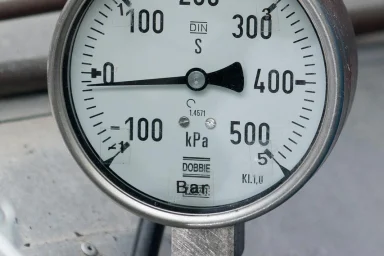
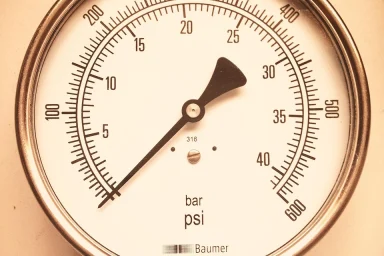
Read the gauge, not the label: Goulds warns the actual setting can differ from the cover, and puts a proper differential at 20 psi, not more than 25 (IM251R01, p. 5). For a Square D Pumptrol switch the sheet gives the order: power off at the breaker, range nut first for the cut-in, differential nut for the cut-out, cover on before the power, then check several cycles (Square D/Telemecanique 65013-005-39, September 2025, p. 1-2, read 11 November 2026). The same sheet says these switches “should be installed, operated and maintained only by qualified personnel” (p. 2), and Franklin warns some controls hold a lethal voltage for 5 minutes after the power is off (AIM M1311, PDF p. 5).
Limits apply: Square D’s data sheet puts the cut-out range at about 20 to 65 psi (9013FSG2J21, 30 July 2024), and if the cut-in moves, the tank’s precharge must follow (Amtrol 9013-0006, p. 7). Well pressure switch settings (30/50, 40/60) and adjustment has the makers’ steps, the limits and what a higher setting does to drawdown.
When the switch itself fails
Replacing a switch means disconnecting the pump’s 115 or 230 volt wires, and no maker we read gives owners steps for it. A plugged tube under the switch can give false readings (Goulds GSSERVICE R10, p. 73), and a waterlogged tank wears out contacts, so check the cause first. Replacing a well pump pressure switch explains what the installer or electrician does, the part’s price and the state rules we read. If the gauge climbs past your cut-out and the pump keeps running, turn off its breaker and call.
Your next step
- Now: read the tank’s label and find its manual on the maker’s site. Note the gauge when the pump stops and starts, and time one run.
- Write down: those readings with the date, the switch’s printed setting, any rust or drips, and whether the tank was ever “topped up”.
- Ask: what the air charge read on the drained tank, whether the check valve and switch were tested, and for a written quote line by line.
- Don’t wait: a breaker that trips again, a pump cycling every few seconds or not stopping, water on the switch, or a tank that leaks, rusts or loses air. Call a licensed pump installer or well contractor.
After any repair, EPA says to test your water “immediately” if “you replace or repair any part of your well system” (EPA, read 11 November 2026); your state or county health department lists certified labs. For other symptoms, see well pump troubleshooting, symptom by symptom.
Sources checked on 11 November 2026. Each maker’s document speaks for that maker’s products only.