A well pressure tank is due for replacement when it has lost its air charge, leaks, or shows rust (how tanks work, their settings and their problems are in our pressure tanks and switches guide). Amtrol’s manuals say never to add air to a tank that has lost it or shows rust; Flexcon’s says a leaking or rusting tank must be replaced at once; Goulds’ says a leaking tank needs replacing by a qualified professional. Amtrol and Flexcon also say a licensed or qualified professional installs the new tank, and Goulds calls one “highly recommended”. Published installed prices are scarce: the two we could use are a 2015 Texas public bid ($999.46 to $1,984.07 from three bidders) and one Missouri shop’s November 2026 price list ($900 to $2,300 by tank size). The tank alone lists from about $210 to $1,131 at two retailers, by size and make. The rest of this page covers the signs, what you can safely look at first, what the installer does, which states we have read on who may do the work, and how to read a quote.
General information, not professional advice. Your pump and tank makers’ manuals and a licensed well or pump contractor decide what’s safe for your system; your state or county decides what needs a permit or a licence.
Don’t add air to a tank that has lost it. Amtrol’s instructions for its precharged well tanks (9015-939, 04/18, p. 2 and p. 4, read 11 November 2026) carry a DANGER warning: don’t adjust or add pressure if the tank has lost air, if there is visible rust on the outside, or if the pump’s cycle time has got shorter than it was. Lost air can mean the tank is corroding inside, and re-pressurising it can make it burst. Flexcon’s steel well tank manual (Rev. 9.21, p. 1 and p. 3, read 11 November 2026) says a tank that shows leaking, corrosion or rust “must be replaced immediately”. If your tank has lost air and you want to understand that problem first, see waterlogged pressure tanks.
Signs it’s time
A pressure tank holds water against a cushion of compressed air, usually behind a rubber bladder or diaphragm. The air pushes water to your taps so the pump doesn’t start every time you open one. The pump starts at the cut-in pressure and stops at the cut-out pressure, both set on the pressure switch. The air cushion’s own pressure, measured with the tank empty of water, is the precharge. The water the tank delivers between a stop and the next start is the drawdown. A tank whose air cushion has gone is called waterlogged: it fills with water, delivers almost none between cycles, and the pump starts and stops every few seconds (short cycling).
What the makers’ documents name as reasons to replace, rather than adjust:
- Lost air, or a pump that now cycles faster than it did. Amtrol treats both as a possible sign of internal corrosion and forbids re-pressurising (9015-939, p. 2 and p. 4; same warning in the Well-X-Trol manual 9016-868, 02/19, p. 2, read 11 November 2026).
- Visible rust or corrosion on the tank. Amtrol: don’t adjust the precharge (9015-939, p. 2). Flexcon: replace immediately and don’t adjust the air (Rev. 9.21, p. 1-3).
- A leak from the tank itself. Goulds’ tank owner’s manual says that if a tank leak appears, “replacement by a qualified professional is required” (IM251R01, p. 5, read 11 November 2026). The same page notes that cold water entering a warm tank can form condensation, especially in warm climates, so a wet tank isn’t always a leaking one. A drip at the fitting is not the same as a leak in the shell.
- Rapid cycling with a waterlogged tank. Franklin Electric’s installation manual for submersible motors lists “waterlogged tank” under “motor starts too often”, with the fix “clean or replace” (AIM Manual 60 Hz 2026, M1311, PDF p. 28, read 11 November 2026), and warns that excessive cycling shortens the life of controls and can damage the motor (PDF p. 6).
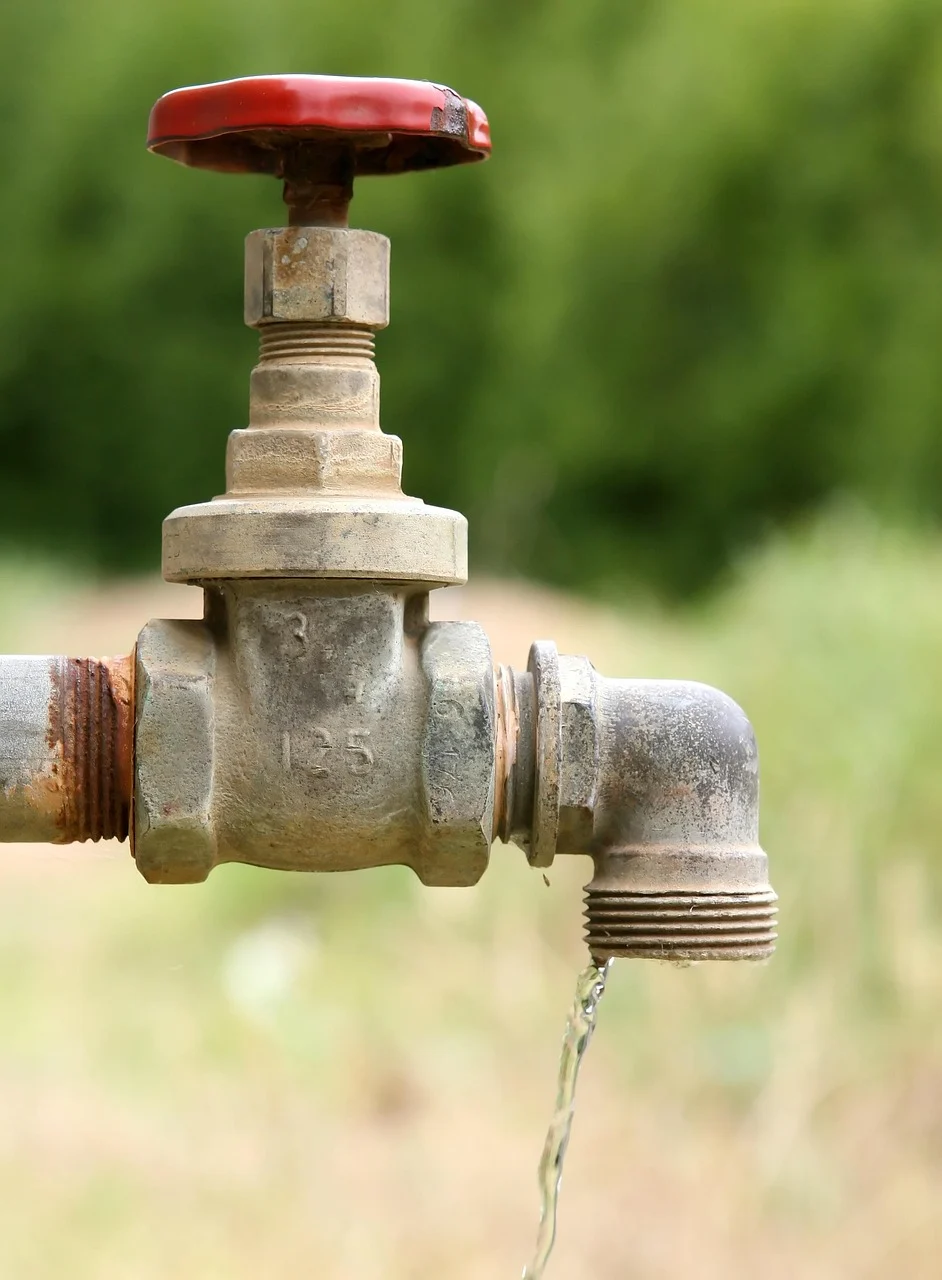
Rapid cycling isn’t always the tank. The same Franklin table lists a check valve stuck open, a leak in the system and the pressure switch as other causes of too-frequent starts (PDF p. 28). A new tank won’t fix any of those. That is why the installer should check the system, not just swap the tank. Our page on a well pump that short-cycles goes through the causes.
Age alone isn’t a sign we can put a number on. We found no tank maker, NGWA or Water Systems Council document that gives a tank’s life expectancy. The “lasts 10 to 15 years” figures you see online come from service and warranty sellers, not from a standard. The Water Systems Council, a well-industry association, lists “pump and pressure tank are less than 15 years old” as an ideal condition when buying a home with a well (association guidance, read 11 November 2026). That is a buyer’s checkpoint, not a lifespan. The makers’ warranty terms are below.
What you can check first
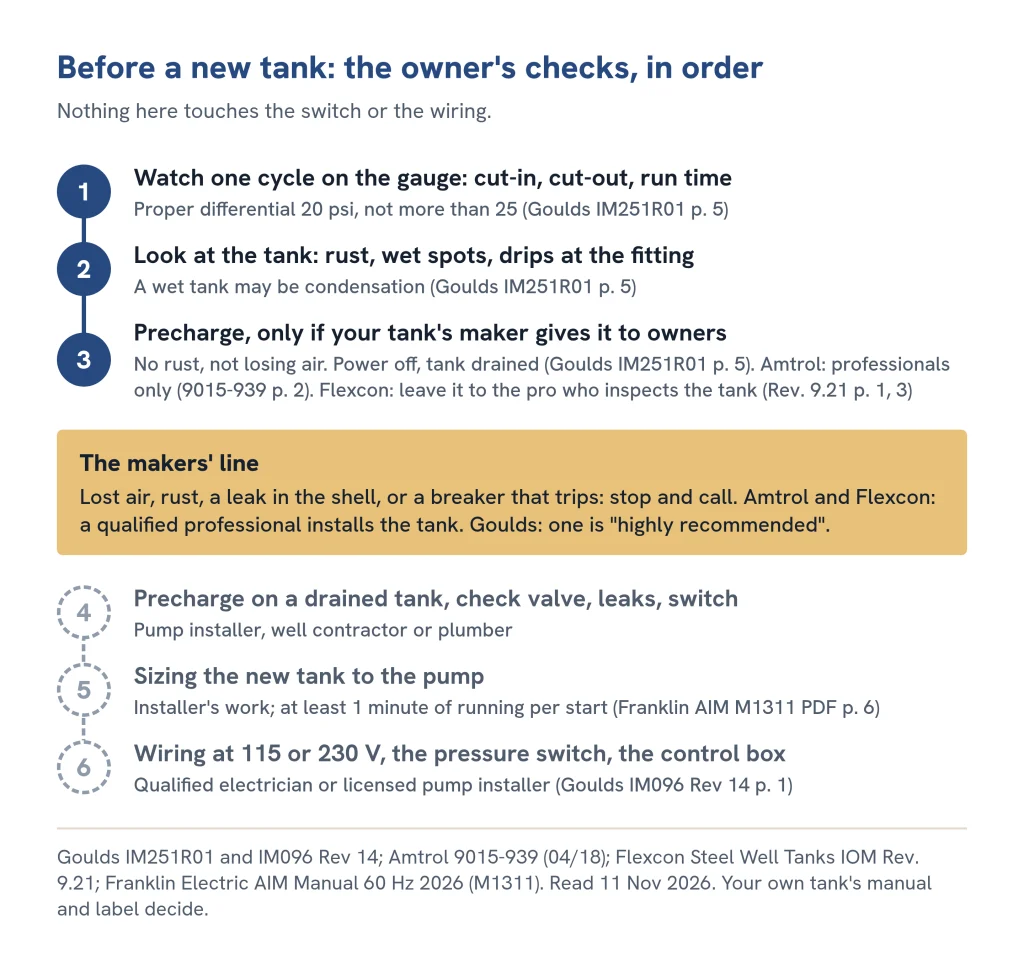
These are the only owner checks the tank makers give, and the makers differ. Amtrol reserves even checking the precharge for professionals. Flexcon’s manual gives its annual check to a qualified professional (Rev. 9.21, p. 3). It says precharge adjustments are to be made before the tank is installed, at 0 psi system pressure, though it also prints an after-installation adjustment, with the pump’s power off and the tank drained, without saying who makes it (Rev. 9.21, p. 1-2). Goulds’ tank owner’s manual prints checks for owners to make before calling a professional (IM251R01, p. 5). Find the maker’s name on your tank’s label and follow that maker’s line.
You check
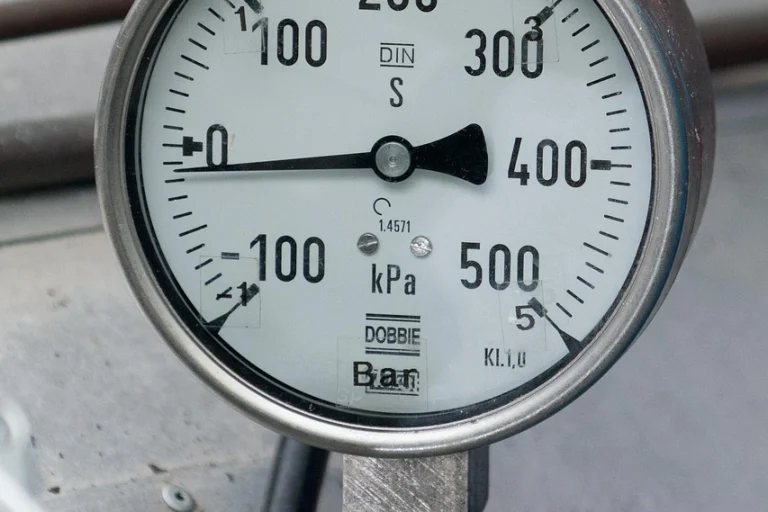
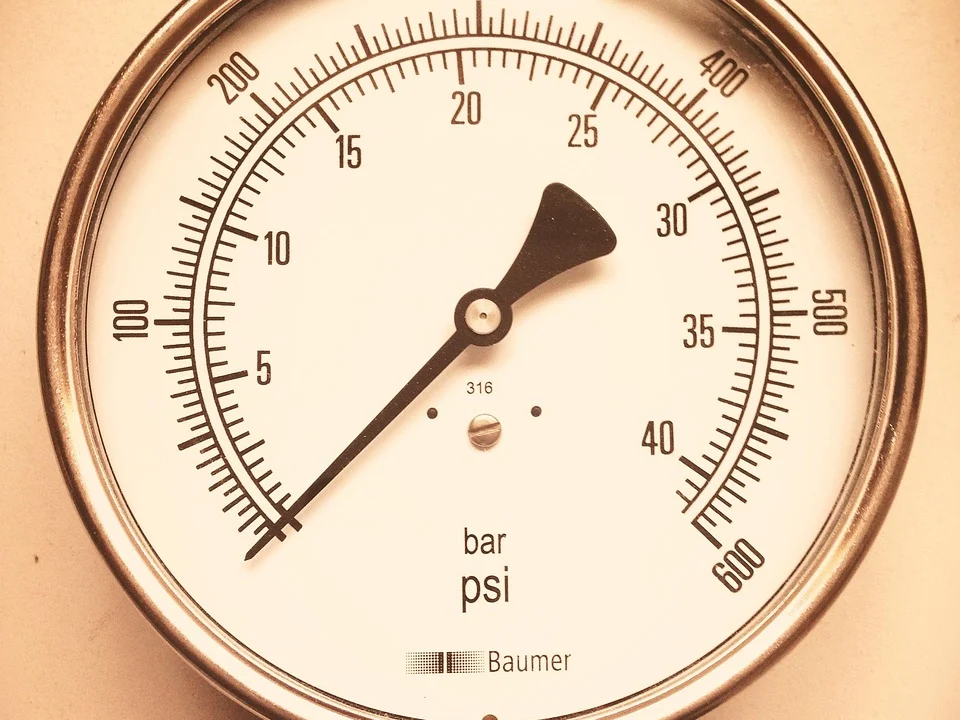
- Watch one cycle on the gauge. Open a tap and note the pressure when the pump starts (cut-in) and when it stops (cut-out). Time how long the pump runs. Goulds’ tank manual asks owners to note unusual behaviour such as short cycling or water spurting from a tap, and to read cut-in and cut-out on the gauge. It gives the proper differential (cut-out minus cut-in) as 20 psi, not more than 25 psi; if yours isn’t, it says to contact a qualified professional (IM251R01, p. 5). Nothing here touches the switch or the tank.
- Look at the tank without touching anything electrical. Check the shell, the base and the fitting for rust, wet spots or drips. Goulds’ owner checks include looking for a small leak near the water fitting, and note that a wet tank may only be condensation (IM251R01, p. 5). Flexcon’s maintenance section has a qualified professional look for leaks or corrosion on the tank and its connection once a year, and says a tank showing them must be replaced (Rev. 9.21, p. 3).
- Only if your tank’s maker gives it to owners, and only if the tank shows no rust and hasn’t been losing air: check the precharge with the power off. Goulds’ steps are: turn off the electric power to the pump, open a nearby tap and drain the tank completely, then read the air valve with a tire gauge. If it isn’t about 2-3 psi below the cut-in, Goulds says the pressure “must be adjusted by a qualified professional” (IM251R01, p. 5). For a Flexcon tank, leave the check to the professional who inspects it (Rev. 9.21, p. 1 and p. 3). For an Amtrol tank, the manual says “ONLY QUALIFIED PROFESSIONALS SHOULD CHECK, ADJUST OR RE-CHARGE” the precharge (9015-939, p. 2), so leave the check to the installer. Our page on pressure tank air charge sets the makers side by side.
The makers’ line
Every tank maker we read points installation to a professional. Amtrol: the tank “MUST BE INSTALLED BY A QUALIFIED PROFESSIONAL”, and a licensed professional must install, periodically inspect and service it (9015-939, p. 2 and p. 4; 9016-868, p. 1). Flexcon: it “must be installed by a Qualified Professional” and inspected annually by one (Rev. 9.21, p. 1). Goulds: it is “highly recommended” that a qualified service professional size, install and maintain the tank (IM251R01, p. 1). Goulds’ owner’s manual does print installation steps, but beside its recommendation of a qualified professional, and Amtrol and Flexcon require one, so this page explains the job and gives no steps for it. Stop and call a professional if the tank has lost air, is rusty or leaking, or if the breaker trips. Wiring at 115 or 230 volts, the pressure switch and the control box are for a qualified electrician or licensed pump installer (Goulds IM096 Rev 14, p. 1: “All electrical work must be performed by a qualified technician”).
The pro
A pump installer, well contractor or plumber, as your state allows (in Wisconsin, only a licensed pump installer; see the state table below), confirms the tank is the problem (precharge on a drained tank, the check valve, leaks, the switch), sizes the new tank to the pump, and replaces it as the next section describes. Ask what they tested before they quote a tank. The full system check is in our well pump troubleshooting guide.
The job, explained
This is what the makers’ manuals ask of whoever installs the tank. It explains what the installer does and why. It isn’t a set of steps to follow yourself.
- Power off and pressure out. Before any work on a tank, Amtrol says to turn off the power to the pump and release all water pressure in the tank and the system (9016-868, p. 2). Goulds says to disconnect power and bleed off water pressure before servicing (IM251R01, p. 2). Franklin warns that more than one disconnect switch may be needed, and that some controls hold a lethal voltage after the power is off, so it says to wait 5 minutes before opening covers (AIM M1311, PDF p. 5).
- The old tank is drained and its air let out before it leaves. Goulds: drain the water and bleed off the air completely. Leaving air in an old tank “creates an explosion hazard”; don’t puncture or burn it, and dispose of it under state and local rules (IM251R01, p. 4 and p. 6).
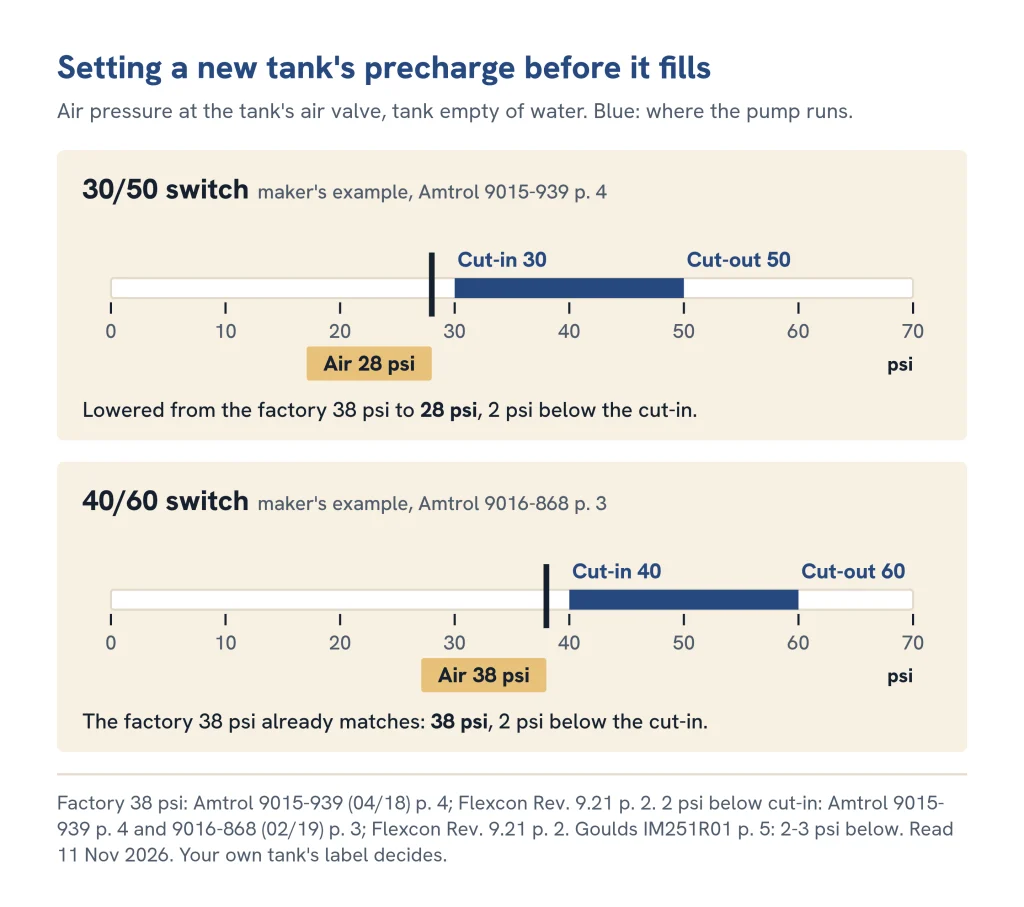
- The new tank’s precharge is set before it fills. Amtrol and Flexcon tanks ship at 38 psi (Amtrol 9015-939, p. 4; Flexcon Rev. 9.21, p. 2). Amtrol and Flexcon say to set the air 2 psi below the switch’s cut-in (Amtrol 9015-939, p. 4; Flexcon Rev. 9.21, p. 2). Amtrol’s examples are 28 psi on a 30/50 switch (9015-939, p. 4) and 38 psi on a 40/60 switch (9016-868, p. 3). Flexcon says to adjust only at 0 psi system pressure and never above 80 psi (Rev. 9.21, p. 1-2). Goulds’ tank manual says 2-3 psi below cut-in (IM251R01, p. 5). The precharge and switch settings calculator works this out for your switch setting.
- Placement. As close to the pressure switch as possible (Amtrol 9015-939, p. 4; Flexcon Rev. 9.21, p. 2), on a level surface that can carry the full tank’s weight (Flexcon, p. 2; Amtrol 9016-868, p. 3; Goulds IM251R01, p. 4). Somewhere a leak won’t do damage, with a drip pan to a drain where it could (Amtrol, p. 2 and p. 4). Flexcon says the tank and its piping “will in time leak” and must be placed with that in mind, out of freezing temperatures and upright (Rev. 9.21, p. 1). Amtrol’s limits are no freezing and no more than 100°F for its 125 psi tanks (9015-939, p. 2), and no more than 130°F (9016-868, p. 1) and no direct sunlight (p. 2) for Well-X-Trol.
- The parts around the tank. Amtrol’s checklist lists a pressure switch, a relief valve, a union, a shut-off valve, a drain valve, a pressure gauge and a tank tee (9015-939, p. 4). Pipe size from the pump to the tank shouldn’t be reduced (same page; Goulds IM251R01, p. 4).
- A relief valve, set by that tank’s rating. The makers differ, so the installer works from the label of the tank going in. Amtrol’s 125 psi tanks call for a relief valve with a maximum relief pressure of 100 psi, able to discharge the pump’s full flow (9015-939, p. 2). Well-X-Trol tanks, tested to 150 psi, call for one set to open at 125 psi or more (9016-868, p. 2). Flexcon says a properly sized relief valve set at no more than 100 psi must be installed (Rev. 9.21, p. 1). Goulds says to fit one within 10 feet of the tank if the system can exceed the tank’s working pressure (IM251R01, p. 4), and its warranty requires a high-pressure cut-off or relief valve on systems that can exceed 100 psi (p. 7).
- Start-up and fine tuning. With the system filled, the installer runs a cycle and looks for leaks (Flexcon Rev. 9.21, p. 2). If water pauses between the tank emptying and the pump starting, Amtrol has the installer adjust the switch’s cut-in (9015-939, p. 4) and Goulds has the tank’s air lowered to 2-3 psi below cut-in (IM251R01, p. 5).
- The right size. A bigger tank holds more water between starts, so the pump starts less often. Franklin asks for at least one minute of running per start (AIM M1311, PDF p. 6). The pressure tank size calculator estimates the smallest tank that gives your pump that run time.
- Old galvanised tanks. Some older systems have a plain (“conventional” or galvanised) tank with no bladder. One Missouri shop’s price list says switching to a bladder tank adds re-plumbing and removal of the in-well bleeder valve, at $250-$900 extra (price table below).
- Afterwards, test the water. EPA says to test your private well “immediately” if you “replace or repair any part of your well system” (EPA, Protect Your Home’s Water, updated 26 February 2026, read 11 November 2026). Ask your state or county health department or the state lab how.
Who may replace it: three states we read
Who may work on a well, and what needs a permit, is set by states and counties. EPA notes that private wells “are not regulated by the Federal Government under the Safe Drinking Water Act nor by most state governments” for water quality and safety (EPA, Private Drinking Water Wells, updated 2 November 2026, read 11 November 2026). We have read three states’ rules on tank work specifically. In the two that allow owners to do it, the makers’ line above still stands beside the law.
| State | The rule, as written | Source, read |
|---|---|---|
| Ohio | “Repair”, which needs no permit, includes “servicing or replacing … storage or pressure tanks”. An owner doing permit-free repair work on the system serving their own dwelling needs no contractor registration, but must still meet the chapter’s rules. | OAC 3701-28-01(BBBB); 3701-28-18(A)(2)(b)-(c), effective 1 Jan 2020; read 11 Nov 2026 |
| North Carolina | A repair permit from the local health department is needed to repair a private drinking water well, “except that a permit shall not be required for the repair or replacement of a pump or tank”. The well contractor certification law exempts a person who repairs a well on land they own or lease. | G.S. 87-97(b)(2); G.S. 87-98.4(b)(2); read 11 Nov 2026 |
| Wisconsin | “Only those persons holding a current pump installer license from the DNR may install and replace pumps, pitless adapters and accessory piping and pressure tanks” on drilled and driven-point potable wells. The owner exception in the same guide covers building a well on one’s own land, not pump or tank work. The guide also lists what the pump installer must do after the work. | DNR “You and Your Well”, PUB-DG-002 (2025), the state agency’s own summary; the code sections behind it (NR 146, NR 812) not read; read 11 Nov 2026 |
| Other states | Not confirmed: ask your state well program or county health department. | See who may do pump work, state by state |
Plumbing and electrical permits for the work around the tank are set locally and we haven’t read them for any state. Your town or county building department can tell you whether one applies.
What it costs: published figures
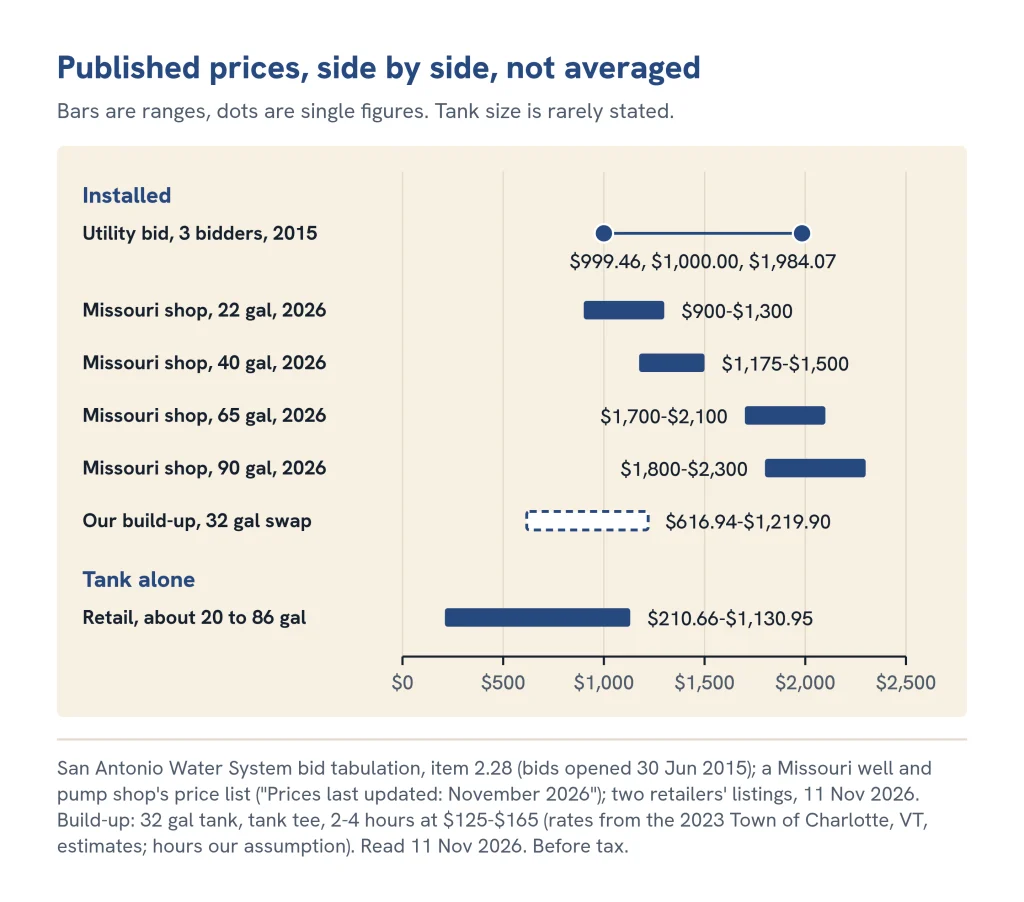
Few installed prices for this job are published by anyone who isn’t selling leads. We didn’t use cost-guide sites run by lead marketplaces, home-warranty sellers or contractor-matching services, and the figures that are left are thin. Only two published sources give an installed price for this job: a public bid from 2015 and one shop’s own price list. The other two below price the tank alone. Here they are side by side, labelled as published estimates and not averaged. The tank size is rarely stated, and the size moves the price more than anything else.
| Source | Figure | What it covers | Date | Why it may lean |
|---|---|---|---|---|
| San Antonio Water System, tabulation of bids, Water Well Mitigation Program (a city water utility’s public bid) | $999.46, $1,000.00 and $1,984.07 from three bidders | “Furnish & Install Pressure Tank”, each, installed; size not stated | Bids opened 30 Jun 2015 | 2015 prices; a utility program with many wells |
| Huston’s Water Solutions, Neosho, Missouri (a well and pump shop’s own price list; serves southwest Missouri, northeast Oklahoma and northwest Arkansas) | 22 gal $900-$1,300; 40 gal $1,175-$1,500; 65 gal $1,700-$2,100; 90 gal $1,800-$2,300; galvanised-to-bladder conversion $250-$900 extra | Installed, before sales tax; “not quotes”. The same page says its most common job, a 40-gallon fiberglass tank, includes a new pressure switch and gauge | “Prices last updated: November 2026”, read 11 Nov 2026 | One shop in one region |
| Town of Charlotte, Vermont, comparison of four drillers’ estimates for the town garage well (a public comparison) | “Pressure Tank Cost” $600 and $790.72 (two of the four estimates) | Tank line inside a new pump system; labour priced separately for the whole pump system ($125 × 8 and $165 × 4; the unit isn’t stated, read here as hours) | No printed date; file dated Jan 2023 | Estimates, not quotes; a new system, not a swap |
| California State Water Resources Control Board, 2024 Drinking Water Needs Assessment, cost appendix (a state agency’s cost model) | $400 | Tank only: a 44-gallon tank at a $367 base price plus tax and shipping; no labour | Developed 2023-24, published Jun 2024 | Material price for a new well, not an installed swap |
Sources: SAWS bid tabulation, item 2.28, p. 3; Town of Charlotte comparison; State Water Board cost appendix, Table 19 and “Pressurized Water Tank” (printed pp. 32 and 34). All read 11 November 2026. The Missouri shop is named as the source of its own prices and isn’t linked or recommended.
The tank alone, by size
Tank prices as listed by retailers on 11 November 2026, before tax and shipping. Prices change by store and ZIP code. “Gallons” is the tank’s total volume; the water it delivers per cycle is much less (see the size calculator). Brands are named only to date the prices, not as picks.
| Size class | Water Worker, listed at McCoy’s | Amtrol Well-X-Trol, listed at PexUniverse |
|---|---|---|
| About 20 gal | $210.66 (HT-20B, store price) | $322.95 (WX-202) |
| 32 gal | $319.99 (HT-32B) | $512.95 (WX-203) |
| 44 gal | $399.99 (HT-44B) | $695.95 (WX-250) |
| 86 gal | $499.99 (HT86B) | $1,130.95 (WX-302) |
Listed prices read on each retailer’s product page on 11 November 2026. The retailers are named only to date the prices and aren’t linked or recommended.
A warranty catch with online tanks. Amtrol’s warranty document says it doesn’t sell Well-X-Trol tanks online or authorise online resale, and that a Well-X-Trol “purchased from an e-commerce source is ineligible” for warranty coverage and other support (Amtrol MC10253, 08/26, p. 3, read 11 November 2026). The online prices above show what the tank is worth as material. They don’t mean a tank bought that way carries the maker’s warranty.
A worked build-up for a 32-gallon swap
To see where an installed price comes from, here is one rough build-up. Labour hours are our assumption, not a published figure. Change them to what your installer quotes.
| Line | Low | High | Basis |
|---|---|---|---|
| Tank, 32 gal | $319.99 | $512.95 | Retail listings above, 11 Nov 2026 |
| Tank tee, 1-inch lead-free brass | $46.95 | $46.95 | Listed at PexUniverse, 11 Nov 2026 |
| Labour | 2 h × $125 = $250 | 4 h × $165 = $660 | Labour rates from the 2023 Charlotte estimates, read as hourly; hours are our assumption |
| Total | $616.94 | $1,219.90 | Before tax |
Left out: a new switch, gauge, relief valve or drain valve; a trip or service-call charge; disposal of the old tank; any permit; and tax. Each of these can be a line on a real quote. For scale, the national median wage for plumbers, pipefitters and steamfitters was $30.67 an hour in May 2025 (BLS Occupational Employment and Wage Statistics, SOC 47-2152, read 11 November 2026). That is pay to the worker, before benefits, the van, insurance, overhead and profit, so it is not what a shop bills. The 2023 Vermont estimates priced labour at $125 and $165 a unit, which reads as an hourly rate.
Warranty terms, not a lifespan
No maker we read promises a life. What they put in writing is a warranty, and none of these covers labour.
| Maker | Term | Conditions worth knowing | Source, read 11 Nov 2026 |
|---|---|---|---|
| Amtrol Well-X-Trol (WX) | 7 years | From purchase, unless installed more than 18 months after manufacture (then from the manufacture date); original purchaser or first user, not transferable; claim within 30 days of the failure; proof of purchase and of home ownership at installation and at failure; labour not covered; online purchases ineligible | MC10253 (08/26 and 10/26), p. 1-3 |
| Amtrol CH and PL well tanks | 5 years | Same terms | MC10253, p. 2; 9015-939, p. 1 |
| Flexcon steel well tanks | 5 years from the date of manufacture | Not transferable; tell the Flexcon distributor or dealer who sold the tank within 30 days of the problem; labour and removal costs not covered; damage from any attempt to repair tank leaks not covered | IOM Rev. 9.21, p. 4 |
| Goulds water system tank | 5 years after installation | Installed to local codes; high-pressure cut-off or relief valve where the system can exceed 100 psi; written notice within 10 days of finding a defect; owner pays labour and shipping (except shipping in California) | IM251R01, p. 7 |
If your tank is inside its term, find the date code on its label before anyone hauls it away. Amtrol and Goulds start a claim with the seller or dealer (Amtrol also takes claims directly, within 30 days of the failure). Flexcon wants the distributor or dealer who sold the tank told within 30 days of the problem, and lists its own number if they don’t answer promptly (Rev. 9.21, p. 4). Goulds wants written notice within 10 days of finding the defect.
What the written quote should list
- Why the tank is being replaced: what was tested (precharge on a drained tank, the check valve, leaks, the switch) and what was found.
- The new tank’s maker, model and total volume, and the drawdown it gives at your switch setting.
- The precharge it will be set to, and the switch setting it is set against.
- Each part as its own line: tank tee, switch, gauge, relief valve and its setting, drain valve, unions, valves.
- Labour, the trip or service charge, disposal of the old tank, any permit, and tax.
- Whose warranty applies to the tank (where it was bought) and what the installer guarantees on the work.
Your next step
Before you call, write down the gauge reading when the pump starts and when it stops, how long one cycle lasts, the switch setting printed on its cover, the tank’s label (maker, model, date code) and the pump’s label if you can see it, what changed and when, and the well log if you have one. Ask the installer what they tested, whether the check valve was looked at, and for a written quote line by line.
What can’t wait: a tank that has lost its air or shows rust (don’t re-pressurise it, per Amtrol 9015-939, p. 2); a leak in the tank shell; a pump that starts every few seconds, which Franklin warns damages controls and the motor (AIM M1311, PDF p. 6); and a breaker that trips again after you reset it. In each case turn off the pump’s breaker and call a licensed pump installer or well contractor.
Sources checked on 11 November 2026: Amtrol 9015-939 (04/18), 9016-868 MC10185 (02/19) and MC10253 (08/26, 10/26); Flexcon Steel Well Tanks IOM Rev. 9.21; Goulds IM251R01 and IM096 Rev 14; Franklin Electric AIM Manual 60 Hz 2026 (M1311); EPA private well pages; Water Systems Council, Buying a Home with a Well; Ohio OAC 3701-28-01 and -18; North Carolina G.S. 87-97 and 87-98.4; Wisconsin DNR PUB-DG-002; SAWS bid tabulation (2015); Town of Charlotte, Vermont (2023); California State Water Resources Control Board (2024); Huston’s Water Solutions price list (November 2026); BLS OEWS May 2025; retailer listings as dated. Maker documents are summarised, not reproduced; your own tank’s manual and label decide.
Sources
- Amtrol 9015-939 (04/18), Precharged Well Tanks installation, operation and maintenance instructions
- Amtrol 9016-868 MC10185 (02/19), Well-X-Trol installation and operation instructions
- Amtrol MC10253, limited product warranty and Well-X-Trol internet sales policy (08/26, 10/26)
- Flexcon Steel Well Tanks IOM, Rev. 9.21
- Goulds Water Technology IM251R01, Water System Tank owner's manual
- Goulds Water Technology IM096 Rev 14, 4-inch submersible pump installation manual
- Franklin Electric AIM Manual 60 Hz, 2026 (M1311)
- EPA, Private Drinking Water Wells
- Water Systems Council, Buying a Home with a Well (association guidance)
- EPA, Protect Your Home's Water
- Ohio Administrative Code 3701-28-01, definitions
- Ohio Administrative Code 3701-28-18, contractor registration
- North Carolina G.S. 87-97
- North Carolina G.S. Chapter 87, Article 7A (87-98.4)
- Wisconsin DNR, You and Your Well (PUB-DG-002, June 2025)
- San Antonio Water System, tabulation of bids, Water Well Mitigation Program (30 June 2015)
- Town of Charlotte, Vermont, Comparison of Well Drilling Estimates for the Town Garage (2023)
- California State Water Resources Control Board, 2024 Drinking Water Needs Assessment, cost assessment appendix
- BLS Occupational Employment and Wage Statistics, May 2025