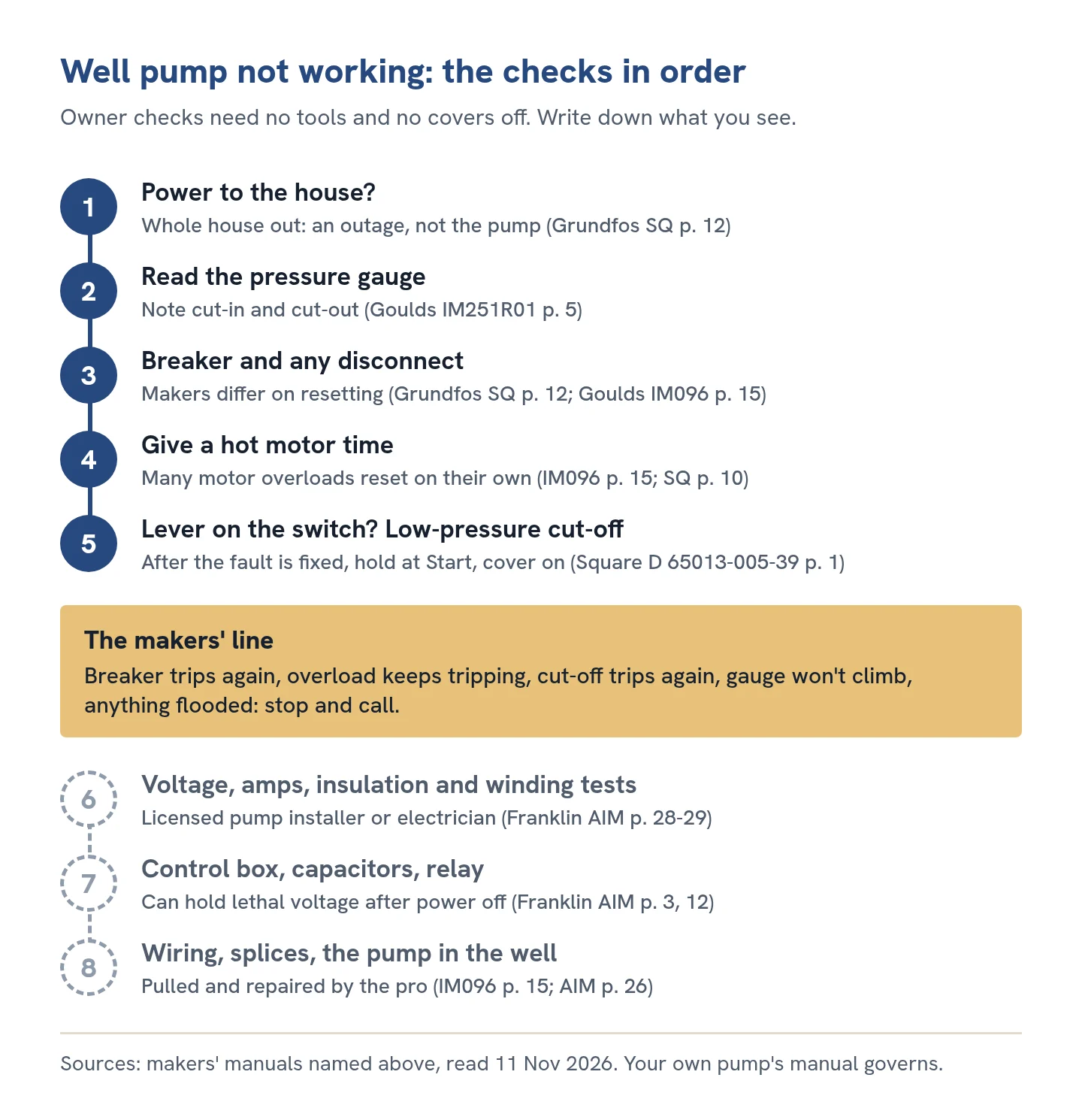
When a well pump won’t run at all, the checks an owner can make come down to five: is there power to the house, what does the pressure gauge read, has the pump’s breaker or disconnect tripped, is a hot motor resting on its own overload, and has a low-pressure switch cut the pump off. Everything after that (the control box, the capacitor, the wiring down the well, the motor) is work the pump makers send to a qualified electrician or licensed pump installer. Their manuals say so in plain words. A breaker that trips again is where you stop.
General information, not professional advice. Your pump and tank makers’ manuals and a licensed well or pump contractor decide what’s safe for your system; your state or county decides what needs a permit or a licence.
This page is part of our guide to no water and pump problems. It covers a pump that does nothing: no hum, no click, no water. For other symptoms, start from the well pump troubleshooting checks. If the pump runs and the taps are still dry, see pump runs but no water pressure. Every owner step below comes from a pump, switch or drive maker’s own manual, named at the step with its document number, revision, page and the date we read it (11 November 2026).
Stop first if any of these apply
- The pump, its control box or its wiring has been under water. EPA’s flood sheet says “DO NOT TURN ON THE PUMP”, and not to turn the equipment on until “the wiring system has been checked by a qualified electrician, well contractor, or pump contractor”; a control box that was submerged must be fully dry before power returns (EPA 816-F-05-021, updated October 2024, read 11 Nov 2026). CDC says the same about wiring after any emergency and adds: “Do not enter the well pit” (CDC, page dated 29 May 2025, read 11 Nov 2026).
- You can see damaged or exposed wiring. EPA’s sheet tells owners to make sure there is no exposed or damaged wiring and, if they notice any damage, to call a professional (same sheet). Franklin Electric’s drive manual says not to use its drive if the power or motor cable is damaged (SubDrive Utility owner’s manual 226115120 Rev. 003, p. 6, read 11 Nov 2026).
- The breaker has already tripped again after one reset. That is the makers’ line, below.
You check, in this order
None of these steps needs a tool, a meter or a cover taken off anything. Write down what you see at each one; it is exactly what an installer will ask for.
1. Is there power to the house?
If the lights are out too, the pump isn’t the problem: it has no supply. Grundfos’s SQ manual lists “No electricity supply” as a cause of a pump that doesn’t run, with the remedy “Contact the electricity provider” (Grundfos SQ/SQE installation and operating instructions, literature 3835175, 2006 edition, p. 12, read 11 Nov 2026). If the pump stays silent once the power is back, our page on restarting a well pump after a power outage goes through it.
Running on a generator? Goulds lists “Power source inadequate for load” for a pump motor that isn’t running, with “Check supply or generator capacity” (Goulds IM096 Rev 14, 4-inch submersible pumps, p. 15, read 11 Nov 2026). Franklin Electric’s application manual says a generator must deliver at least 65% of the motor’s nameplate voltage while the motor starts, that a transfer switch “must be used any time a generator is used as standby or back up on power lines”, and that the generator should be started before the motor is turned on and the motor turned off before the generator is shut down (Franklin Electric AIM Manual, 2026 edition, M1311, printed p. 6, read 11 Nov 2026). Connecting a generator to a pump circuit is an electrician’s job; checking that it is running and big enough for the pump is yours.
2. Read the pressure gauge
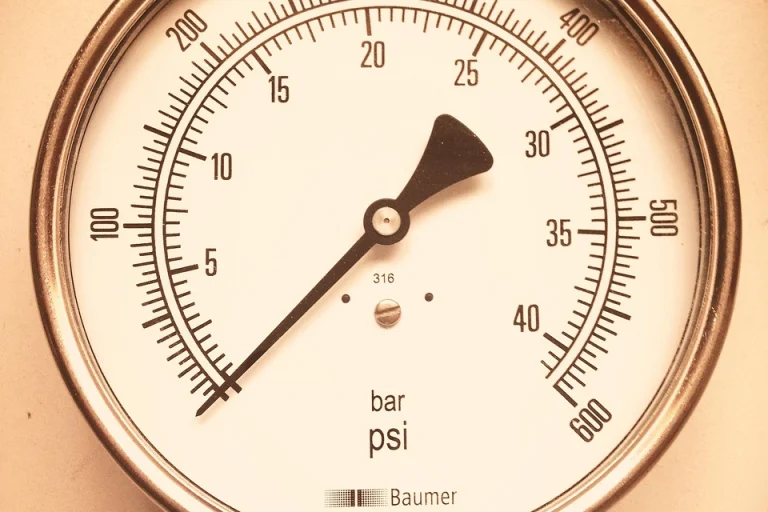
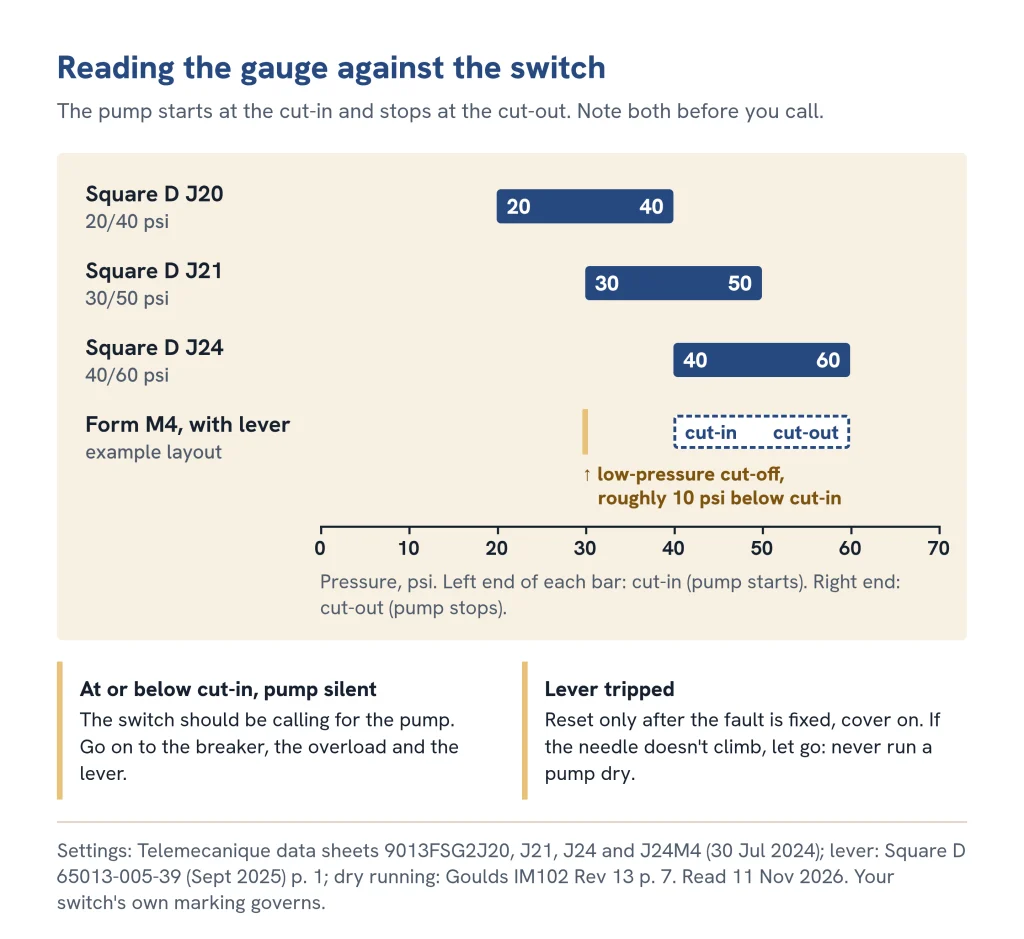
Find the gauge on the pipe near the pressure tank. Goulds’s tank owner’s manual asks owners to watch the system run and note the gauge reading when the pump stops (cut-out) and when it starts (cut-in) before calling a professional (Goulds IM251R01, p. 5, read 11 Nov 2026). The switch’s setting is usually marked on it as two numbers; Square D’s Pumptrol 9013FSG2J20, J21 and J24 switches, for example, are set at 20/40, 30/50 and 40/60 psi (Telemecanique data sheets, 30 Jul 2024, read 11 Nov 2026). What those numbers mean for the tank is in the precharge and switch settings calculator.
- Gauge at or below the cut-in, taps dry, pump silent: the switch should be calling for the pump and nothing is answering. Carry on with steps 3 to 5.
- Gauge well above zero but a tap gives nothing: the pressure is there, so the pump isn’t the first suspect. Note the reading and the tap.
- Needle low or at zero: note it. Low pressure with a silent pump is also what a low-pressure cut-off leaves behind (step 5).
3. Check the breaker, and any disconnect near the tank or well
Look at the breaker (or fuse) for the pump in your main panel, and for any separate disconnect switch near the pressure tank or the well. Franklin warns that “more than one disconnect switch may be required” to cut power to a pump system (AIM M1311, printed p. 3), and Goulds’s installation drawings show a disconnect switch between the supply and the controls (IM096 Rev 14, p. 3), so a pump can have a breaker in the panel and a switch of its own. A constant-pressure controller isn’t one of them: Amtrol’s manual for its Well-X1 says “The pump controller is not a disconnect” (Amtrol 9013-0006, 01/19, p. 2, read 11 Nov 2026).
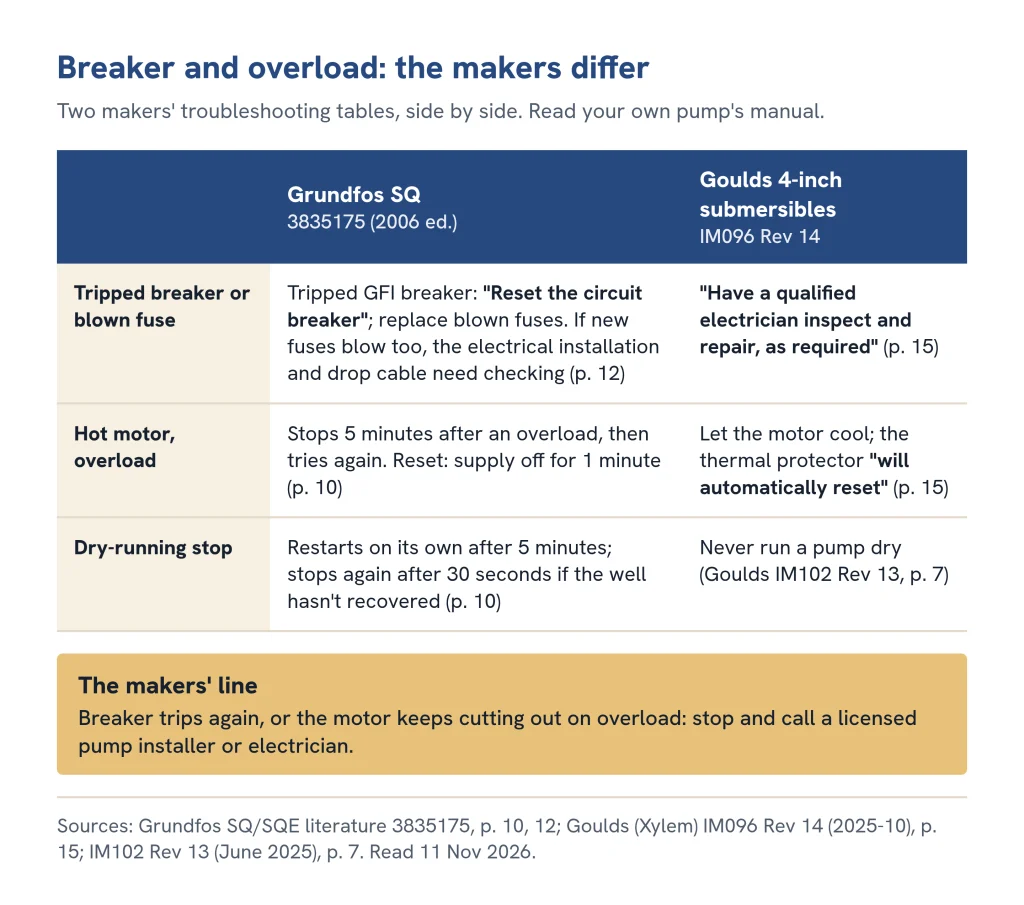
The makers don’t agree on whether resetting is owner work. Grundfos’s SQ troubleshooting table answers a tripped GFI circuit breaker with “Reset the circuit breaker”, and blown fuses with replacing them, adding that if the new fuses blow too, the electrical installation and the drop cable need checking (SQ 3835175, 2006 edition, p. 12). Goulds lists “Open circuit breaker or blown fuse” for a motor that isn’t running and answers it with “Have a qualified electrician inspect and repair, as required” (IM096 Rev 14, p. 15). Read your own pump’s manual. If you reset a breaker, do it once. Franklin’s drive manual warns against handling controls with wet hands or while standing on a wet or damp surface (SubDrive Utility 226115120 Rev. 003, p. 6), and the same care makes sense at a panel. Don’t switch the pump off and on in quick succession either: Franklin notes that restarting a 2-wire motor within about 5 seconds of cutting the power can trip its overload (AIM M1311, printed p. 11).
If it trips again, stop there. A breaker that trips twice is protecting the circuit from something. Grundfos points repeat fuse failures to the electrical installation and the drop cable (p. 12), and the other causes the makers list for a motor that won’t run (wiring, a splice, the control box, the motor, a jammed pump) are past the owner’s line.
4. Give a hot motor time to reset itself
Pump motors carry their own overload protection, and some reset on their own. Goulds’s first cause for a motor that isn’t running is a tripped thermal protector, with the remedy: let the motor cool and the protector “will automatically reset” (IM096 Rev 14, p. 15). Grundfos’s SQ pump stops for 5 minutes after an overload and then tries again; after a dry-running stop it restarts on its own after 5 minutes, and if the well hasn’t recovered it stops again after 30 seconds. Its reset is to switch off the supply for 1 minute (SQ 3835175, 2006 edition, p. 10).
So if the breaker is on and the pump is silent, waiting is a legitimate check. Note how long it was off and whether it started again. The same feature is a reason never to work on a pump that seems dead: Goulds warns that automatic thermal overload protection “may allow an overheated pump to restart unexpectedly”, and its manuals say to disconnect and lock out electrical power before installing or servicing electrical equipment (IM096 Rev 14, p. 1; Goulds IM102 Rev 13, June 2025, p. 2, read 11 Nov 2026). A pump that trips on overload again and again has a cause behind it. Goulds lists the wrong control box, faulty connections, a faulty protector, low voltage and a control box that runs too hot (IM096 Rev 14, p. 15), all of them electrician’s rows.
5. A lever on the pressure switch? Check for a low-pressure cut-off
Some pressure switches have a small lever on the side. On a Square D Form M4 switch, that lever belongs to a low-pressure cut-off: “Low water or loss of system pressure will cause the pump to be cut off” (Square D Pumptrol instruction sheet 65013-005-39, September 2025, p. 1, read 11 Nov 2026), roughly 10 psi below the cut-in (Telemecanique data sheet 9013FSG2J24M4, 30 Jul 2024). The switch did its job: it stopped a pump that wasn’t building pressure.
The sheet’s reset is for after the cause has been dealt with: “After the fault in the system has been corrected”, move the lever to Start and hold it until enough pressure builds to keep the contacts closed (65013-005-39, p. 1). The cover stays on; the same sheet’s danger box says the cover goes back on before power is restored. Watch the gauge while you hold the lever. Square D gives no time limit, but Goulds is blunt: “NEVER RUN A PUMP DRY” (IM102 Rev 13, p. 7). If the needle doesn’t climb, let go, and treat it as a pump that runs but gives no pressure (linked above). If the cut-off trips again soon after a reset, the fault hasn’t been corrected: the sheet names low water and a loss of system pressure as what trips it, and finding which is the installer’s work.
If you have a constant-pressure drive: count the flashes
A constant-pressure system has an electronic drive (a box with indicator lights) instead of a plain switch. Franklin’s SubDrive Utility signals faults by a number of flashes, from an underload (an over-pumped well is one cause it lists) to under- or overvoltage, a locked pump or an open circuit, and it tries to restart itself when a fault clears (SubDrive Utility 226115120 Rev. 003, p. 31-33). Count the flashes and write the number down; it tells the installer where to start. Don’t open the drive: the same manual says “Equipment can start automatically” (p. 5) and that capacitors inside can hold lethal voltage after power is off, so 5 minutes must pass before the cover comes off (p. 6).
Why the pressure switch isn’t an owner fix
A worn switch is a real cause: Franklin’s troubleshooting table lists a damaged pressure switch for a motor that doesn’t start, checked by measuring voltage at the contact points, with “Replace pressure switch or clean points” (AIM M1311, printed p. 26). That table is written for installers (the manual is for “technically qualified personnel”, printed p. 3), and the check is a live-voltage measurement inside the switch. Square D’s sheet opens with a danger box: “Disconnect all power before wiring or servicing”, and the cover goes back on before power is restored (65013-005-39, p. 1). Its footer says its products “should be installed, operated and maintained only by qualified personnel” (p. 2).
So tapping the switch, prying its contacts or cleaning them with the cover off are not on this page. Pages elsewhere online show them, but no maker we read gives them to owners. Changing a switch’s cut-in and cut-out settings is a different job, done with the power off. A failed switch is replaced, and that is a job for a licensed pump installer or electrician, not a step on this page.
The makers’ line
Past the five checks above, every maker we read hands the work to a qualified person.
- Goulds: “All electrical work must be performed by a qualified technician” (IM096 Rev 14, p. 1). Its rows for a motor that won’t run, from incorrect or faulty connections and low voltage to damaged cable insulation and a faulty splice, all say “Have a qualified electrician inspect and repair” (p. 15).
- Franklin Electric: the equipment “should be installed and serviced by technically qualified personnel”; “More than one disconnect switch may be required”; “Some controls can hold lethal voltage after power has been disconnected. Allow 5 minutes” before covers come off (AIM M1311, printed p. 3).
- Grundfos: the electrical connection “should be carried out by an authorized electrician in accordance with local regulations” (SQ 3835175, 2006 edition, p. 6).
- Square D: switches “installed, operated and maintained only by qualified personnel” (65013-005-39, p. 2).
Stop and call when: the breaker trips again; the motor keeps cutting out on overload; the low-pressure cut-off trips again after a reset; the gauge doesn’t climb while you hold the lever; anything was under water; or you’d need to open the control box, the switch, the drive or the well cap to go further. That is the point to call a licensed pump installer, a well contractor or an electrician. Wiring at 115 or 230 volts, control boxes, capacitors and motors are theirs.
The pro, explained
Knowing what the installer does helps you follow the visit and read the invoice. These are the tests and checks the makers describe for their own installers.
Tests from the surface, before anything is pulled
Franklin lists four tests to finish before a motor comes out of the well: line-to-line voltage (within 10% of the nameplate), amps on every motor wire, insulation resistance from each lead to ground, and winding resistance (AIM M1311, printed p. 28). The resistance tests are done with the master breaker open and the leads disconnected. Insulation resistance is measured with a megohmmeter (a “megger”), and Franklin’s table reads anything under 0.5 megohms on a motor in the well as insulation damage to locate and repair (printed p. 28). Winding resistance is compared with the motor’s specification to find a shorted or open winding, a bad cable joint, or leads that have been mixed up (printed p. 29). Not every maker allows the same tests: Grundfos’s SQ manual says insulation-resistance and high-voltage test instruments “are not allowed” during troubleshooting on that pump (SQ 3835175, 2006 edition, p. 13). That is one reason the installer works from your pump’s own manual.
The control box, if your pump has one
Single-phase submersibles come in two kinds. Franklin describes a 2-wire motor’s starting switch as part of the motor’s own solid-state controls (AIM M1311, printed p. 11). A 3-wire motor needs a control box holding its starting capacitor and starting relay, and in some sizes overload protectors, run capacitors and contactors. Franklin calls the box and motor “two pieces of one assembly”: their horsepower and voltage must match, and running a 3-wire motor without the right box can ruin the motor and void the warranty (printed p. 12). The installer tests the box’s parts and repairs or replaces it (printed p. 26). Because the capacitors can keep a lethal charge after the power is off (printed p. 3), this is not a box to open to “have a look”.
Wiring, splices and the pump itself
Other causes on the makers’ lists sit down the well: damaged cable insulation, a faulty splice, a damaged motor (IM096 Rev 14, p. 15; AIM M1311, printed p. 26). A pump jammed by sand draws 3 to 6 times its normal amps until the overload trips, and the fix is to pull the pump and correct the problem (AIM M1311, printed p. 26). Goulds’s answer to a pump bound by foreign matter is likewise to pull it, clean it and adjust the depth it is set at (IM096 Rev 14, p. 15). Pulling a pump means lifting the pump, its pipe and its cable out through the top of the casing, which is the installer’s work. Whether your state lets an owner do pump work is a separate question, covered in can I replace my own well pump?. Electrical work falls under your state’s and county’s electrical rules, which an electrician applies.
After any repair that opens the well
EPA tells well owners to test the water immediately if “You replace or repair any part of your well system” (EPA, Protect Your Home’s Water, updated 26 Feb 2026, read 11 Nov 2026). Test after a repair or a flood: your state or county health department can point you to a certified lab.
Check the warranty before anyone pulls the pump
If the pump is fairly new, find the installation date before work starts, because the terms are strict. Goulds covers standard 4-inch submersibles for 36 months from installation or 42 months from manufacture, whichever is shorter; it needs written notice within 10 days of a defect first showing, doesn’t pay for removal or reinstallation, and has no warranty obligation for products repaired by third parties or without its written approval (IM096 Rev 14, p. 15). Grundfos’s SQ manual gives 24 months from installation, no more than 30 months from manufacture (SQ 3835175, 2006 edition, p. 2). Franklin’s standard terms are 1 year from installation and no more than 2 years from manufacture, and a Franklin product bought other than from a distributor or from Franklin must be installed by a Franklin Certified Installer for that warranty to apply (Franklin Electric M1571 08-19 standard terms, section C, read 11 Nov 2026). Your installer’s paperwork, the pump’s manual or the label on the control box usually names the maker.
Your next step
Write this down before you call:
- When the water stopped, and what happened just before (a storm, a power cut, a flood, heavy watering, a pool fill).
- The gauge reading now, and the cut-in and cut-out numbers on the switch.
- Whether the breaker had tripped, whether you reset it, and whether it tripped again.
- Whether the pump started on its own after a rest, and after how long.
- Whether the switch has a lever, and what happened when you held it at Start.
- On a drive: the number of fault-light flashes.
- The labels on the pump’s control box or drive, and the tank; the well log and the pump’s installation date if you have them.
Ask the installer: what they measured (voltage, amps, insulation and winding resistance) and the readings; whether the fault is above ground (switch, box, wiring) or in the well; whether the pump is still under warranty; and for a written quote line by line before a pump is pulled.
What can’t wait: a breaker that trips again, anything that has been under water, damaged wiring, and an open or damaged well cap. Leave those switched off and call.
Sources checked on 11 November 2026: Goulds (Xylem) IM096 Rev 14 (2025-10), IM102 Rev 13 (June 2025) and IM251R01; Franklin Electric AIM Manual 60 Hz, 2026 edition (M1311), SubDrive Utility owner’s manual 226115120 Rev. 003 (10/20) and standard terms M1571 (08-19); Grundfos SQ/SQE instructions, literature 3835175 (2006 edition, the newest found on the maker’s site); Square D (Telemecanique) instruction sheet 65013-005-39 (September 2025) and data sheets 9013FSG2J20, J21, J24 and J24M4 (30 Jul 2024); Amtrol 9013-0006 (01/19); EPA 816-F-05-021 and EPA’s Protect Your Home’s Water page; CDC’s well disinfection after an emergency page. Page numbers are the printed numbers where a manual prints them. See something out of date? Tell us through our corrections page.
Sources
- Goulds (Xylem) IM096 Rev 14 (2025-10), 4-inch submersible pumps instruction manual, p. 1-3, 15 (read 11 Nov 2026)
- Goulds (Xylem) IM102 Revision 13 (June 2025), jet pumps instruction manual, p. 2, 7, 12 (read 11 Nov 2026)
- Goulds IM251R01, water system tank owner's manual, p. 5 (read 11 Nov 2026)
- Franklin Electric AIM Manual 60 Hz, 2026 edition (M1311), printed p. 3, 6, 11, 12, 26, 28-29 (read 11 Nov 2026)
- Franklin Electric SubDrive Utility owner's manual 226115120 Rev. 003 (10/20), p. 5-6, 31-33 (read 11 Nov 2026)
- Franklin Electric M1571 (08-19) standard terms and conditions, section C standard limited warranty (read 11 Nov 2026)
- Grundfos SQ/SQE installation and operating instructions, literature 3835175 (2006 edition), p. 2, 6, 10, 12-13 (read 11 Nov 2026)
- Square D (Telemecanique) Pumptrol instruction sheet 65013-005-39 (September 2025), p. 1-2 (read 11 Nov 2026)
- Telemecanique product data sheet 9013FSG2J24M4 (30 Jul 2024) (read 11 Nov 2026)
- Telemecanique product data sheet 9013FSG2J21 (30 Jul 2024) (read 11 Nov 2026)
- Telemecanique product data sheet 9013FSG2J20 (30 Jul 2024) (read 11 Nov 2026)
- Telemecanique product data sheet 9013FSG2J24 (30 Jul 2024) (read 11 Nov 2026)
- Amtrol Well-X1 installation and operating instructions 9013-0006 (01/19), p. 2 (read 11 Nov 2026)
- EPA 816-F-05-021, What to do after the flood (updated October 2024) (read 11 Nov 2026)
- EPA, Protect Your Home's Water (updated 26 Feb 2026; read 11 Nov 2026)
- CDC, How to disinfect wells after an emergency (page dated 29 May 2025; read 11 Nov 2026)