When the water from a private well stops all at once, the cause is usually on the power and control side: a tripped breaker, a pressure switch that has cut out, a pump that has shut itself off, or a fault in the wiring or the pump. Less often, the water in the well has dropped below the pump. You can narrow it down in a few minutes with checks that are mostly looking, not repairing: whether it’s every tap, the breaker, the pressure gauge, and, on some systems, a lever or a fault light. Past those checks, the makers hand the job to a licensed pump installer or electrician. This page, part of our No Water and Pump Problems guides, gives the checks in order, each with the maker’s or agency’s document behind it.
General information, not professional advice. Your pump and tank makers’ manuals and a licensed well or pump contractor decide what’s safe for your system; your state or county decides what needs a permit or a licence.
Before you touch anything
- Flooded? Stop here. If water has reached the well, the pump, the pressure switch or a control box, don’t switch anything on. EPA’s flood fact sheet says in capitals “DO NOT TURN ON THE PUMP” and asks for the wiring to be checked first by “a qualified electrician, well contractor, or pump contractor” (EPA 816-F-05-021, read 11 Nov 2026).
- Power off before you touch a switch, a tank drain or a pump housing. Square D’s pressure switch sheet: “Disconnect all power before wiring or servicing” (65013-005-39, Sept 2025, p. 1). Franklin Electric adds that more than one disconnect may be needed, and that some controls hold a lethal voltage after the power is off: wait 5 minutes before a cover comes off (AIM Manual M1311 06-26, PDF p. 5, printed p. 3). Those covers are for qualified people anyway (below).
- A silent pump can still start. Goulds warns that many pumps have a thermal overload that can let an overheated pump restart unexpectedly (IM096 Rev 14, p. 1).
First: every tap, or one?
This first question is ours, not a maker’s, and it needs nothing but a walk round the house. Open a cold tap in the kitchen, in a bathroom and, if you have one, an outside tap.
- One tap or one fixture dry, the rest fine: the well is delivering. The problem sits at that fixture or the pipe to it, and that’s plumbing, not the well.
- Every tap dry or sputtering: carry on below. Note whether the taps gave nothing at all, or spat air first. Air and sputtering before the flow stopped is worth telling the installer: the National Ground Water Association (NGWA, a well industry association) compares a well whose water has dropped below the pump to a straw left above the water in a glass, which ends up “sucking air” (wellowner.org, Drought, read 11 Nov 2026).
The checks in order
You check
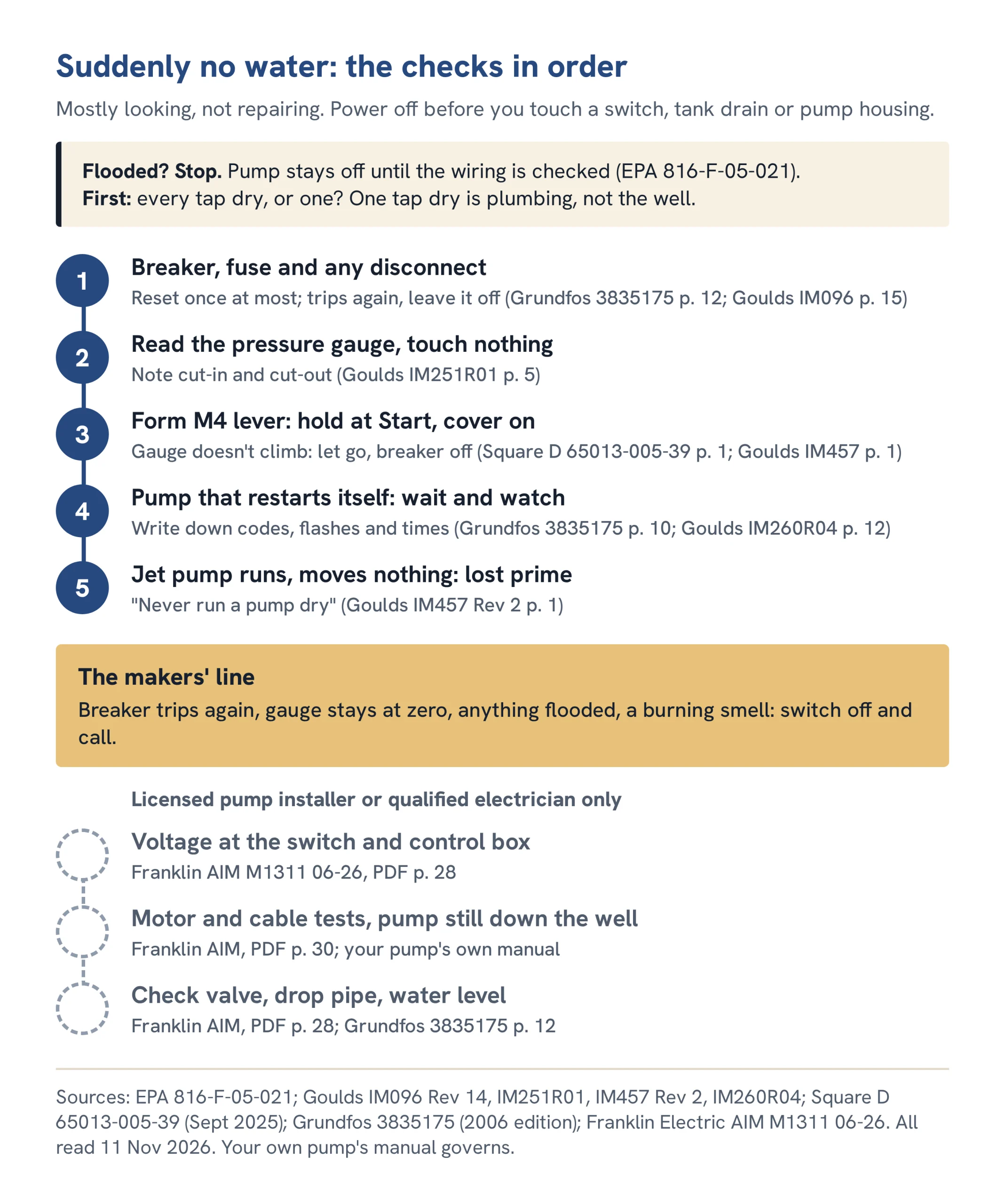
- The pump’s breaker or fuse, and any disconnect switch. Look at the panel for the breaker marked for the well or pump. Goulds’ wiring diagrams show the supply running from the fuse box or breaker through a separate disconnect switch to the pressure switch (IM096 Rev 14, p. 14), so look for a switch near the tank too and see that it’s on. Grundfos’ troubleshooting table for its SQ pumps answers a tripped (GFI) breaker with “Reset the circuit breaker” and a blown fuse with a new one; if the new fuse blows too, the electrical installation and the cable down the well need checking (Grundfos SQ/SQE manual, literature 3835175, 2006 edition, p. 12). Goulds’ table for its 4-inch submersibles lists an open breaker or blown fuse with one action: “Have a qualified electrician inspect and repair, as required” (IM096 Rev 14, p. 15). Putting the two together, our reading is: reset once at most. If it trips again, leave it off and call a licensed pump installer or electrician. Don’t flick the power off and straight back on: Franklin says restarting a 2-wire motor within about 5 seconds of power-off may trip its overload (AIM M1311 06-26, PDF p. 13, printed p. 11).
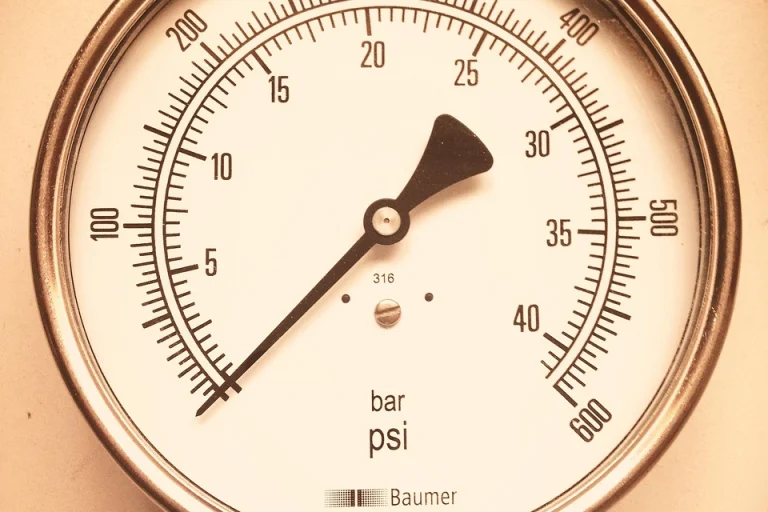
- Read the pressure gauge, without touching anything. The gauge sits on or near the pressure tank. Goulds’ tank owner’s manual asks owners to watch how the system runs and to note the gauge where the pump starts (the cut-in) and stops (the cut-out) before they call their dealer (IM251R01, p. 5). Square D sells Pumptrol switches set at 20/40, 30/50 and 40/60 psi (Square D product data for 9013FSG2J20, 9013FSG2J21 and 9013FSG2J24M4, read 11 Nov 2026). The same Goulds page notes that the real setting can differ from what the cover says, so your own past readings beat the label. What the reading points to is in the table below.
- A switch with a lever on the side: Square D Form M4. Some pressure switches have a low-pressure cut-off with an outside lever marked for Auto, Start and Off. Square D’s sheet says that on the Form M4, low water or a loss of system pressure cuts the pump off, and that “after the fault in the system has been corrected”, you move the lever to Start and hold it until the pressure builds enough to keep the contacts closed (65013-005-39, Sept 2025, p. 1). Its datasheet puts the cut-off at roughly 10 psi below the cut-in (9013FSG2J24M4, 30 Jul 2024). Hold the lever only; the cover stays on, and nothing inside it is touched with the power on. Watch the gauge while you hold it. If it doesn’t climb, let go and switch the pump’s breaker off: the pump isn’t moving water, and running a pump without water is what the makers warn against (“Never run a pump dry”, Goulds IM457 Rev 2, p. 1). Remember why the lever tripped: low water or lost pressure, such as a burst pipe. If that cause is still there, the lever will trip again, and if you can’t tell what the cause was, finding it is the installer’s job, not the lever’s.
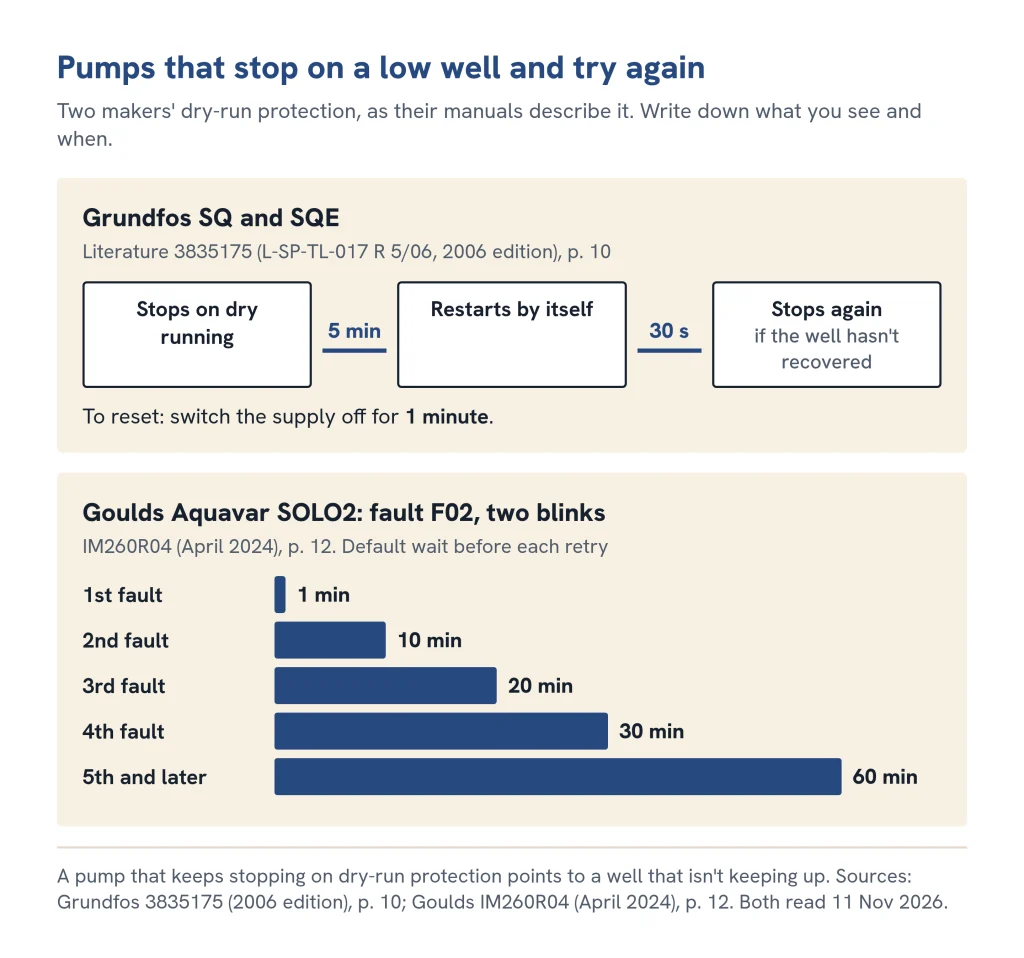
- A pump that restarts itself: wait and watch. Some submersibles and drives stop themselves when the well runs low and try again later. Grundfos’ SQ and SQE pumps stop on dry running, restart automatically after 5 minutes, and stop again after 30 seconds if the well hasn’t recovered; to reset one, switch the supply off for 1 minute (3835175, 2006 edition, p. 10). Constant-pressure controllers flash a code. On Franklin’s SubDrive Utility, one flash is “Motor Underload”, and the first cause listed is an over-pumped well (226115120 Rev 003, p. 32). On Goulds’ Aquavar SOLO2, a dry well fault is F02, two blinks, and by default the controller retries after 1, 10, 20, 30 and then 60 minutes (IM260R04, April 2024, p. 12). Write down the code, the flashes and the times. A pump that keeps stopping on its dry-run protection is telling you the well isn’t keeping up: see the section on the well running low below.
- A jet pump above ground that runs but moves nothing may have lost its prime. Shallow-well jet pumps sit beside the tank and pull water up a suction pipe. Goulds prints the priming steps (IM457 Rev 2, p. 1; IM102 Rev 13, p. 6), with power locked out first before any maintenance (IM457 Rev 2, p. 1), and they are on our jet pump priming page. Goulds is plain about the limit: “NEVER RUN A PUMP DRY” (IM102 Rev 13, p. 7).
What the gauge tells you
| Gauge, with every tap dry | What it points to | Next |
|---|---|---|
| Normal, between your cut-in and cut-out | There’s pressure in the tank. The water stops somewhere between the tank and the taps: a closed valve, a frozen pipe, or something fitted in the house line | A plumbing check inside the house, not the well |
| Below your cut-in, pump silent | The pump should be running and isn’t: no power, a switch that hasn’t closed, a Form M4 that has cut out, a motor protector that has tripped, a control box or wiring fault | Steps 1 to 4. Goulds: a tripped motor protector resets by itself once the motor cools (IM096 Rev 14, p. 15). Past that, the pro |
| At or near zero and not rising | Either the pump isn’t running, or it runs and delivers nothing: water below the pump, a lost prime on a jet pump, a stuck check valve or a broken pipe | If steps 1 to 5 don’t bring the pressure up, turn the pump’s breaker off and call. Grundfos: when the flow suddenly falls because the pump is drawing more than the well yields, the pump must be stopped at once (3835175, p. 10) |
| Swings fast, pump clicking on and off | A cycling problem rather than no water. For a motor that starts too often, Franklin’s table lists the pressure switch, a check valve stuck open, a waterlogged tank or a leak (AIM M1311 06-26, PDF p. 28) | The short cycling section of the troubleshooting guide linked at the end of this page |
If the pump runs and the gauge climbs but stays low, that’s a different problem with its own page: pump runs but no water pressure. If the water stopped with a power cut, start with restarting a well pump after an outage.
The makers’ line
This is where the owner’s checks end. Every maker we read puts the rest with qualified people:
- Any electrical work. Goulds: “All electrical work must be performed by a qualified technician” (IM096 Rev 14, p. 1). Franklin: its equipment “should be installed and serviced by technically qualified personnel” (AIM M1311 06-26, PDF p. 5, printed p. 3). Grundfos: the electrical connection by “an authorized electrician” (3835175, p. 6). Square D: its switches should be “installed, operated and maintained only by qualified personnel” (65013-005-39, p. 2). Pump circuits run at 115 or 230 volts (Goulds IM102 Rev 13, p. 4; Grundfos 3835175, p. 6), so opening a switch cover, a control box or a disconnect, testing with a meter or changing wiring is work for a qualified electrician or licensed pump installer.
- A breaker or fuse that goes again. Goulds: a qualified electrician (IM096 Rev 14, p. 15).
- The control box and its capacitors. Franklin warns some controls hold a lethal voltage after the power is off and asks for 5 minutes before a cover comes off (AIM, PDF p. 5). That warning is written for the people who open them.
- The pump itself. The rows in Goulds’ troubleshooting table that say “Pull pump” (IM096 Rev 14, p. 15) mean lifting the pump, its pipe and its cable out of the well: an installer’s job, with the rig to do it.
- A flooded system. Nothing goes back on until a qualified electrician, well contractor or pump contractor has checked the wiring (EPA 816-F-05-021; CDC, below).
You may see this elsewhere: “tap the pressure switch to get the pump going.” We checked it against the switch maker’s own sheet, and it isn’t there. Square D’s sheet covers wiring, a replacement contact kit, turning the range and differential nuts to set the pressures and, on the Form M4, holding the lever at Start after the fault is fixed; nothing about tapping or knocking the switch. It carries a DANGER box, “Disconnect all power before wiring or servicing”, asks for the cover to be fitted before the power goes back on, and leaves its switches to qualified personnel (65013-005-39, Sept 2025, p. 1-2). Franklin’s troubleshooting table treats damaged switch contacts as a fault to clean or replace (AIM M1311 06-26, PDF p. 28), and replacing a switch is installer work. Read 11 November 2026.
The pro: what an installer tests
A licensed pump installer, well contractor or electrician will try to find the fault from the surface before pulling anything out of the well. Knowing their checks helps you follow the visit and the quote. None of this is a set of steps for owners.
- Power at the switch and the control box. Franklin’s system troubleshooting table starts “motor does not start” with the voltage at the line terminals, fuses and breakers, and the pressure switch contacts, where poor contact can leave less than full voltage reaching the pump (AIM M1311 06-26, PDF p. 28, printed p. 26).
- Tests on the motor and cable while the pump is still down the well. Before a motor is pulled, Franklin’s manual has the installer check line voltage, the current on every motor wire, the insulation resistance to ground and the resistance of the windings; for the insulation test, with a megohmmeter, the master breaker is opened and the leads disconnected first (AIM, PDF p. 30, printed p. 28). Grundfos doesn’t allow insulation, resistance or high-voltage testers when troubleshooting its SQ pumps (3835175, 2006 edition, section 14.1, p. 13), so a good installer works from your pump’s own manual. Ask what they measured and what the readings were.
- The control box, on a 3-wire pump. Franklin’s single-phase 3-wire motors need a control box with starting capacitors and a starting relay; box and motor must match, and a wrong box can lead to motor failure and voids the warranty (AIM, PDF p. 14, printed p. 12). Its 2-wire motors start through a solid-state switch described with the motor instead (AIM, PDF p. 13). More on the box on our well pump control box page.
- The check valve and the pipe. A check valve stuck shut gives a pump that runs and delivers nothing; Franklin and Grundfos both list it, and Grundfos’ fix is to pull the pump and clean or replace the valve (AIM, PDF p. 28; 3835175, p. 12). For a motor that runs continuously, Franklin’s table also names a leak in the system, a loose coupling or broken motor shaft, and a worn pump, whose signs it compares to a leaking drop pipe (AIM, PDF p. 28).
- The water level. Franklin’s table includes “low water level in well”: the pump may be drawing more than the well yields, so the installer shuts it off, lets the well recover and checks the static level (where the water stands with the pump off) and the drawdown (how far it falls while pumping) from the well head (AIM, PDF p. 28). Penn State Extension describes the usual tool, a water level meter: a probe on a measuring tape lowered until it signals water (Managing Your Well During Drought, updated 2 Jun 2025).
If the answer is a new pump or a deeper well, the installer’s written quote should name each part and each hour of work, so you can hold it against what they tested.
When the well itself has run low
USGS defines it plainly: “A well is said to have gone dry when water levels drop below a pump intake” (Drought and Groundwater Levels, page dated 17 Sep 2026, read 11 Nov 2026). As NGWA’s straw comparison puts it, the water may still be there, just below the pump. Whether a well is at risk depends on its depth and the aquifer: USGS says wells in unconfined, water-table aquifers feel a lack of rain more directly, and a deep well in a confined aquifer with little pumping nearby is less likely to go dry.

- Season matters. In a typical Pennsylvania well, Penn State Extension shows groundwater highest in March and April and lowest in late September or October, so most well problems show up in late summer and early fall. Shallow hand-dug wells are often the first to dry up; deeper wells may be slower to feel a drought and slower to recover from one (Managing Your Well During Drought, updated 2 Jun 2025). Other regions follow their own pattern.
- It can be temporary. Penn State notes the level may drop below the pump only while water is pumped often, such as during showers or laundry, and that cutting water use to essentials can keep the well going.
- One rain won’t fix it. NGWA says a well won’t recover after a single rainfall: it takes several slow, soaking rains, and deeper aquifers can take months to respond (wellowner.org, Drought, association guidance, read 11 Nov 2026).
- Neighbours are a clue. NGWA suggests asking whether the drought is worse than usual, whether it happened in past droughts and whether nearby wells are affected, to tell a falling water table from a failing well.
How you find out. Penn State says finding the water level directly is difficult and usually takes a water level meter; in practice that’s a contractor’s visit (the last item in the list above). It also points owners to USGS county drought indicators, including groundwater, as a less direct sign. Your well’s own driller’s log (the record of depth, casing and water levels when it was drilled) helps the contractor too, so dig it out if you have it. When the water is back, our flow rate calculator turns a timed bucket into gallons per minute, which measures what the pump delivers at that tap, not the well’s yield.
What can be done, explained, with no verdict. Penn State lists lowering the pump in the existing well, usually a short-term answer, then deepening the well or drilling a new one, and warns that deepening may not raise the yield. NGWA adds redeveloping the well and hydrofracturing, which uses water under high pressure to open fractures in the rock, and says deepening is never a guarantee of more water. Which, if any, fits your well is for a licensed well contractor who knows the local geology. Deepening is construction work: EPA advises hiring a certified driller for any well construction or modification (Protect Your Home’s Water, updated 26 Feb 2026), and some states need a permit for it. Ohio counts “deepening a well” as an alteration (OAC 3701-28-01(A)(5)) that needs a board of health permit before work starts (3701-28-03(A)); in an emergency, as the rule defines it (the system fails to produce enough drinkable water, an immediate threat to health and safety, with no other source), a registered contractor may start before the permit is issued, telling the board of health the next business day and applying for the permit within three business days, with no approval guaranteed (3701-28-03(J), which sets further conditions and limits); Virginia, for work after 6 Nov 2024, needs a written construction permit from the state health commissioner to “increase the depth of a private well” (12VAC5-630-220(B)); both read 11 Nov 2026. Elsewhere, ask your state or county health department, and see our well permit guide.
After the repair: test the water
Most fixes for no water open the well: a pump pulled, a pipe or check valve replaced, a well deepened. EPA says to test your water right away if “You replace or repair any part of your well system” (EPA, Protect Your Home’s Water, read 11 Nov 2026). Your state or county health department or the state lab tells you how. After a flood or other emergency, CDC says work on a well “should be done by a well or pump contractor”, the power to the well area goes off before debris is cleared, and “Do not enter the well pit. Gases and vapors can build up in well pits” (CDC, page dated 29 May 2025). EPA’s flood page (updated 18 Jun 2026) covers what follows.
What to write down, and what can’t wait
Before you call, note:
- When the water stopped, and what came before it: a storm, a power cut, heavy use, sputtering taps, a noise.
- The gauge reading now, and your usual cut-in and cut-out if you know them.
- The breaker: on, tripped once, or tripped again after a reset.
- Any lever position, flashing code or fault number, with the times you saw it.
- The labels on the pump controls, pressure switch and tank (a phone photo is fine), the pump’s age if you know it, and the well log if you have it.
- Whether neighbours on wells have had trouble.
Ask the installer what they tested and what the readings were (voltage, amps, insulation and winding resistance), whether they measured the water level, whether the check valve was looked at, and for a written quote line by line before any pump comes out.
Don’t wait if the breaker trips again, the system has been flooded, you smell burning near the controls, a pump runs with the gauge at zero (switch it off at the breaker), or the well cap or casing is open or damaged: keep people, and especially children, away from an open well, and never climb into a well pit. For a symptom that isn’t “no water”, start from our troubleshooting guide.
Sources
- Goulds Water Technology (Xylem): IM096 Rev 14 (2025-10), 4-inch submersible pumps, p. 1, 14-15; IM251R01, water system tank owner’s manual, p. 5; IM457 Rev 2 (2025-07), jet pump quick guide, p. 1; IM102 Rev 13 (June 2025), jet pumps, p. 4, 6-7; Aquavar SOLO2 IM260R04 (April 2024), p. 12.
- Franklin Electric: AIM Manual 60 Hz, M1311 06-26, PDF p. 5, 13-14, 28, 30; SubDrive Utility owner’s manual 226115120 Rev 003 (10/20), p. 32.
- Grundfos: SQ/SQE installation and operating instructions, L-SP-TL-017 R 5/06 (literature 3835175, 2006 edition), p. 6, 10, 12-13.
- Square D / Telemecanique Sensors: Pumptrol instruction sheet 65013-005-39 (September 2025), p. 1-2; datasheet 9013FSG2J24M4 (30 Jul 2024); datasheet 9013FSG2J21 (30 Jul 2024); product page 9013FSG2J20.
- EPA: What to Do After the Flood, EPA 816-F-05-021 (listed by EPA as updated October 2024); Protect Your Home’s Water (updated 26 Feb 2026).
- CDC: wells after an emergency (29 May 2025).
- USGS: Drought and Groundwater Levels (17 Sep 2026).
- Penn State Extension: Managing Your Well During Drought (updated 2 Jun 2025).
- National Ground Water Association, association guidance: wellowner.org, Drought.
- Ohio Adm. Code 3701-28-01 and 3701-28-03 (both effective 1 Jan 2020); Virginia 12VAC5-630-220.
Sources checked on 11 November 2026. Makers’ manuals describe their own products; your pump, switch and controller’s own documents decide for your system.
Sources
- Goulds IM096 Rev 14 (2025-10), 4-inch submersible pumps installation, operation and troubleshooting (p. 1, 14-15)
- Goulds IM251R01, water system tank owner's manual (p. 5)
- Goulds IM457 Rev 2 (2025-07), jet pump quick guide (p. 1)
- Goulds IM102 Rev 13 (June 2025), jet pumps (p. 4, 6-7)
- Goulds Aquavar SOLO2 IM260R04 (April 2024), dry well settings (p. 12)
- Franklin Electric AIM Manual 60 Hz, M1311 06-26 (PDF p. 5, 13-14, 28, 30)
- Franklin Electric SubDrive Utility owner's manual 226115120 Rev 003 (10/20), fault codes (p. 32)
- Grundfos SQ/SQE installation and operating instructions L-SP-TL-017 R 5/06, literature 3835175, 2006 edition (p. 6, 10, 12-13)
- Square D / Telemecanique Pumptrol instruction sheet 65013-005-39 (September 2025)
- Square D datasheet 9013FSG2J24M4, Form M4 low-pressure cut-off, 40-60 psi (30 Jul 2024)
- Square D datasheet 9013FSG2J21, 30-50 psi (30 Jul 2024)
- Telemecanique / Square D product page 9013FSG2J20, 20-40 psi
- EPA 816-F-05-021, What to Do After the Flood
- EPA: Protect Your Home's Water (updated 26 Feb 2026)
- EPA: What to do with your private well after a flood
- CDC: disinfecting wells after an emergency (29 May 2025)
- USGS Water Science School: Drought and Groundwater Levels (17 Sep 2026)
- Penn State Extension: Managing Your Well During Drought (updated 2 Jun 2025)
- NGWA wellowner.org: Drought (association guidance)
- Ohio Adm. Code 3701-28-01, definition of alteration (deepening a well)
- Ohio Adm. Code 3701-28-03, permits
- Virginia 12VAC5-630-220, permits (increase the depth of a private well)