A new well is a hole whose depth nobody knows until it is drilled, papers your state or county wants before and after, and a price a driller sets mostly by the foot. There is no national permit, setback or price. The guides below take the steps in order: the kind of well, its depth, the paperwork, the quote and the finished well, each rule with its section and each figure with its source and date.
General information, not professional advice. Your pump and tank makers’ manuals and a licensed well or pump contractor decide what’s safe for your system; your state or county decides what needs a permit or a licence.
Keep every well cover on and never climb into a well or a well pit. Old dug wells are usually 3 to 5 feet wide and a fall hazard (NGWA, Old, Unused Wells, association guidance), and CDC warns that “Gases and vapors can build up in well pits” (CDC; both read 11 November 2026).
Start with the kind of well
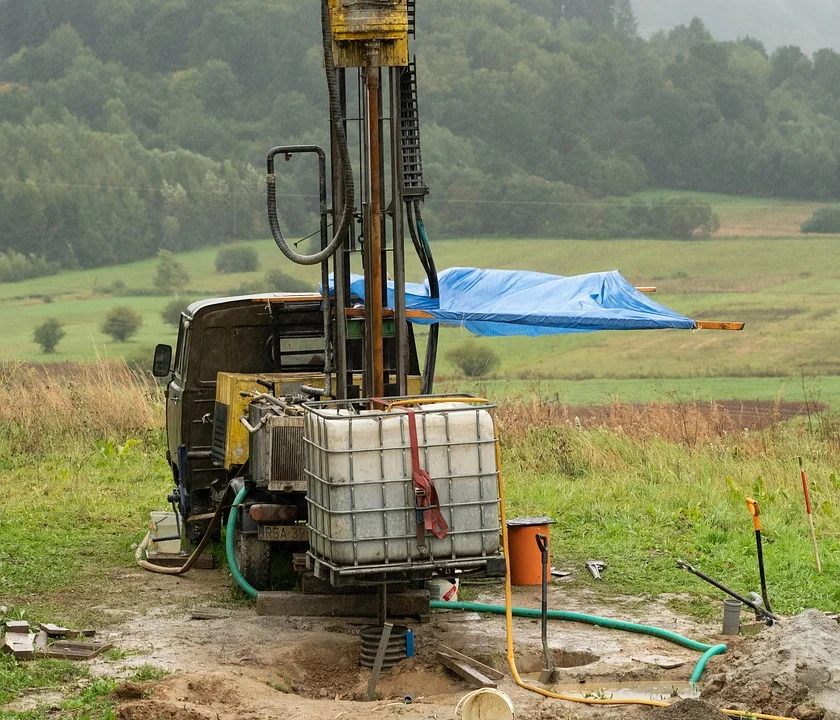
EPA sorts private wells into three types: dug or bored wells, wide and about 10 to 30 feet deep; driven wells, a narrow pipe with a screened point hammered into sand or gravel, about 30 to 50 feet; and drilled wells, made by a rotary or percussion rig and lined with casing, which “can be thousands of feet deep” (EPA, Learn About Private Water Wells, updated 14 September 2026, read 11 November 2026). EPA credits drilled wells with a lower risk of contamination “due to their depth and use of continuous casing”.
The type sets which pumps fit, how the well copes with drought or flood, and sometimes the loan: HUD’s handbook says a property served by “sand-point wells” is “not eligible for FHA mortgage insurance” (HUD Handbook 4000.1, issued 12 August 2026, p. 188, read 11 November 2026). Our comparison of drilled, driven and dug wells sets the three side by side, shows how to tell which one you have without opening anything, and gives the state rules on well types we have read.
How deep your well will go
In a USGS study of well records from the lower 48 states, the median domestic well was 142 feet deep, but depths varied “by an order of magnitude by lithology”, the rock and sediment underneath (USGS Scientific Investigations Report 2021-5069, read 11 November 2026). Your neighbours’ well records are a far better guide to your lot, and many states put them online.
“Depth” can mean four numbers on a record: the total depth of the hole, the static water level when nothing is pumping, the pumping level while the pump runs, and the pump setting, where the pump hangs. Each pump maker sets its own limits for the setting, and setting or resetting a pump means pulling it on its pipe and cable, which is installer work; Goulds says “All electrical work must be performed by a qualified technician” (IM096 Rev 14, p. 1, read 11 November 2026). Our guide to how deep a well is explains each number, the makers’ setting rules side by side, and the state well-record databases we have opened.
Permits, setbacks and the driller’s log
EPA notes that water from private wells is “not regulated by the Federal Government under the Safe Drinking Water Act nor by most state governments and laws” (EPA, Private Drinking Water Wells, updated 2 November 2026, read 11 November 2026). Building a well is another matter, and three papers come up again and again:
- A permit or notice before drilling. North Carolina requires a construction permit from the local health department (G.S. 87-97(b)); Washington wants a notice of intent at least 72 hours ahead, with a $200 fee for a well with top casing under 12 inches (WAC 173-160-151).
- Setbacks while siting. CDC advises placing a well at least 50 feet from septic tanks and leach fields (CDC, About Private Well Water, read 11 November 2026): guidance, not law. State rules run from 25 feet to a septic tank for a Wisconsin well built after 1 July 2020 (NR 812.08, as DNR PUB-DG-102 reproduces it) to 100 feet to a drain field in New York, Pennsylvania and Washington, and more in some cases: Vermont’s 2019 rules set leach-field isolation zones of up to 500 feet, depending on slope and the kind of well (Table 11-2).
- The driller’s log after completion. Depth, casing, grout, water levels and the yield test. In the states we read that set a deadline, it is due within 30 days (Washington, WAC 173-160-141) to 90 days (Vermont, 26 V.S.A. 5608).
Our well permit, setbacks and driller’s log guide has the 17 states we have read in official text, each with its sections and read date, and says “not confirmed” where we could not read a rule. It also covers who may drill: EPA asks owners to make sure drillers and pump installers are “bonded and insured”, and licensed and certified “if required in your state”. Check a licence on the state agency’s lookup. We don’t recommend or rank drillers.
What a new well costs
Depth is the biggest line on any quote, and the public figures we could trace are wide. NGWA’s 2021 Well Owner’s Guide puts drilling alone at about $24 a foot for a 4-inch well and $30 for a 6-inch one (p. 8, association guidance); a San Antonio Water System bid tabulation of 4 April 2024 shows $100 and $125 a foot for a utility’s multi-well contract. Four drillers’ 2023 estimates for one Vermont town well ran $16,482 to $26,121 with the pump system (Town of Charlotte comparison). All read 11 November 2026, shown as published estimates, never averaged.
Our well drilling cost guide sets each figure beside its source and what it includes, works the per-foot arithmetic at three depths, explains every line a written quote should show, and lists the permit fees we have read. To run your own depth and casing through the same figures, use the well drilling cost estimator: its defaults (a 300-foot rock well, 60 feet of 6-inch casing, a pump and tank package) give $16,220 to $55,271.50, and a quote’s per-foot prices narrow those lines. Your driller’s written, itemized quote decides.
Ask before work starts what you pay if the hole is dry or weak. For money help, USDA funds 1% loans of up to $15,000 per water well system, for up to 20 years, through nonprofit grantees, but not for a well “associated with the construction of a new dwelling” (7 CFR 1776.14 and 1776.15, as of 1 November 2026, read 11 November 2026). Our guide to USDA well loans and grants has the income limits.
Flow, yield and the finished well
A bucket filled at an outside tap with the pump running gives gallons ÷ seconds × 60 = gallons per minute: five gallons in 30 seconds is 10 gpm. That is what the pump delivered at that tap, not the well’s yield, which only a yield test by a licensed well contractor measures. Don’t run a long test on a weak well: Goulds prints “never run a pump dry” (IM102 Rev 13, p. 7, read 11 November 2026). We found no national minimum flow; FHA lenders look for at least 3 gpm on an existing well and 5 gpm held for four hours on a new one (HUD Handbook 4000.1, p. 189). Our flow rate and casing storage calculator sets your figure beside those and adds up the water standing in your casing, about 1.47 gallons a foot in a 6-inch casing.
Test the water before a new well goes into use, and after any repair that opens the well or a flood; EPA says to test “immediately” when you replace or repair any part of the well system (EPA, Protect Your Home’s Water, read 11 November 2026). Your state or county health department tells you where.
The old well on the site
A new well often replaces an old one. CDC says: “If you are no longer using your well, you must retire it by filling and properly sealing it” (CDC, About Private Well Water, above). Who may seal a well differs by state; our guide to sealing an abandoned well covers it.
Your next step
- Look up nearby wells in your state’s records and note their depth, casing, static level and yield.
- Ask your county or state health department what a new household well needs at your address: permit or notice, fee, setbacks, inspections. EPA keeps a directory of state well programs.
- Sketch the septic tank and drain field (yours and a neighbour’s near the line), fuel tanks and sewer lines, with distances.
- Check each driller’s licence with the state, and get more than one written, itemized quote, including who files the permit and what a dry hole costs.
- When the well is done, keep your copy of the driller’s log and have the water tested before you drink from it.
Sources checked on 11 November 2026. The Private Well is independent and has no ties to any driller, pump installer, lender or parts seller.