A well pressure tank is sized so that the water it gives out between pump stop and pump start keeps the pump running for its minimum time per start. A 10 gpm pump that should run at least 1 minute needs about 10 gallons of drawdown. On a 40/60 pressure switch with the precharge at 38 psi, only about 26% of a tank’s total volume is drawdown, so the tank needs a total volume of about 38.8 gallons: in makers’ common sizes, a 44-gallon tank. The calculator on this page runs the same arithmetic on your pump, your switch and your pump maker’s run time. It is one of our guides to pressure tanks and switches, and it gives an estimate, not a tank choice.
General information, not professional advice. Your pump and tank makers’ manuals and a licensed well or pump contractor decide what’s safe for your system; your state or county decides what needs a permit or a licence.
Before you size a new tank: never add air to one that has lost it
If your tank is short of air now, the tool won’t fix that and neither will a tyre pump. Franklin’s motor manual names a waterlogged tank as a cause of rapid cycling, the pump starting and stopping in quick succession (AIM Manual M1311, 2026, PDF p. 13, read 11 Nov 2026). Amtrol’s instructions say not to add air or adjust the precharge after a loss of air, with visible rust on the outside, or when the pump’s cycle time has dropped, because that can mean corrosion inside and the tank can rupture (Amtrol 9015-939 (04/18), p. 4, read 11 Nov 2026). Flexcon says to replace a leaking or corroded tank at once (Flexcon Steel Well Tanks IOM, Rev. 9.21, EN p. 1-3). A tank like that is a replacement job for a licensed pump installer: see waterlogged pressure tanks.
What the calculator works out
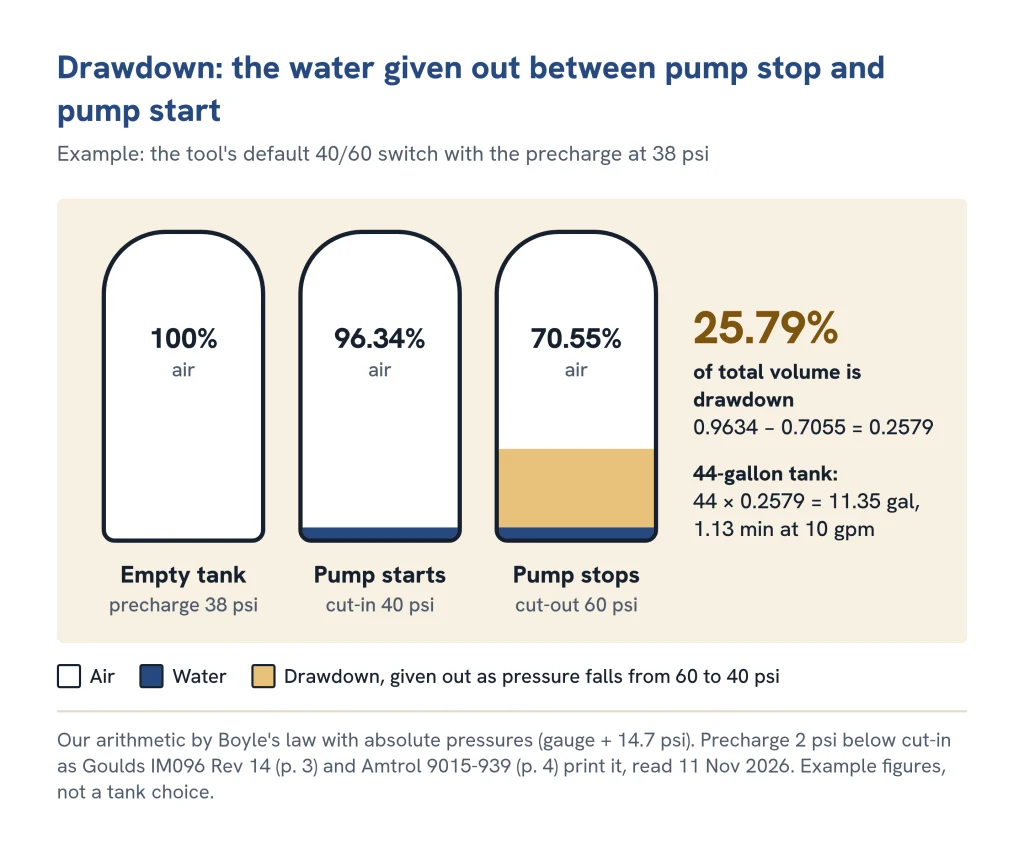
A bladder or diaphragm tank holds a cushion of air above (or around) the water. When the pump runs, water squeezes the air until the pressure reaches the switch’s cut-out and the pump stops. As you use water, the air pushes it out until the pressure falls to the cut-in and the pump starts again. The water delivered between those two moments is the drawdown. It is always a fraction of the tank’s total volume, the gallons printed on its label. The precharge is the air pressure in the empty tank. Our explainer on how a pressure tank works covers the parts.
The inputs:
- Pump flow (gpm). The rated flow on the pump label or paperwork is a starting point. A pump delivers less as pressure rises; Amtrol’s sizing sheet averages the flow it reads off the pump curve at cut-in and at cut-out (Amtrol 9017-102 (03/19), Step 2, read 11 Nov 2026). If you only know what reaches a tap, the bucket-test flow calculator measures that, which is the pump’s delivery at that tap, not the well’s yield.
- Switch setting. 20/40, 30/50, 40/60, 50/70 psi, or your own cut-in and cut-out. It’s usually printed on the switch or its box.
- Minimum run time per start. Default 1 minute, from Franklin Electric’s motor manual; 2 minutes for larger pumps by Goulds’ and Amtrol’s sizing rules (below). Your pump maker’s figure decides.
- Precharge below cut-in. Default 2 psi, as Goulds and Amtrol print it (30/50 switch: 28 psi) (Goulds IM096 Rev 14 (2025-10), p. 3; Amtrol 9015-939, p. 4). Some tanks differ: Goulds’ tank owner’s manual says 2-3 psi (IM251R01, p. 5), and Pentair’s instructions for its WellMate UT, HP and SP tanks say 4 psi, or 10 psi for high flows, pressures or temperatures (W3720 Rev P (2014), p. 1, read 11 Nov 2026). Your tank’s own label or manual decides.
- Optional: your current tank’s total volume, the water you use a day, and the motor’s horsepower, to check run time and starts a day.
The formula, step by step
Air in a closed tank follows Boyle’s law: pressure times volume stays the same, as long as you use absolute pressure (gauge reading plus 14.7 psi at sea level). Amtrol’s sizing sheet uses the same 14.7 (9017-102, Step 3), and Goulds and Pentair say their drawdown tables are based on Boyle’s law (Goulds GSSERVICE R10 (8/2025), p. 61; Pentair WM900 (09-01-23), p. 4).
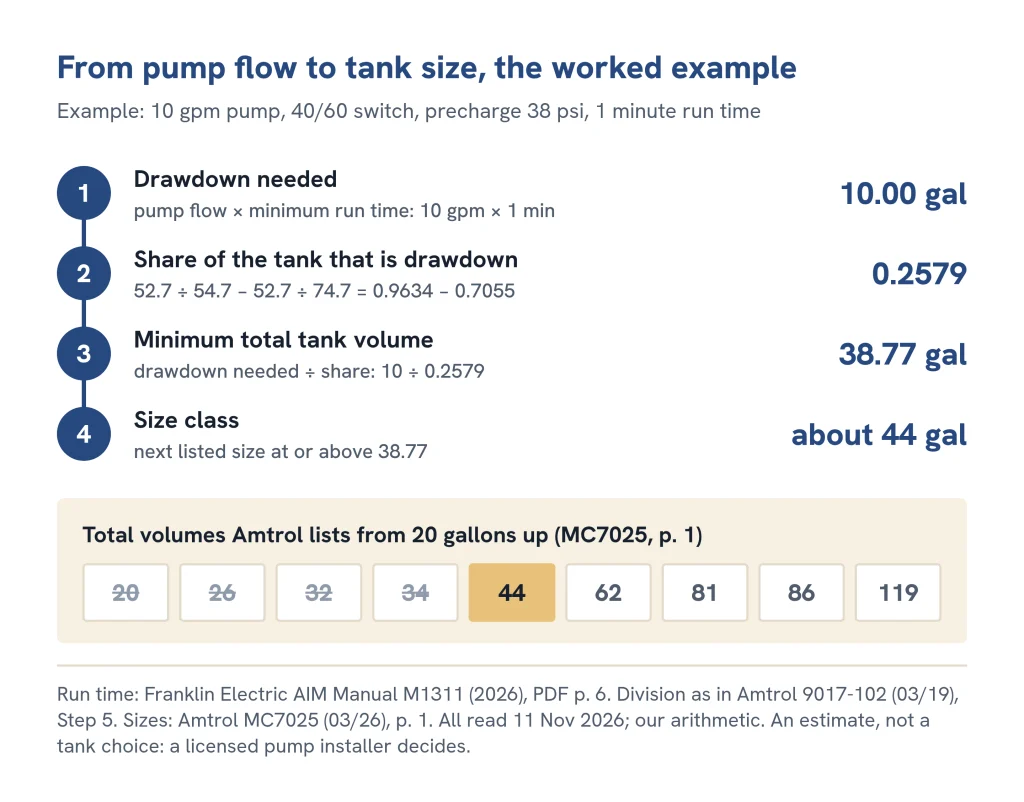
- Drawdown needed = pump flow × minimum run time. 10 gpm × 1 minute = 10 gallons.
- Share of the tank that is drawdown = (precharge + 14.7) ÷ (cut-in + 14.7) − (precharge + 14.7) ÷ (cut-out + 14.7). The first term is the share of the tank filled with air when the pump starts; the second, when it stops. The difference is the water given out in between.
- Minimum total tank volume = drawdown needed ÷ share. This is the same division Amtrol’s sheet uses (“total volume = run-time volume ÷ acceptance factor”, 9017-102, Step 5).
- Size class: the next size up among the total volumes Amtrol lists from 20 gallons up: 20, 26, 32, 34, 44, 62, 81, 86 or 119 gallons (MC7025 (03/26), p. 1; Flexcon’s chart and Goulds’ table list sizes close to these). Above 119 gallons, Amtrol’s quick-sizing table lists two or three tanks (MC7025, p. 2), and its sizing sheet for larger systems lists bigger single tanks (9017-102, Table 1).
With your own tank entered, the tool turns it round: your tank’s drawdown = total volume × share, and run time per start = that drawdown ÷ pump flow. With your daily use entered, it divides the gallons a day by the drawdown to give a rough count of starts, and compares that count with Franklin’s limit for the motor size you picked.
Worked example
General information, not professional advice. Your pump and tank makers’ manuals and a licensed well or pump contractor decide what’s safe for your system; your state or county decides what needs a permit or a licence.
The tool’s default numbers: a 10 gpm pump, a 40/60 switch, precharge 38 psi, 1 minute minimum run time.
| Step | Working | Result |
|---|---|---|
| Absolute pressures | 38 + 14.7; 40 + 14.7; 60 + 14.7 | 52.7, 54.7, 74.7 psi |
| Air share at pump start | 52.7 ÷ 54.7 | 0.9634 |
| Air share at pump stop | 52.7 ÷ 74.7 | 0.7055 |
| Drawdown share | 0.9634 − 0.7055 | 0.2579 (25.79%) |
| Drawdown needed | 10 gpm × 1 min | 10.00 gal |
| Minimum total volume | 10 ÷ 0.2579 | 38.77 gal |
| Size class | next listed size at or above 38.77 | about 44 gal |
| Check: a 20-gallon tank | 20 × 0.2579 = 5.16 gal; 5.16 ÷ 10 | 0.52 min, under 1 minute |
| Check: a 44-gallon tank | 44 × 0.2579 = 11.35 gal; 11.35 ÷ 10 | 1.13 min |
| Starts a day at 300 gal | 300 ÷ 11.35 | about 26 |
Quick table by pump flow
The tool’s results at 1 minute of run time and precharge 2 psi below cut-in. Each cell is the minimum total volume, then the next common size. For 2 minutes, double the minimum volume.
| Pump flow | 30/50 switch | 40/60 switch | 50/70 switch |
|---|---|---|---|
| 5 gpm | 16.9 gal → 20 | 19.4 gal → 20 | 21.9 gal → 26 |
| 7 gpm | 23.7 gal → 26 | 27.1 gal → 32 | 30.6 gal → 32 |
| 10 gpm | 33.9 gal → 34 | 38.8 gal → 44 | 43.7 gal → 44 |
| 12 gpm | 40.6 gal → 44 | 46.5 gal → 62 | 52.4 gal → 62 |
| 15 gpm | 50.8 gal → 62 | 58.2 gal → 62 | 65.6 gal → 81 |
| 20 gpm | 67.7 gal → 81 | 77.5 gal → 81 | 87.4 gal → 119 |
Notice two things. A higher switch setting needs a bigger tank for the same pump, because compressed air gives back a smaller share of the tank between two higher pressures. And the tank doesn’t set your pressure: the switch does. A bigger tank at the same setting means more water between starts, so fewer starts, not stronger flow.
Why makers’ charts print more
Put a tank’s label volume into the tool and you’ll get a smaller drawdown than the maker’s brochure prints. That’s not an error on either side. Makers count drawdown in two other ways, and the tool shows both beside its own figure:
| Way of counting | Who prints it | Share at 30/50 | Share at 40/60 | Share at 50/70 |
|---|---|---|---|---|
| Between pump stop and pump start, precharge 2 psi below cut-in (this tool) | no maker table found | 29.53% | 25.79% | 22.88% |
| Precharge assumed equal to cut-in | Amtrol (MC7025; 9017-102), Pentair (WM900 drawdown factors) | 30.91% | 26.77% | 23.61% |
| Down to a precharge 2 psi below cut-in | Flexcon (2019 sizing chart), Goulds (GSSERVICE p. 61) | 34.00% | 29.45% | 25.97% |
Checked against the makers’ own tables (read 11 Nov 2026):
- Amtrol’s 20-gallon tank at 30/50: Amtrol prints 6.2 gallons (MC7025, p. 1). Set the tool’s precharge gap to 0 and it gives 6.18. With the 2 psi gap, it gives 5.91.
- Amtrol’s 86-gallon tank at 50/70: Amtrol prints 20.3; the tool with a 0 gap gives 20.31.
- Flexcon’s 20-gallon tank at 30/50: Flexcon prints 6.8, with a footnote that its drawdown assumes a precharge 2 psi below cut-in (Flexcon quick sizing chart, 2019). The tool shows 6.80 on its Flexcon-and-Goulds line. Goulds’ 19.9-gallon tank at 28/50 prints 6.8 too (GSSERVICE, p. 61).
- Pentair’s worked example: 8 gpm × 1 minute ÷ 0.30 = 26.7 gallons (WM900, p. 13), using a rounded factor with the precharge at cut-in; Pentair’s own factor table gives .309 for 30/50 (p. 24). With a 0 gap the tool gives 25.88 (8 ÷ 0.309); with its default 2 psi gap, 27.09.
- Amtrol’s large-pump example: 98 gpm × 2 minutes = 196 gallons; acceptance factor 0.518 at 30/78; 196 ÷ 0.518 = 378 gallons (9017-102, Steps 2-5). The tool with a 0 gap and a custom 30/78 setting gives 378.5.
Why the tool keeps its own way: with the precharge 2 psi below cut-in, as Goulds, Amtrol and Flexcon tell installers to set it, the pump starts while there is still a little water in the tank. The water below cut-in comes out only after the pump has started, so it doesn’t stretch the time between starts. Flexcon’s and Goulds’ figures count it; Amtrol’s assume no gap. The tool counts only the water between pump stop and pump start, so its tank size is the cautious one.
Against Amtrol’s own quick-sizing table for pumps up to ¾ hp at 1 minute (MC7025, p. 2), the quick table above lands on the same tank size in 16 of 18 cells. The two that differ: at 10 gpm and 30/50 Amtrol lists its 32-gallon tank, whose printed 9.9 gallons is just under 10, where the tool goes to 34; and at 20 gpm and 50/70 Amtrol’s 86-gallon tank holds 20.3 gallons by its count but 19.7 by the tool’s, so the tool goes to 119. Amtrol, Flexcon and Goulds all footnote that real drawdown varies with conditions such as temperature and pressure; Flexcon and Goulds add elevation.
One minute or two?
The makers we read don’t agree on one run time, so the tool lets you choose. Each figure below comes from the maker’s own document, read 11 Nov 2026:
| Maker and document | What it says |
|---|---|
| Franklin Electric, AIM Manual, 2026 edition (M1311), PDF p. 6 | Run motors at least one minute to get rid of the heat from starting current. Most starts per 24 hours, encapsulated motors: 300 up to 0.75 HP; 100 for 1 to 5.5 HP single-phase (300 three-phase); 50 for 7.5 to 30 HP single-phase. Pick pump, tank and controls to keep starts as low as possible. |
| Goulds, GSSERVICE R10 (8/2025), p. 61 | Size the tank for a minimum run time of 1 minute for ⅓ to 1½ HP pumps, 2 minutes for 2 HP and larger. |
| Amtrol, MC7025 (03/26), p. 2 | Quick sizing at 1 minute for pumps up to ¾ hp, 2 minutes for pumps over ¾ hp. |
| Flexcon, Steel Well Tanks IOM Rev. 9.21, EN p. 1 | A properly sized tank stores at least one gallon of water for every gpm of pump capacity (one minute’s worth). |
Franklin’s one minute is a minimum for each start, not a sizing target, and the starts-a-day count in the tool is rough: real use comes in bursts, not evenly through the day. Pumps that start too often wear their controls and motors, which Franklin’s manual names as the reason for the limits. The page on short cycling covers a pump that starts much more often than this.
Getting your own numbers
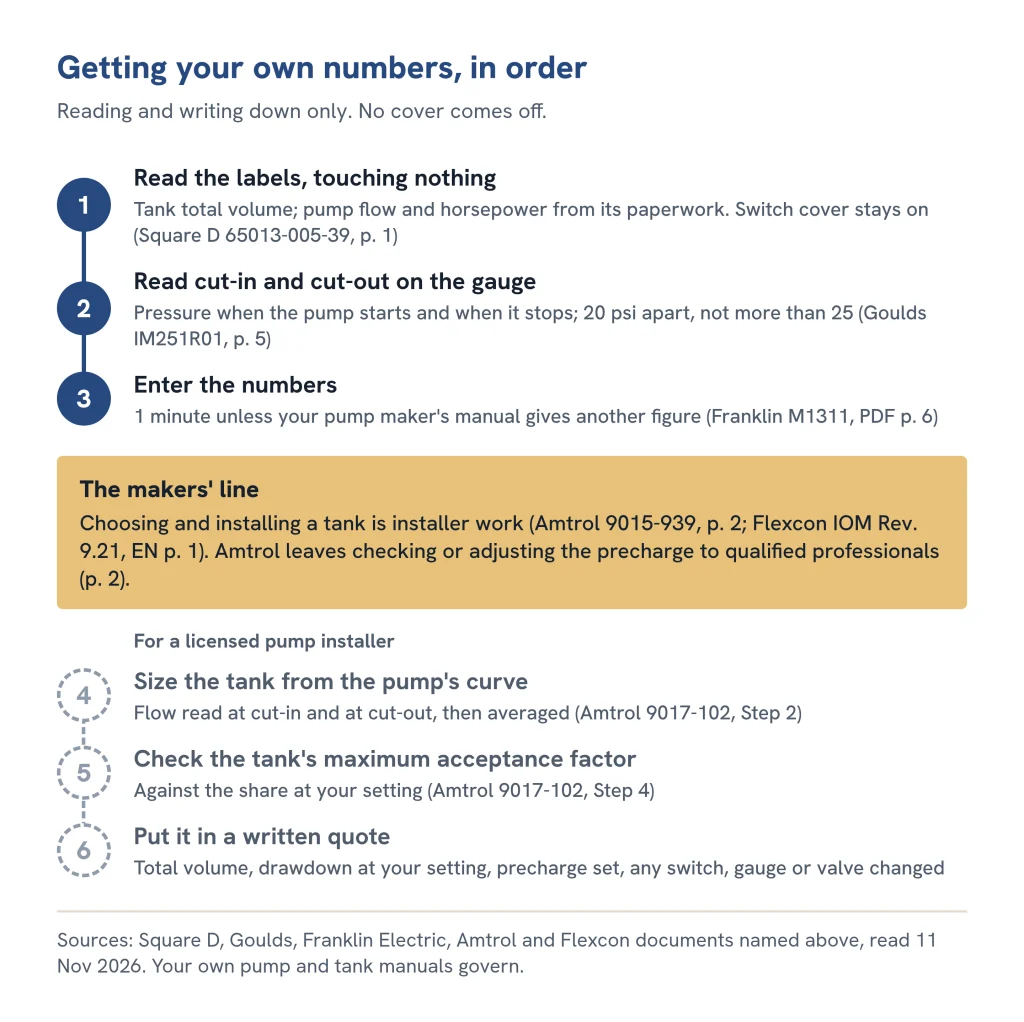
You check
- Read the labels, touching nothing. The tank’s total volume (not its drawdown) and the pump’s rated flow and horsepower, if the pump paperwork or the well record shows them. Don’t open the pressure switch cover or any control box to look: the switch is wired at 115 or 230 volts, and Square D’s switch sheet says to disconnect all power before wiring or servicing (65013-005-39, Sept 2025, p. 1).
- Read the switch setting on the gauge. Goulds’ tank owner’s manual has the owner watch the system run and note the gauge pressure when the pump starts and when it stops; it gives 20 psi as the proper difference between the two, not more than 25 (IM251R01, p. 5). If the readings are far off the setting printed on the switch, write them down for the installer.
- Enter the numbers. Use the tool’s 1-minute default unless your pump maker’s manual gives another figure for your pump.
The makers’ line
Choosing and installing a tank is installer work in every maker’s document we read. Amtrol says its tanks must be installed and maintained by a licensed professional, and only qualified professionals should check, adjust or recharge the precharge (9015-939, p. 2 and 4). Flexcon says its tanks must be installed by a qualified professional (IOM Rev. 9.21, EN p. 1). Goulds’ tank manual says a precharge that isn’t about 2-3 psi below cut-in “must be adjusted by a qualified professional” (IM251R01, p. 5). Franklin’s motor manual is written for “technically qualified personnel” and warns that more than one disconnect switch may be needed and that some controls can hold a lethal voltage after the power is off, so allow 5 minutes before removing covers (AIM, PDF p. 5). Precharge and switch settings have their own page: the precharge and switch settings calculator.
The pro, explained
A licensed pump installer sizes the tank from the pump’s own curve, not just its label: Amtrol’s sheet reads the flow at cut-in and cut-out and averages them (9017-102, Step 2). They check the tank’s maximum acceptance factor, the largest share of the tank its diaphragm can take, against the share at your setting (Step 4): at 20/40, for example, Amtrol’s 32-gallon tank lists a factor of 0.35 (MC7025, p. 1), just below the 0.366 share that Amtrol’s way of counting gives at that setting (our arithmetic; Pentair’s factor table prints .366 for 20/40, WM900 p. 24). They set the precharge on a drained tank with the power off, as Flexcon’s instructions give it (IOM Rev. 9.21, EN p. 2), and may fit two or three tanks where one listed tank holds too little, as Amtrol’s quick-sizing table does for larger pumps (MC7025, p. 2). On a constant-pressure (variable-speed) system the rules change: the drive maker’s own tank recommendation comes first, and Amtrol’s brochure gives a fallback table for when the drive maker gives none: a tank of at least 20% of the pump’s gpm in gallons, rounded to the next size up, with the precharge “set according to drive manufacturer” (Amtrol MC10188 (04/24), p. 7), so this tool doesn’t apply. Ask for a written quote that lists the tank’s total volume and drawdown at your setting, the precharge set, and any switch, gauge or valve changed. What the job involves and costs is on the pressure tank replacement page.
Claims you may see
- “Precharge should equal cut-in.” Goulds, Amtrol and Flexcon all print 2 psi below cut-in, checked on an empty tank (IM096, p. 3-4; 9015-939, p. 4; IOM Rev. 9.21, EN p. 2). Amtrol’s drawdown table assumes precharge at cut-in only as a way of counting.
- “A bigger tank gives more pressure.” The switch sets the pressure range. A bigger tank at the same setting holds more water between starts.
- “Just add air to a tank that’s lost it.” Amtrol forbids it on a tank that has lost air, shows rust or cycles faster than it did (9015-939, p. 4).
- “Drawdown is the tank’s size.” A tank’s drawdown is roughly a quarter to a third of its total volume at common settings (the shares table above).
Next step
- Write down for the installer: the gauge readings at cut-in and cut-out, the setting printed on the switch, the tank’s label (total volume, maker, age if shown), the pump’s label or paperwork (flow, horsepower), how long the pump runs per start if you’ve noticed, and this tool’s result with the run time you used.
- Ask: what run time the pump maker gives for your pump; the drawdown of the tank they propose at your switch setting, and by which maker’s way of counting; the precharge they’ll set; whether the check valve was looked at.
- What can’t wait: a tank that has lost its air or shows rust (don’t re-pressurise it), a breaker that trips again, a pump that won’t stop, or water around the tank. Turn the pump’s breaker off and call a licensed pump installer. EPA advises testing your water after you replace or repair any part of the well system, or after a flood: see EPA’s private well testing page (read 11 Nov 2026) or your state or county health department.
Sources checked on 11 November 2026. Makers’ documents were read on the makers’ own websites on that date: Franklin Electric AIM Manual 2026 (M1311 06-26); Goulds IM096 Rev 14, IM251R01 and GSSERVICE R10; Amtrol 9015-939 (04/18), 9017-102 (03/19), MC7025 (03/26) and MC10188 (04/24); Flexcon Steel Well Tanks IOM Rev. 9.21 and quick sizing chart (2019); Pentair WM900 (09-01-23) and WellMate W3720 Rev P (2014); Square D 65013-005-39 (Sept 2025); EPA’s private well page on protecting your home’s water. We name makers only as sources; we don’t recommend any tank, pump or brand.
Formulas and sources
- Cut-in used: Goulds Water Technology (Xylem), IM096 Rev 14 (2025-10), 4-inch submersible pumps, p. 3: precharge 2 psi below cut-in
- Cut-out used: Goulds Water Technology (Xylem), IM096 Rev 14 (2025-10), 4-inch submersible pumps, p. 3: precharge 2 psi below cut-in
- Precharge used: Goulds Water Technology (Xylem), IM096 Rev 14 (2025-10), 4-inch submersible pumps, p. 3: precharge 2 psi below cut-in
- Share of the tank between pump stop and pump start: Boyle's law with absolute pressure (gauge + 14.7 psi), the basis Goulds GSSERVICE R10 (8/2025) p. 61 and Pentair WM900 (09-01-23) state for their drawdown tables
- Water the tank must give per cycle: Franklin Electric, Application, Installation and Maintenance (AIM) Manual, 60 Hz, 2026 edition (M1311 06-26), Frequency of Starts, PDF p. 6 (printed p. 4)
- Minimum total tank volume: Amtrol, Sizing the Well-X-Trol, 9017-102 (03/19), Steps 3 and 5: acceptance factor 1 – (cut-in + 14.7)/(cut-out + 14.7), total volume = run-time volume / factor
- Size class at or above the minimum: Amtrol, Well-X-Trol card MC7025 (03/26), p. 1 drawdown table (tank volumes 2.0 to 119 gal; the tool uses 20, 26, 32, 34, 44, 62, 81, 86 and 119)
- Share as Amtrol's table counts it (precharge at cut-in): Amtrol, Sizing the Well-X-Trol, 9017-102 (03/19), Steps 3 and 5: acceptance factor 1 – (cut-in + 14.7)/(cut-out + 14.7), total volume = run-time volume / factor
- Share as Flexcon's and Goulds' charts count it (down to the precharge): Flexcon, quick sizing chart (2019), footnote: total drawdown assumes precharge 2 psi below cut-in
- Your tank's drawdown, counted between stop and start: Boyle's law with absolute pressure (gauge + 14.7 psi), the basis Goulds GSSERVICE R10 (8/2025) p. 61 and Pentair WM900 (09-01-23) state for their drawdown tables
- Your tank's run time per start: Franklin Electric, Application, Installation and Maintenance (AIM) Manual, 60 Hz, 2026 edition (M1311 06-26), Frequency of Starts, PDF p. 6 (printed p. 4)
- Your tank against the minimum run time: Franklin Electric, Application, Installation and Maintenance (AIM) Manual, 60 Hz, 2026 edition (M1311 06-26), Frequency of Starts, PDF p. 6 (printed p. 4)
- Your tank's drawdown as Amtrol counts it: Amtrol, Well-X-Trol card MC7025 (03/26), p. 1 drawdown table (tank volumes 2.0 to 119 gal; the tool uses 20, 26, 32, 34, 44, 62, 81, 86 and 119)
- Your tank's drawdown as Flexcon and Goulds count it: Flexcon, quick sizing chart (2019), footnote: total drawdown assumes precharge 2 psi below cut-in
- Pump starts a day: Franklin Electric, Application, Installation and Maintenance (AIM) Manual, 60 Hz, 2026 edition (M1311 06-26), Frequency of Starts, PDF p. 6 (printed p. 4)
- Starts a day against Franklin's table: Franklin Electric, Application, Installation and Maintenance (AIM) Manual, 60 Hz, 2026 edition (M1311 06-26), Frequency of Starts, PDF p. 6 (printed p. 4)
- Atmospheric pressure added to gauge pressure (Amtrol 9017-102) (14.7, as of 2019-03-01): Amtrol, Sizing the Well-X-Trol, 9017-102 (03/19), Steps 3 and 5: acceptance factor 1 – (cut-in + 14.7)/(cut-out + 14.7), total volume = run-time volume / factor
- Franklin's most starts a day, motors up to 0.75 HP (300, as of 2026-06-01): Franklin Electric, Application, Installation and Maintenance (AIM) Manual, 60 Hz, 2026 edition (M1311 06-26), Frequency of Starts, PDF p. 6 (printed p. 4)
- Franklin's most starts a day, 1 to 5.5 HP single-phase motors (100, as of 2026-06-01): Franklin Electric, Application, Installation and Maintenance (AIM) Manual, 60 Hz, 2026 edition (M1311 06-26), Frequency of Starts, PDF p. 6 (printed p. 4)
- Size class 1: about 20 gallons total (Amtrol MC7025 lists 20.0) (20, as of 2026-03-01): Amtrol, Well-X-Trol card MC7025 (03/26), p. 1 drawdown table (tank volumes 2.0 to 119 gal; the tool uses 20, 26, 32, 34, 44, 62, 81, 86 and 119)
- Size class 2: about 26 gallons total (Amtrol MC7025 lists 26.0) (26, as of 2026-03-01): Amtrol, Well-X-Trol card MC7025 (03/26), p. 1 drawdown table (tank volumes 2.0 to 119 gal; the tool uses 20, 26, 32, 34, 44, 62, 81, 86 and 119)
- Size class 3: about 32 gallons total (Amtrol MC7025 lists 32.0) (32, as of 2026-03-01): Amtrol, Well-X-Trol card MC7025 (03/26), p. 1 drawdown table (tank volumes 2.0 to 119 gal; the tool uses 20, 26, 32, 34, 44, 62, 81, 86 and 119)
- Size class 4: about 34 gallons total (Amtrol MC7025 lists 34.0) (34, as of 2026-03-01): Amtrol, Well-X-Trol card MC7025 (03/26), p. 1 drawdown table (tank volumes 2.0 to 119 gal; the tool uses 20, 26, 32, 34, 44, 62, 81, 86 and 119)
- Size class 5: about 44 gallons total (Amtrol MC7025 lists 44.0) (44, as of 2026-03-01): Amtrol, Well-X-Trol card MC7025 (03/26), p. 1 drawdown table (tank volumes 2.0 to 119 gal; the tool uses 20, 26, 32, 34, 44, 62, 81, 86 and 119)
- Size class 6: about 62 gallons total (Amtrol MC7025 lists 62.0) (62, as of 2026-03-01): Amtrol, Well-X-Trol card MC7025 (03/26), p. 1 drawdown table (tank volumes 2.0 to 119 gal; the tool uses 20, 26, 32, 34, 44, 62, 81, 86 and 119)
- Size class 7: about 81 gallons total (Amtrol MC7025 lists 81.0) (81, as of 2026-03-01): Amtrol, Well-X-Trol card MC7025 (03/26), p. 1 drawdown table (tank volumes 2.0 to 119 gal; the tool uses 20, 26, 32, 34, 44, 62, 81, 86 and 119)
- Size class 8: about 86 gallons total (Amtrol MC7025 lists 86.0) (86, as of 2026-03-01): Amtrol, Well-X-Trol card MC7025 (03/26), p. 1 drawdown table (tank volumes 2.0 to 119 gal; the tool uses 20, 26, 32, 34, 44, 62, 81, 86 and 119)
- Size class 9: about 119 gallons total (Amtrol MC7025 lists 119.0) (119, as of 2026-03-01): Amtrol, Well-X-Trol card MC7025 (03/26), p. 1 drawdown table (tank volumes 2.0 to 119 gal; the tool uses 20, 26, 32, 34, 44, 62, 81, 86 and 119)
Sources
- Franklin Electric, AIM Manual 60 Hz, 2026 edition (M1311 06-26), PDF p. 5, 6, 13
- Goulds Water Technology, IM096 Rev 14 (2025-10), 4-inch submersible pumps, p. 3
- Goulds Water Technology, IM251R01, pressure tank owner's manual, p. 5
- Goulds Water Technology, Service manual GSSERVICE R10 (8/2025), p. 61, tank selection
- Amtrol, Precharged Well Tanks Installation and Operating Instructions, 9015-939 (04/18), p. 2, 4
- Amtrol, Sizing the Well-X-Trol, 9017-102 (03/19)
- Amtrol, Well-X-Trol card MC7025 (03/26), p. 1-2
- Amtrol, Well-X-Trol brochure MC10188 (04/24), p. 7
- Flexcon, Steel Well Tanks Installation, Operation and Maintenance, Rev. 9.21 (2021)
- Flexcon, quick sizing chart (2019)
- Pentair WellMate, composite pressure tank catalog WM900 (09-01-23), p. 4, 13, 24
- Pentair WellMate UT, HP and SP series installation instructions, W3720 Rev P (2014), p. 1
- Square D (Telemecanique Sensors), Pumptrol pressure switch instruction sheet 65013-005-39 (September 2025)
- US EPA, Private Drinking Water Wells: Protect Your Home's Water (when to test)