This page, part of our no water and pump problems guide, is for a pump that runs but builds no pressure. If you can hear the pump running but the pressure gauge stays near zero and the taps give little or nothing, the pump is turning without moving water up to the tank. The makers’ troubleshooting tables list the same short set of causes: a valve left closed, a leak or broken pipe, a jet pump that has lost its prime, a check valve that is stuck or failing, water in the well that has dropped below the pump, or a worn or clogged pump. Most of them are below ground and are a pump installer’s work. Your first job is to stop the pump running dry. Pump makers say to stop it. Grundfos says that if a pump’s flow suddenly falls, it may be pumping more than the well can yield, and it “must immediately be stopped and the fault corrected”, and Pentair’s jet pump manual says to stop the pump and check the prime before looking for other causes (Grundfos SQ/SQE L-SP-TL-017 R 5/06, p. 10; Pentair P15001 (09-01-23), p. 12; both read 11 November 2026). Below: what you can check in order, where the makers draw the line, and what the installer will test.
General information, not professional advice. Your pump and tank makers’ manuals and a licensed well or pump contractor decide what’s safe for your system; your state or county decides what needs a permit or a licence.
Stop first
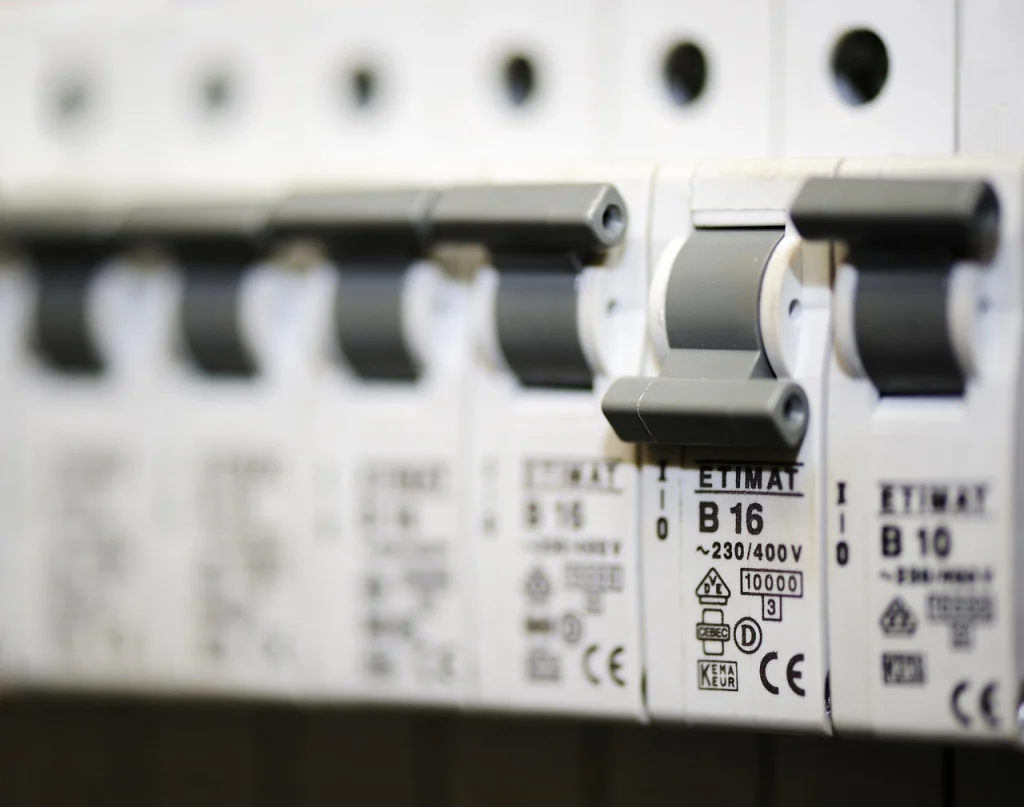
- Turn off the breaker for the pump if it keeps running and the gauge doesn’t climb. Goulds: “Never run a pump dry. Damage will result, and the warranty will be voided” (Goulds IM457 Rev 2 (2025-07), p. 1). Some systems have more than one disconnect (Franklin Electric AIM Manual, 2026 edition, M1311 06-26, p. 3 (PDF p. 5)).
- Don’t handle a pump that has been running. Pentair’s jet pump manual says to let the motor cool for 20 minutes after shutdown before handling it, and warns that a jet pump run against a closed outlet can boil the water inside, building hazardous pressure (P15001, p. 3 and p. 11).
- Don’t open the control box, the motor cover or any wiring. Franklin warns that some controls hold a lethal charge after the power is off (AIM, p. 3). That work belongs to a qualified electrician or licensed pump installer.
- If the well, pit or pump has been under floodwater, leave the pump off. EPA: “DO NOT TURN ON THE PUMP” until a qualified electrician, well contractor or pump contractor has checked the wiring (EPA 816-F-05-021, read 11 November 2026). Don’t enter a well pit (CDC).
Is this your problem?
This page is for one pattern: you can hear or see the pump running, but the gauge at the tank stays at or near zero, or climbs a little and stalls, and the taps sputter or give nothing. Other patterns have their own pages:
- Nothing runs at all (no hum, no click, the breaker is off or trips): see well pump not working.
- The gauge reaches its normal cut-out and the pump stops, but the taps are weak: the pump is building pressure, so the problem is closer to the taps. See low water pressure from a well.
- Not sure which symptom you have: start at the well pump troubleshooting page, which takes each symptom in order.
It also helps to know which kind of pump you have. A jet pump sits above ground, usually beside the pressure tank, and pulls water up from the well; EPA describes jet pumps as the type used for shallow wells, 25 feet deep or less (EPA, Learn About Private Water Wells, read 11 November 2026). A submersible pump hangs down inside the well on a pipe (the drop pipe), so all you see in the house is the pipe coming in, the switch and the tank. Some homes have a constant-pressure drive, a control box with a display or lights that varies the pump’s speed instead of switching it on and off.
Why a pump that moves no water gets damaged
A pump depends on the water it moves. Without flow it heats up, and makers treat running it that way as misuse:
- Cooling. Franklin’s submersible motors are designed to run with water flowing over and around the full length of the motor (AIM, p. 8 (PDF p. 10)). Grundfos says its 3-inch pumps should never run below 0.2 gpm, and never against a closed outlet valve for more than 5 minutes, because without flow there is no cooling and the motor and pump can overheat (L-SP-TL-017, p. 10).
- Bearings. Franklin says a pump that keeps running below its normal head (the height and pressure it works against) pushes up on the motor’s thrust bearing. That’s acceptable for a moment at each start. Running continuously that way causes excessive wear on that bearing (AIM, p. 5 (PDF p. 7)).
- Seals and heat in jet pumps. Pentair says a jet pump run without water can overheat, damage the seal and burn whoever handles it (P15001, p. 11).
- Warranty. Goulds’ warranties exclude damage from “failure to properly prime, or operation without flow” (Goulds IM096 Rev 14 (2025-10), p. 15; Goulds IM102 Revision 13 (June 2025), p. 12).
So the useful habit is the opposite of what a dry tap tempts you to do. Don’t leave the pump on in the hope that water turns up. Turn it off, look at what you can see, and call.
You check, in this order
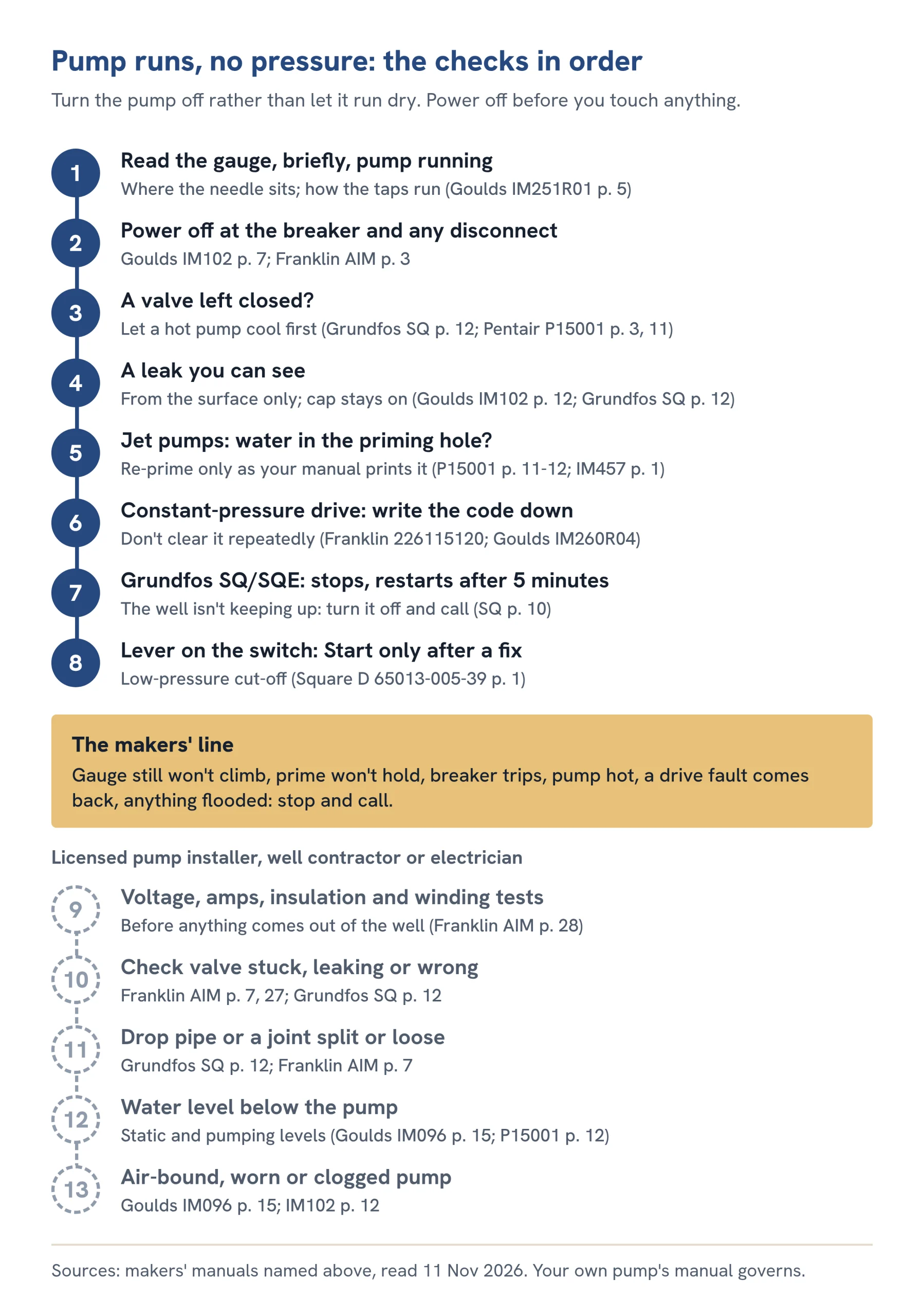
You check (power off before you touch anything)
- Read the gauge, briefly, with the pump running. Note where the needle sits and whether it moves: stuck at zero, climbing slowly and stalling, or bouncing. Note whether the taps run, sputter or give nothing. Goulds’ tank owner’s manual asks owners to watch the system before calling, and gives water spurting from a faucet instead of a steady flow as a sign of air in the system (Goulds IM251R01, p. 5, read 11 November 2026). If a tap near the tank runs strongly while the gauge reads zero, tell the installer that too: it may point to the gauge rather than the pump (our assumption, not a maker’s).
- Power off at the breaker for the pump, and any other disconnect. Goulds: “ALWAYS DISCONNECT AND LOCK-OUT ALL ELECTRICAL POWER” before working on pumps, motors or switches (IM102, p. 7). Franklin: more than one disconnect may be needed (AIM, p. 3). Keep the power off for the next steps unless a step says otherwise.
- Look for a valve left closed. Check the valves you can see between the well line and the tank, and on the line into the house, especially if anyone has worked on the system recently. Grundfos’ troubleshooting table gives “The discharge valve is closed” as the first cause of “The pump runs but gives no water”, with the remedy “Open the valve” (L-SP-TL-017, p. 12); Goulds lists “closed valve(s)” for jet pumps that deliver little or no water (IM102, p. 12). If a jet pump has been running against the closed valve, let it cool first. Pentair warns that this can boil the water inside, and that the pump should cool for 20 minutes before anyone handles it (P15001, p. 3 and p. 11). If the pump body is hot, hissing or leaking, leave it alone and call. If you found a valve closed and the pump is cool, open the valve with the power still off, then turn the breaker back on and watch the gauge.
- Look, without digging, for a leak you can see. Check the fittings at the tank and switch, the pipe where it comes through the wall or floor, a hose bib or toilet running, and the ground over the buried line between the well and the house, where a new wet or soft patch can show a break. Goulds lists “leaks in discharge piping or at house” among the causes of a jet pump that won’t shut off, and Grundfos a “hole in discharge pipe” among the causes of a pump that runs at reduced capacity (IM102, p. 12; L-SP-TL-017, p. 12); a large enough leak can keep the gauge from climbing at all. Look from the surface only: leave the well cap on, and don’t climb into a well pit (CDC).
- Jet pumps only: check the prime. Priming means filling the pump and its suction pipe with water so it can pull more water up (IM102, p. 6). With the power off and the pump cool, open a tap to release the pressure in the system (Pentair: release all pressure before working on any component, P15001, p. 3). Then do what Pentair’s manual tells owners to do first: unscrew the priming plug and see whether there is water in the priming hole (P15001, p. 12). If it’s empty, the pump has lost its prime. Re-prime it only as your pump’s own manual prints it: Goulds says to fill the pump through the discharge of the housing or tee (IM457, p. 1; IM102, p. 6), and Pentair says to fill the pump and piping, restore power, and if there’s no water after 2 or 3 minutes, stop, refill and try again, which can take up to 15 minutes on a pump lifting water 25 feet (P15001, p. 11). Our priming page sets out each maker’s steps side by side.
- Constant-pressure drives: read the light or code, don’t clear it repeatedly. Franklin’s SubDrive Utility stops with a “Broken Pipe” fault, if that feature is switched on, when the drive runs at full power for 10 minutes without reaching its pressure setting, and lists “large leak or broken pipe” as the cause (Franklin SubDrive Utility owner’s manual 226115120 Rev. 003 (10/20), PDF p. 30 and 33). Goulds’ Aquavar SOLO2, when its low-pressure cut-off is switched on, shows that fault when pressure stays 20 psi below the set point for 30 seconds, which Goulds says may mean a broken pipe, and a dry-well fault when the water falls below the pump inlet; Goulds marks its fault table for professional installers or qualified personnel only (Goulds IM260R04 (April 2024), PDF p. 15 and 18). Write the code down and give it to the installer.
- Grundfos SQ and SQE pumps: watch for the 5-minute pattern. If your installation papers or the pump’s records say Grundfos SQ or SQE, the pump has its own dry-running protection. Grundfos says it stops the pump, restarts it after 5 minutes, and stops it again after 30 seconds if the well has not recovered (L-SP-TL-017, p. 10). A pump that keeps starting, running briefly and stopping with no pressure is telling you the well isn’t keeping up. Grundfos’ reset is to switch the supply off for 1 minute (p. 10), but resetting doesn’t put water back in the well, so turn it off and call.
- Pressure switch with a lever on its side. That is a low-pressure cut-off switch (Square D calls it Form M4). Its maker says it shuts the pump off on low water or loss of pressure (roughly 10 psi below cut-in, on the data sheet for one 40/60 model), and that only after the fault has been corrected do you hold the lever at Start until pressure builds (Square D 65013-005-39 (September 2025), p. 1; datasheet 9013FSG2J24M4, both read 11 November 2026). So use the lever only once you have found and fixed a cause, such as a valve you opened in step 3. If you haven’t found one, leave the lever alone, turn the breaker off and call. If you hold it after a fix and the gauge doesn’t climb, the fault isn’t fixed: let go, turn the breaker off and call. Don’t wedge the lever.
If a closed valve was the cause and the gauge now climbs to its usual cut-out and the pump stops on its own, watch the next few cycles. If the gauge still doesn’t climb, stop. What’s left is below the well cap or inside the pump.
The makers’ line
Past these checks, the makers’ documents send the work to a professional. Goulds: “All electrical work must be performed by a qualified technician” (IM096, p. 1). Franklin: equipment “should be installed and serviced by technically qualified personnel” (AIM, p. 3). Grundfos: the electrical connection by “an authorized electrician” (L-SP-TL-017, p. 6). The makers’ own remedies for a pump that delivers little or no water include “Pull pump” and “Pull the pump and clean or replace the valve” (IM096, p. 15; L-SP-TL-017, p. 12): that is pump installer work. Stop and call a licensed pump installer or well contractor if:
- the gauge doesn’t climb after the valve, leak and prime checks;
- a jet pump keeps losing its prime, or won’t hold one after a second try;
- the breaker trips, or the pump hums, smells hot or is too hot to touch;
- a constant-pressure drive shows a fault again after it was cleared;
- the well, pit or control box has been flooded.
One jet pump manual we read also gives owners steps for discharging a motor capacitor and filing switch contacts (P15001, p. 3 and 12). We leave those to an electrician, as Goulds and Franklin do.
What the pro checks, explained
Knowing what each cause looks like helps you follow the diagnosis and read the quote. None of what follows is a set of owner steps.
Tests before anything comes out of the well
Franklin lists the tests to complete before a submersible motor is pulled: line voltage, amps on every motor wire, insulation resistance from the motor leads to ground, and winding resistance (AIM, p. 28 (PDF p. 30)). The amp reading matters here. Franklin’s SubDrive reports a motor running with too little load as an “underload” fault, and lists an over-pumped well, a broken shaft or coupling, a blocked screen, a worn pump and an air-locked pump among the causes (SubDrive Utility manual, PDF p. 32). Makers differ on the test tools: Grundfos says insulation-test, resistance-test and high-voltage-test instruments are not allowed when troubleshooting its SQ pumps (L-SP-TL-017, p. 13, section 14.1). That’s one reason the installer works from your pump’s own manual.
A check valve that’s stuck, leaking or wrong
A check valve lets water up and stops it draining back down when the pump stops. Franklin calls for at least one positive-sealing check valve in a submersible installation, a line check valve within 25 feet of the pump and below the drawdown level if the pump has none built in, and never a swing-type check valve (AIM, p. 7 (PDF p. 9)). A valve stuck shut gives exactly this symptom: the pump runs and nothing comes up (Grundfos, L-SP-TL-017, p. 12; Goulds lists “faulty or incorrectly installed check valve”, IM096, p. 15). Franklin’s check valve table says a missing or leaking one lets the pump start against no head, which pushes the pump’s shaft and the motor upward (upthrust) and can cause premature failure of both; and that water hammer, where a lower check valve leaks while one above it holds, a swing-type valve is used, or the lowest valve sits more than 30 feet above the standing water level, can split pipes and break joints. Its instruction for the water hammer case: “Shut down the system, and contact the pump installer” (AIM, p. 27 (PDF p. 29)). On a jet pump, the foot valve at the bottom of the suction pipe does the same job, and Pentair lists a leaking foot valve or check valve, and air leaks in the suction line, among the reasons a jet pump won’t pick up or hold its prime (P15001, p. 12). More on each in check valves, foot valves and pitless adapters.
A split, holed or unscrewed drop pipe
If the pipe the pump hangs on cracks or a joint lets go below the water, the pump pushes water straight back into the well. Grundfos lists a hole in the discharge pipe and a defective riser pipe among the causes of a pump that runs at reduced capacity (L-SP-TL-017, p. 12). Franklin warns that the motor’s starting torque tends to unscrew threaded joints and that a joint that unscrews can break the cable and lose the pump and motor down the well, which is why it asks installers to tighten joints to a set torque (AIM, p. 7 (PDF p. 9)). Finding and fixing this means pulling the pump.
Water below the pump
In dry weather, or when a pump draws more than the well can supply, the water level can drop to the pump’s intake. Goulds’ remedy for a pump that isn’t fully submerged is “Check well recovery, lower pump if possible”; Grundfos lists setting the pump deeper, throttling it or fitting a smaller pump (IM096, p. 15; L-SP-TL-017, p. 12). For a shallow-well jet pump, Goulds says total suction lift must not exceed 25 feet (IM457, p. 1), and Pentair says a deep-well pump is needed if the water level in the well recedes more than 25 feet (P15001, p. 12). The contractor measures the static level (with the pump off) and the pumping level (while it runs) to tell a low well from a failed pump. If you have a driller’s log, find it. Our flow rate and casing storage calculator shows how much water the casing holds above the pump, but only a yield test by a licensed contractor tells you what the well supplies.
Air in the pump, a worn pump, or a lift too high
Goulds’ table for 4-inch submersibles also lists a pump that is air-bound, bound by debris, worn, or asked to lift water higher than it can (IM096, p. 15); for jet pumps, a worn or plugged impeller or jet, system head too high, and low voltage that slows the motor (IM102, p. 12). For an air-bound submersible, Goulds’ remedy is to start and stop the pump in succession until flow comes. Franklin limits how often a motor may start (at least 1 minute of running per start) and how many starts a day it allows (AIM, p. 4 (PDF p. 6)), so this is the installer’s procedure, done with the right gear, not something to try by flicking the breaker. Low voltage, wiring and the control box go to a qualified electrician or the pump installer.
If the pump itself has failed, who may replace it depends on your state’s rules as well as the makers’ line. After you repair or replace any part of the well system, EPA says to test your well water “immediately” (EPA, Protect Your Home’s Water, read 11 November 2026); your state or county health department can point you to a certified lab.
What to write down for the installer
- What the gauge did with the pump running: stuck at zero, climbed to a number and stalled (which number), or bounced.
- Pump type (jet beside the tank, submersible in the well, or a constant-pressure drive) and anything on its label, plus the switch’s printed setting.
- Any fault code or light pattern, and how often it came back.
- What happened just before: a power cut, a storm, a long dry spell, heavy watering, recent work on the system.
- What you checked: valves, visible leaks, the priming hole, and what you found.
- The well log or driller’s report, if you have one (depth, pump setting, static level).
What to ask
- What did you test before pulling the pump: voltage, amps, insulation and winding readings? What were they?
- What is the static water level, and the pumping level?
- Was the check valve the cause, and how many check valves are there, of what type, and where?
- Was the drop pipe or a joint damaged, and is the pitless adapter sound?
- If you recommend a new pump, why this size and setting depth? Will you put it in writing, line by line?
What can’t wait
A breaker that trips again, a pump that is hot or smells burnt, a flooded well, pit or control box, and any water hammer (banging in the pipes when the pump starts) all go to the installer or an electrician now, with the pump off. Franklin’s instruction for water hammer is to shut the system down and contact the pump installer (AIM, p. 27 (PDF p. 29)). Until then, keep the breaker off rather than letting the pump run dry.
Sources checked on 11 November 2026. Maker documents were read on the makers’ own websites; page numbers are the printed page, with the PDF page where they differ.
Sources
- Goulds IM096 Rev 14 (2025-10), 4-inch submersible pumps IOM
- Goulds IM102 Revision 13 (June 2025), jet pumps instruction manual
- Goulds IM457 Rev 2 (2025-07), jet pumps quick guide
- Goulds IM251R01, water system tank owner's manual
- Goulds Aquavar SOLO2 IM260R04 (April 2024)
- Pentair P15001 (09-01-23), Pro shallow-well jet pumps owner's manual
- Grundfos SQ/SQE installation and operating instructions L-SP-TL-017 R 5/06 (literature 3835175)
- Franklin Electric AIM Manual 60 Hz, 2026 edition (M1311 06-26)
- Franklin Electric SubDrive Utility owner's manual 226115120 Rev. 003 (10/20)
- Square D Pumptrol instruction sheet 65013-005-39 (September 2025)
- Square D product data sheet 9013FSG2J24M4 (30 July 2024)
- EPA: Learn About Private Water Wells (updated 14 September 2026)
- EPA: Protect Your Home's Water (updated 26 February 2026)
- EPA 816-F-05-021: What to do with your private well after a flood
- CDC: How to disinfect wells after an emergency (29 May 2025)